

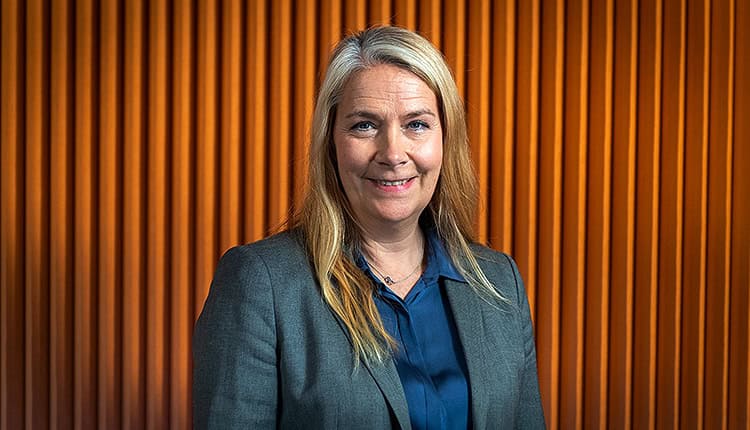
Open Innovation and AI will define the next generation of manufacturing: Annika Olme, CTO, SKF


As global manufacturing enters an era shaped by AI, intelligent automation, and sustainability, the role of R&D is undergoing a profound shift. Innovation is no longer confined to centralized global hubs. Increasingly, companies are building distributed innovation ecosystems where engineering, digital intelligence, and product development happen closer to markets, customers, and talent pools. India has emerged at the centre of this transformation. What was once seen primarily as an execution destination is now becoming a strategic nerve centre for advanced engineering, industrial AI, and next-generation manufacturing innovation.
For global industrial technology leader SKF, this evolution is playing out through deeper investments in engineering, AI-led industrial intelligence, digital manufacturing, and open innovation. From predictive maintenance and autonomous condition monitoring to AI-native manufacturing systems and sustainability-driven industrial design, SKF is redefining how industrial enterprises build resilience, efficiency, and scalability in a rapidly changing world.
As part of this larger innovation push, SKF is also bringing together industry leaders, technology experts, and ecosystem partners at its upcoming Technology & Innovation Summit on May 11–12, focused on the future of industrial intelligence, AI, sustainability, and next-generation manufacturing
In this interaction with Express Computer, CTO Annika Olme discusses how India has become integral to SKF’s global innovation strategy, the growing maturity of India’s engineering and AI talent, and why the future of manufacturing will depend on connected ecosystems, intelligent infrastructure, and collaborative innovation models. She also shares insights on the role of AI in industrial operations, the evolution of condition monitoring, the company’s approach to open innovation and sustainability, and how SKF is preparing for the next phase of Industry 5.0.
Some edited excerpts:
India has moved from execution to co-creation in many global firms. What were the inflection points that made India a true R&D nerve centre for SKF?
India’s transition from an execution hub to a co-creation centre has been shaped by the rapid maturation of engineering talent, strong digital capabilities, and the increasing complexity of customer requirements. As innovation cycles have shortened and sustainability and digitalisation have become central to industrial development, the need to anchor R&D closer to high-quality talent and agile ecosystems has grown significantly.
At SKF, this shift is reflected in how we have strengthened our innovation and technical capabilities in India. Our Global Technical Centre India (GTCI) in Bengaluru brings together advanced labs and testing, materials science, tribology, and digital engineering, enabling faster development cycles and more effective problem-solving. This allows us to move beyond supporting global mandates to actively co-creating solutions that address both local and global needs.
Additionally, our focus on open innovation and collaboration with startups, academia, and industry partners has further accelerated this transition. By combining deep technical expertise with a collaborative ecosystem, we are positioning SKF in India as a technical partner of choice for customers driving innovation and scalable and future-ready solutions.
What differentiates India’s engineering and AI talent today from what you saw even five years ago?
The evolution of India’s engineering and AI talent over the past five years reflects a clear shift from execution-led roles to more advanced, solution-oriented and innovation-driven capabilities. As industries move towards smarter, more connected systems, the ability to work with digital platforms, data, and AI has become central to engineering excellence.
At SKF, this shift is evident in how our teams in India are leveraging AI, analytics, and digital tools to solve complex, real-world customer challenges. There has been a strong focus on areas such as design automation, model-based development, sensor integration, and engineering data management enabling faster innovation cycles and more efficient outcomes. The growing use of AI in predictive maintenance and real-time diagnostics further highlights how engineering talent is driving smarter, more connected, and data-driven solutions.
This is further strengthened by the development of AI-enabled tools such as SKF’s GenAI-powered Product Assistant, which can interpret complex technical queries and deliver precise, contextual responses in real time. Together, these advancements reflect a broader shift where engineering talent is not only building technology but embedding intelligence into it, enabling faster decision-making, improved reliability, and more resilient industrial systems.
“Local-for-local” is often discussed but rarely executed well. How is SKF ensuring that India-specific industrial challenges translate into globally scalable innovations?
“Local-for-local” at SKF is about combining local responsiveness with global consistency. For us, it means staying obsessed with solving for customer’s specific industrial challenges – whether it’s lead times, cost pressures, or operating conditions- while ensuring those solutions are scalable across markets.
Our planned investment of ₹800–950 crore by 2030, including the ₹653 crore ‘Factory of the Future’ in Pune is a testament to this approach. By embedding technologies like digital twins and AI for energy-efficient production, we are creating models that can be replicated across regions.
This is further strengthened by our expanding manufacturing footprint in Ahmedabad and Pune, alongside the work of the Global Technical Centre India (GTCI), which ensures that localization goes beyond manufacturing into engineering and innovation. For example, solutions developed for applications like Vande Bharat trains are rooted in India’s operating conditions but designed for global relevance.
Our strengths in tribology, material science, product design, and digital technologies enable us to solve complex, real-world challenges and scale these learnings. Combined with our focus on sustainability, including SKF India (Industrial)’s accelerated journey towards CO₂ neutrality by 2027, this ensures that innovations developed locally also contribute to SKF’s global product platforms and sustainability agenda.
In sectors like mining and cement, downtime is costly. What tangible impact have AI-led anomaly detection systems delivered so far?
AI-led anomaly detection systems are delivering tangible impact by significantly reducing unplanned downtime and improving equipment reliability in sectors like mining and cement, where disruptions are highly cost-intensive. At SKF, the use of AI in predictive maintenance and real-time diagnostics enables early detection of anomalies well before failure, allowing for timely intervention and ensuring higher uptime, improved operational continuity, and better energy efficiency.
This is further reinforced by industry use cases, where AI-powered systems continuously monitor parameters such as vibration, temperature, and pressure to detect early signs of equipment wear. This enables more effective maintenance planning, reduces unexpected breakdowns, and improves overall asset life, resulting in lower operational costs and enhanced productivity. These outcomes highlight how data-driven and automated systems not only enhance reliability but also deliver clear economic and sustainability benefits across industrial operations.
Industrial AI often struggles with legacy systems and fragmented data. How has SKF navigated this complexity at scale?
It’s true that legacy systems and fragmented data are a real challenge in industrial environments.
We focus on connecting machine-level data- things like vibration, temperature, and other key parameters- and bringing it into a unified analytical environment. This allows us to move away from siloed data and build a clearer, more consistent view of asset health across operations.
From there, the real value comes from applying diagnostics and analytics to turn that data into actionable insights. It enables a shift toward predictive maintenance, better reliability, and reduced unplanned downtime.
Importantly, this is a step-by-step journey. Customers don’t need to overhaul their entire infrastructure. Instead, they can progressively build digital capabilities on top of existing systems, transforming fragmented data into meaningful operational intelligence at scale.
SKF’s Open Innovation System challenges traditional R&D silos. What has been the biggest mindset shift internally to make this work?
At SKF, we have long believed in collaboration, which is why partnerships with universities and academia have always been a natural part of how we work. What has evolved is how deeply this thinking is embedded across the organization.
Given the pace of technological disruptions and other macro trends impacting , its important that are open to sharing challenges openly both internally and externally and being comfortable with not having all the answers. That requires trust, openness, and the willingness to learn from others. This allows companies to accelerate development cycles and ensure the products and solutions are more relevant to the rapidly changing needs of our customers.
When teams see external partners not as competitors but as extensions of our own capability, innovation accelerates. Open innovation, at its core, is really a mindset about curiosity, collaboration, and collective progress.
With SKF Ventures, how do you identify which emerging technologies are worth betting on versus those that are hype-driven?
SKF Ventures operates across three key areas: scanning for emerging technologies, exploring and validating new ideas through open innovation, and building ventures that can scale into sustainable businesses. This approach complements SKF’s internal R&D and strengthens its ability to respond to fast-changing market dynamics. The initiative is expected to deliver tangible outcomes, including faster innovation cycles, early access to breakthrough technologies, and the creation of new business models. Many of the ventures will focus on areas such as energy efficiency, circularity, and digital solutions which are key priorities for SKF and its customers.
SKF Ventures will also strengthen the company’s position within the broader innovation ecosystem, enabling it to partner more effectively with the startup and technology community. This will support SKF’s ambition to lead in industrial transformation and deliver long-term value through innovation.
The Patent Bay initiative is a bold move against conventional IP protection. What problem were you trying to solve, and how has the industry responded? In an era of ecosystem-led innovation, what does competitive advantage really mean?
We have always believed in sharing – it’s been part of our long-term DNA. But today the need is different. The climate crisis makes it urgent, and digital tools make it possible in a way that wasn’t before. So now is the right time to scale that mindset into something global.
With The Patent Bay, we have chosen to share technologies that can accelerate technologies with the potential to advance sustainability. These are areas where collaboration can accelerate progress for society, while SKF continues to develop core technologies essential to our business. It’s about choosing the patents where sharing makes the biggest difference, for the planet and for people. This is not about giving away everything – it’s about unlocking selected high-impact innovations for broader use. We believe returns come from new partnerships, faster market entry, and follow-on business. Exclusivity has its place, but climate benefit must guide openness. Patents certainly have an important role to play; in fact we built our company on one of them. At the same time, companies need to collaborate to accelerate innovation. It’s a balance between maintaining a competitive edge while contributing to the broader industrial ecosystem and society at large.
Condition monitoring is evolving rapidly. What will it look like in the next 3–5 years- predictive, autonomous, or something beyond? Where do you see the biggest untapped opportunity in industrial automation today?
Condition monitoring is set to evolve beyond predictive capabilities into largely autonomous systems over the next 3–5 years, driven by AI, IIoT, and self-healing technologies. The model will shift from ‘detect & alert’ to ‘diagnose and act’ where systems combine real-time sensor data with AI to forecast failures weeks in advance, while digital twins simulate asset lifecycles for highly tailored insights. We will also see self-optimising and self-healing capabilities- from automated adjustments to minor robotic interventions, significantly reducing the need for manual oversight.
At SKF, we’re already advancing this through AI-led analytics, embedded diagnostics, and platforms like Microlog Analyzer dBX, supported by innovation at GTCI.
From my perspective, the biggest untapped opportunity lies in scaling these capabilities across existing operations, deploying plug-and-play, AI-driven solutions that integrate with legacy systems without disruption. This is especially critical for energy-intensive industries, where intelligent condition monitoring can unlock significant gains in efficiency, reliability, and sustainability.
How critical will AI-native infrastructure be in shaping the next generation of manufacturing systems?
AI-native infrastructure will become a non-negotiable in shaping the next-gen manufacturing systems. We are already seeing a shift toward environments where AI is not an add-on, but an integral part of how systems are designed, enabling agile, more informed decision-making, lower latency, and more secure, on-site data processing.
This evolution is what will drive more intelligent and autonomous operations- from predictive maintenance and quality inspection to workflow optimization and digital twins that strengthen supply chain resilience. At the same time, it supports greater collaboration between humans and machines, which is central to Industry 5.0.
At SKF, we’ve been embedding AI into our systems for over a decade, particularly in areas like condition monitoring, where combining application data with AI allows us to predict performance and improve uptime. What’s becoming increasingly important now is building the right infrastructure- from data governance to edge capabilities, that allows these systems to scale effectively.
Ultimately, AI-native manufacturing will be key to achieving more efficient, resilient, and sustainable operations, while enabling faster, more informed decision-making across the value chain.
As India positions itself as a global manufacturing hub, what role can companies like SKF play beyond technology—perhaps in shaping standards and ecosystems?
As India strengthens its position as a global manufacturing hub, SKF can play a role that goes well beyond technology, particularly in shaping standards and enabling connected ecosystems.
This begins with setting benchmarks. From the GTCI, to the ‘Factory of the Future’ to be set up in Pune, are designed not just as manufacturing facilities, but as ‘living labs’- demonstrating how AI, automation, and low-carbon practices can come together in real-world operations. They help define what next-gen, sustainable manufacturing can look like at scale.
Ecosystem building is something I care deeply about. Through our manufacturing footprint, supplier networks, and GTCI, we work closely with partners, startups, and academia to co-create solutions and accelerate adoption across the value chain- including SMEs.
We also actively engage with industry bodies to help shape frameworks around quality, sustainability, and circularity.
In that sense, the opportunity is not just to contribute to India’s manufacturing growth, but to be a genuine partner in its manufacturing ascent.