

6 kW to 150 kW: Equinix’s Manoj Paul on the changing architecture of AI data centres


For much of India’s data centre expansion, scale has been expressed in megawatts. The larger the announced capacity, the larger the perceived significance of the project. That metric still matters, particularly as cloud and AI workloads drive demand for increasingly dense computing infrastructure. But it is no longer sufficient to describe what enterprises actually need from a data centre.
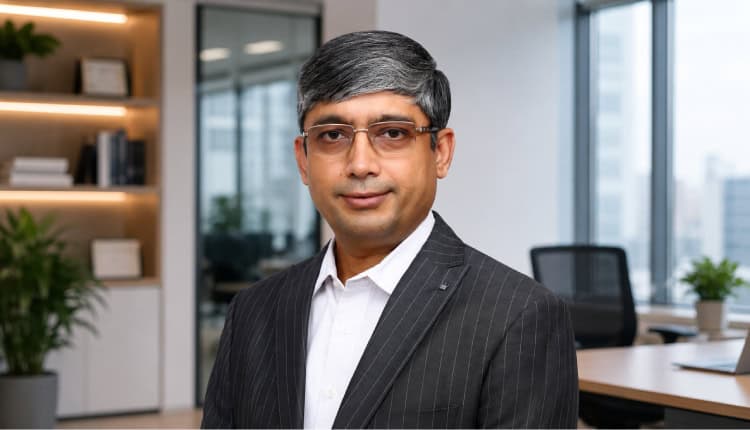
The more complicated question is what sits around that power. For enterprises running workloads across multiple clouds, networks and service providers, connectivity and proximity can matter as much as physical capacity. That is changing the nature of the data centre conversation, says Manoj Paul, Managing Director, India, Equinix.
“When we talk to our customers, they see our value and the discussion moves away from megawatts all the way to what value we are creating for them,” he adds.
The distinction is important because the requirements of a hyperscaler and those of a conventional enterprise are increasingly diverging. Hyperscalers can plan large blocks of capacity around predictable workloads. Enterprises, by contrast, may require a combination of conventional computing, cloud connectivity and increasingly GPU-intensive workloads within the same facility.
That makes the next phase of data centre development less straightforward than simply adding more power.
The infrastructure around the workload
Equinix currently has five operational data centres in India, four in Mumbai and one in Chennai. About 4,700 cabinets have been deployed across them, with further phases expected to take the combined capacity to around 13,000 cabinets.
But the significance of those facilities, in Paul’s account, lies less in the cabinet count than in the networks and services connected to them.
The company’s Mumbai facilities house cloud providers, content providers, OTT and CDN players, internet exchanges and around 175 ISPs. The concentration allows customers to establish connections to multiple networks and services within the same environment.
The same logic is now extending into financial services. At MB3 in Mumbai, Equinix is bringing stockbrokers and other financial institutions into the facility. Paul says an exchange is also moving into the data centre, potentially allowing brokers and other participants in that ecosystem to establish low-latency connections within the facility.
For such customers, a data centre requirement may not amount to several megawatts. It may be measured in cabinets, connectivity and the ability to reach multiple counterparties.
Paul says some enterprise customers have expressed concerns that smaller deployments could receive less attention in facilities dominated by very large workloads. “They are not the megawatt customers. They don’t buy in megawatts and they don’t really need the megawatts,” he points out.
The larger issue is that the traditional capacity metric does not capture the value of a facility that functions as a meeting point for clouds, networks, content providers and enterprises.
AI brings a different problem
Artificial intelligence complicates that equation further because not all AI workloads have the same infrastructure requirements.
Paul distinguishes between training and inferencing. Training requires large amounts of compute and is driving the emergence of very large campuses. Inferencing, however, needs to be closer to users, data and networks. That difference could have implications for where AI infrastructure is built.
“The bigger capacity” will be required for learning and training, Paul notes, while inferencing has “a very different requirement”. It needs to be closer to the customer, closer to the data and connected to multiple networks.
For enterprise data centres, the more immediate challenge may be accommodating AI alongside existing workloads rather than replacing one with the other.
A customer, Paul says, could require 50 cabinets, with 10 of them carrying GPUs at around 100 kilowatts per cabinet while the remaining cabinets operate at around six kilowatts.
That is a considerably more demanding design problem than building an entire facility around a single workload profile.
“For hyperscalers, it’s much easier because they know that the full building is only AI and then it’s one specification,” Paul says. “But enterprises… it’s a lot more difficult, a lot more challenging.”
He compares the difference to a warehouse and a mall. A warehouse can be designed around one customer and one requirement. A mall has to accommodate different customers with different needs in the same physical environment. That is increasingly the problem facing colocation facilities as AI enters enterprise infrastructure.
Power density is only half the problem
The physical consequences are significant. A conventional cabinet drawing six or 10 kilowatts is one thing. A rack requiring 150 kilowatts is another.
Higher density requires changes to the way electricity is delivered within the facility as well as to its cooling architecture. Liquid cooling becomes part of the infrastructure equation.
Paul says Equinix’s Mumbai and Chennai facilities can accommodate liquid cooling. The underlying chilled-water infrastructure can work with different liquid-cooling technologies depending on the customer’s deployment. The broader industry question, however, extends outside the data centre.
India may have sufficient generation capacity to support growing digital infrastructure, but distribution capacity is location-specific. A data centre cannot operate on national generation statistics alone. It needs adequate power delivery at the particular site where it is being built.
Paul states that the industry is currently receiving the power it requires, but expects demand to increase sharply over the next two to three years. He also points to greater coordination between government departments and industry around location-specific requirements.
Whether that coordination translates into infrastructure being built quickly enough remains an open question.
The environmental question will become harder
The other unresolved issue is resource consumption.
As data centre construction accelerates, public opposition to facilities in parts of the US has brought questions around electricity, water and local environmental impact into sharper focus. India, with its own constraints around water and power, is unlikely to avoid that debate indefinitely.
Paul argues that data centres should be viewed in the context of the digital services they enable, rather than as isolated consumers of electricity and water. He also points to efficiency gains from consolidating computing infrastructure in specialised facilities.
Equinix has committed to becoming climate neutral by 2030 and says 96 percent of its power globally is backed by green energy in some form. In India, it operates a group captive solar plant in Yavatmal, Maharashtra, and is planning a wind project.
The more difficult issue, however, is the rate at which AI could increase energy requirements.
“The bigger challenge comes in from the fact of the AI, the workload, and the power moving from a certain dimension to a totally going up in a hockey stick manner,” Paul says.
That challenge also changes the relevance of location. Paul shares that Equinix will consider additional cities based on where its enterprise customers require infrastructure, rather than simply following the emergence of new hyperscale locations.
The distinction captures where India’s data centre market may be heading. The first phase was about establishing capacity. The next will have to reconcile capacity with connectivity, increasingly uneven power densities, cooling requirements and the environmental cost of supporting workloads that are becoming considerably more demanding.
Megawatts will remain an important measure of the market. They are unlikely to remain its only meaningful one.
The question for the industry is no longer simply how much data centre capacity India can build. It is whether the infrastructure around that capacity can evolve at the same speed.
