

Can development turn Mangaluru from a political afterthought into Karnataka’s next tech corridor?

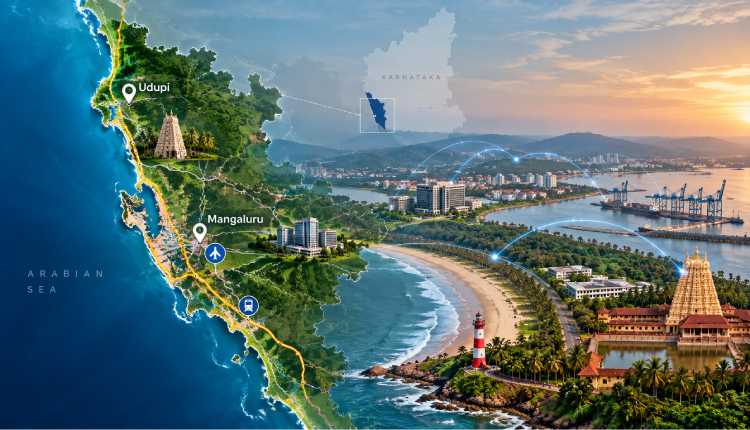

For years, Mangaluru and the wider coastal Karnataka region had an unusual problem. It produced talent, but struggled to retain it.
Engineers graduated from institutions across the region, built careers in Bengaluru, Hyderabad, Mumbai or overseas, while the companies and infrastructure capable of keeping high-value technology work closer to home remained limited.
Now, that equation is beginning to change. The timing is significant. Mangaluru-Udupi has long been a stronghold of the BJP. In the 2023 Assembly elections, the BJP won 11 of the 13 seats across Dakshina Kannada and Udupi. In the 2024 Lok Sabha elections, the party also won both the Dakshina Kannada and Udupi-Chikmagalur constituencies.
Against that backdrop, the Congress government’s renewed focus on the coastal region carries a political dimension, according to sources familiar with the region. But the more tangible question is what that push can deliver on the ground.
The government’s first Cabinet meeting in Mangaluru in September brought that focus into sharp relief. The state approved a package involving more than Rs 32,000 crore in projects, with around Rs 16,000 crore earmarked for Mangaluru, Udupi and the coastal region, covering infrastructure, tourism, healthcare, education and other areas.
For sources in the region, the political calculation is straightforward. A stronger development push in a region where the Congress has historically faced a difficult electoral landscape can help the government build a stronger connect with the people.
But there is another side to the equation. If the investment creates jobs, attracts companies, improves infrastructure and gives local talent a reason to stay, the region benefits regardless of the political calculation behind it. And increasingly, technology is becoming one of the most important vehicles for that transformation.
A region beginning to change
The contours of that transformation emerged during a three-day technology ecosystem tour of Mangaluru and Udupi organised by the Karnataka Digital Economy Mission (KDEM) as part of Mangaluru Technovanza 2026.
The tour brought together technology companies, GCCs, managed workspace operators, start-ups and research institutions. What emerged was not a single technology cluster, but the early architecture of one.
Managed workspaces are expanding. GCCs are setting up engineering operations. Technology companies are building specialised capabilities. A Udupi-based company is developing semiconductor technology. And NITK is opening high-end research infrastructure to industry.
The most revealing part is that much of this activity is being driven not by a single government announcement, but by companies responding to an ecosystem that is gradually becoming viable.
The infrastructure is following the demand
Vertex, a managed workspace provider, offers perhaps the clearest indication of the change. The company entered Mangaluru in 2021 with a 300-seat facility. Five years later, it has crossed 5,000 seats across seven premises.
The original expectation was that Mangaluru would grow slowly. “We started with a mere 300 seater at that point of time, and we were assuming we’ll have 100 seater every year because Mangaluru is not a very fast paced city like Bengaluru,” says Gaureesh Raj, Lead – Community & Outreach, Vertex. “But then today, five years down the line, we are already at 5000 plus seats because this is not how we have grown. Mangaluru has grown, and we were forced to grow ourselves as well.”
Vertex says there are around 12,000 to 15,000 IT professionals working from offices in Mangaluru, while the broader coastal Karnataka belt has an estimated 20,000 to 30,000 IT professionals, including hybrid and remote workers. The company says around 5,000 people work from its premises.
It currently hosts more than five GCCs, according to the company. That growth is also reshaping the geography of the city. Vertex has concentrated its expansion along the airport corridor, reflecting the emerging relationship between office infrastructure, residential development and connectivity.
Another managed workspace provider, wrkwrk, is seeing a similar trajectory. It has three locations across Mangaluru and Udupi with more than 2,000 seats. Another 150,000-square-foot building is coming up on the airport road. The company says two large GCCs are currently operational in its facilities, with another expected shortly.
That expansion is also changing the kind of infrastructure available to companies entering the market.
As Vinodh Kumar, Chief Operating Officer, wrkwrk puts it, “when EG came here they didn’t have an enterprise grade building. So that’s the first part of the ecosystem that we kind of evolved. Otherwise Mangaluru doesn’t have that ecosystem. Didn’t have that but now we have that. And slowly other buildings are coming up. The trend is set.”
This is more than a real estate story. Managed workspaces are lowering the entry barrier for companies that want to establish operations outside Bengaluru. Companies can start with a small engineering team and scale without immediately taking on the cost and complexity of building their own facilities. That flexibility matters in a market that is still developing.
GCCs are testing the waters
The more important shift is that the companies arriving in Mangaluru are not necessarily looking only for low-cost operations.
NTT DATA’s Mangaluru operation has become its Google Cloud Centre of Excellence, with around 1,200 people. The company says most of its high-end Google Cloud technology and digital transformation work is delivered from the Mangaluru office.
That changes the nature of the talent proposition. The argument for Mangaluru is no longer simply that engineers can work from a less expensive city. It is that sophisticated engineering work can be done there. “Our pitch was if we bring exciting work back to Mangaluru, can we get people to stay back?” says Shashir Shetty, Chief Growth Officer, Niveus Solutions, Part of NTT Data Inc. “The moment you are able to offer cutting edge work to engineers here, they stay back.”
Unicourt offers another example. Founded by a Mangaluru native, Prashanth Shenoy Katpady, who returned from the US, the company has built its engineering operation in the city around a specialised legal-data business. It aggregates publicly available litigation data from courts across the US and says it now covers nearly 85% of the US market.
Importantly, Unicourt is not operating as a conventional GCC. Its Mangaluru team forms the engineering side of a business whose customers include major law firms and companies for which litigation is part of their business process. “We are not a GCC. We are the engineering, split into two parts and we are the engineering team, the entire business team,” says Prashanth Shenoy Katpady, Co-founder & Chief Technology Officer, UniCourt.
That distinction matters. It shows that Mangaluru can be the base for a technology business serving a global market, rather than merely the satellite location of a company headquartered elsewhere.
The talent question will decide the next phase
There is, however, a catch. Fresh talent is available. Experienced talent is harder to find. The region produces engineering graduates, but companies looking for professionals with 15 or 20 years of experience face a much smaller pool. That could become a constraint as the ecosystem moves from small engineering teams to larger product and technology organisations.
The experience of companies already operating here suggests that the talent challenge can be managed, but not ignored. Vertex has seen one engineering operation grow from six employees to 84 in 18 months. As the company expanded, it moved across three campuses to accommodate its laboratory and workforce. The significance of such growth is greater than the number itself. It demonstrates that companies can begin small in Mangaluru and scale if the surrounding infrastructure is capable of keeping pace.
NITK could be the missing piece
The region’s biggest long-term advantage, however, may not be office space. It may be the research infrastructure already sitting within its academic institutions.
At NITK, the Central Research Facility houses more than 60 high-end research instruments. The project, as mentioned by a top executive close to the institution, involved an investment of more than Rs 100 crore, of which around Rs 80 crore went into scientific equipment and the rest into the building and infrastructure. The facility provides testing and analysis services to researchers and companies. Its reach already extends well beyond the campus.
The facility receives samples from institutions across 28 states and around 180 institutions and research laboratories. It has also been supporting companies in areas such as materials engineering, coatings and aerospace components, while increasingly working with MSMEs that need help understanding how to test and qualify their products.
NITK says it has around 400 patents and around 400 research students across disciplines. But the institution itself recognises that patents are only one part of the equation. The next challenge is commercialisation.
The objective, according to the NITK team, is to bring companies into the ecosystem so that research can move towards collaboration, licensing, product development and start-ups rather than remaining confined to academic institutions.
That could prove critical for Mangaluru. A technology hub requires not only companies that employ engineers, but institutions that generate technologies those companies can build on.
Deep tech is already taking shape
That transition is visible in Udupi. Sophrosyne is developing semiconductor technology and has created a separate talent-development operation to train engineers in silicon design, embedded firmware and testing. The company says it received $1.2 million under the Design Linked Incentive scheme and has reached Technology Readiness Level 4. Its first chip is being fabricated at 65 nanometres in Taiwan, with initial samples expected for customer proof-of-concept work.
The company is also confronting the central challenge of deep tech in a non-traditional technology location. It cannot simply recruit an entire experienced semiconductor workforce. Its answer is to train engineers locally and build the talent pipeline alongside the product company. “That can happen only if you train these engineers in Udupi. So we decided there should be a second company which will do the back-end talent supply to the technology,” its executive said.
That model could be particularly relevant to the region because it links universities, local talent and high-value technology rather than treating Mangaluru simply as an alternative office location.
A different technology model
There are other signals. NITK’s facilities span AI, drones, geospatial applications, high-performance computing and advanced testing. Its incubation ecosystem has already supported more than 170 start-ups, with 22 currently being incubated, according to the institute.
Vertex, meanwhile, is reportedly exploring modular data-centre infrastructure in partnership with a service provider, reflecting the possibility that Mangaluru’s technology ecosystem could eventually develop infrastructure beyond conventional office space.
NTT DATA is also reportedly exploring the possibility of a future data-centre conversation in Mangaluru, although its representative stressed that this remains an early-stage possibility rather than an active project. The company currently views the city primarily as a Cloud Centre of Excellence.
These developments point towards something more interesting than a Bengaluru satellite. Mangaluru does not necessarily need to replicate Bengaluru’s model of scale.
Its opportunity may lie in building a different kind of technology corridor around GCC engineering, specialised technology businesses, deep tech, semiconductor design, research and a regional talent pool.
The political economy of technology
That is where the government’s role becomes important. The Beyond Bengaluru programme is explicitly designed to encourage technology and digital-economy activity outside Bengaluru, and the Mangaluru-Udupi ecosystem is increasingly becoming part of that conversation. The companies encountered during the Technovanza tour repeatedly pointed to the importance of infrastructure, incentives, talent and government support in making the model work.
The state’s latest coastal push gives that ecosystem a broader development context. The September Cabinet meeting in Mangaluru approved projects spanning roads, urban infrastructure, healthcare, education, tourism and other sectors. The government has described the broader objective as more balanced regional development.
For the Congress government, there is an obvious political incentive in demonstrating development in a region where the BJP has remained electorally dominant.
For the region, however, the equation is less complicated. Jobs are jobs. Investment is investment. Infrastructure benefits businesses and citizens irrespective of which party initiated it.
That is why one source familiar with the region described the emerging consensus as a win-win for both the government and the public. The political calculation may be part of the story, but it does not have to determine the outcome.
The real test is what happens next
Mangaluru’s technology moment will ultimately be judged by something more difficult than announcements, investment figures or political intent.
Can a graduate from the region build a technology career without leaving it?
Can a start-up scale without moving to Bengaluru?
Can a research project become a company?
Can an engineering centre grow from a few hundred people into a strategic global operation?
And can the Mangaluru-Udupi corridor become attractive to companies not merely because it offers cost arbitrage, but because it offers talent, research, infrastructure and a quality of ecosystem that is increasingly difficult to find in an overcrowded Bengaluru?
The ingredients are beginning to come together. There is office infrastructure. There are GCCs. There are global engineering operations. There are research facilities. There are start-ups and deep-tech ambitions. There is a growing talent pool.
What is missing is scale and, more importantly, connectivity between these pieces. If that connection is made, Mangaluru’s biggest export may no longer be its talent. It could be the technology businesses, products and intellectual property created by that talent at home.
