


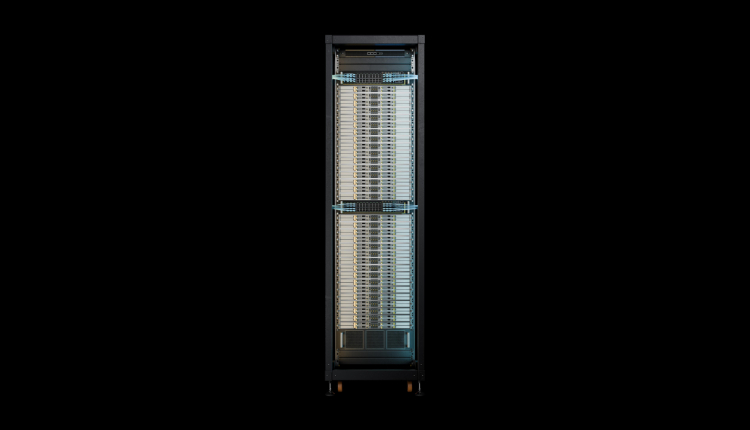

AMD has introduced Helion, an open rack-scale infrastructure design for agentic artificial intelligence workloads, offering configurations that combine central processing units (CPUs) and graphics processing units (GPUs), as well as CPU-only systems for large-scale deployments.
Announced on October 12, the AMD Helion platform is based on an Open Compute Project (OCP) specification design. It is intended to help data centre operators and enterprises configure computing resources according to the requirements of AI agents, including execution, model inference and supporting workloads.
The platform will support different rack configurations, including air-cooled and liquid-cooled systems. One configuration, designed for hyperscale deployments, will use sixth-generation AMD EPYC processors and support up to 32,768 CPU cores. Another will combine AMD EPYC CPUs, AMD Instinct MI350P GPUs and general-purpose computing resources for enterprise deployments.
“Agentic AI is not a single workload. It spans personal agents, enterprise applications, code execution and complex workflows, each with different compute requirements,” said Dan McNamara, senior vice president and general manager of Compute and Enterprise AI at AMD.
“To do that takes optimised compute and infrastructure that can adapt to different workloads. With AMD Helion, we are bringing AMD EPYC performance, open software and flexible rack designs together so our partners can build systems around customer needs and make efficient use of available power,” he added.
AMD plans to contribute the Helion specification to the Open Compute Project for further development and adoption. The company said rack configurations are under development with ecosystem partners and are planned to become available in November 2026.
Several infrastructure providers, including Cisco, Dell Technologies, Hewlett Packard Enterprise, Lenovo, QCT, Supermicro and Wiwynn, have expressed support for the reference design.
Jeremy Foster, senior vice president and general manager of Cisco Compute, said agentic AI infrastructure requirements extend beyond computing performance.
“Agentic AI is changing what customers need from their infrastructure. It’s not just about compute performance, but how the entire system is connected, managed and secured,” Foster said.
He added that architectures such as AMD Helion, combined with Cisco’s infrastructure capabilities, could give customers greater flexibility to deploy and scale agentic AI workloads.
AMD said Helion builds on its open-platform approach to rack-scale computing, allowing partners to tailor CPU and GPU configurations to performance, power and cost requirements. The design is also intended to support deployments that use existing IT infrastructure.