

mEDGE.io: Building an integrated cybersecurity platform to strengthen digital trust

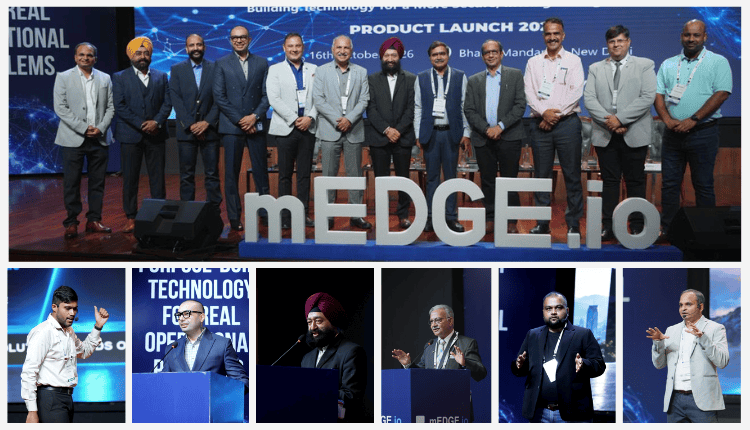

At the recent platform launch in New Delhi, mEDGE.io’s leadership outlined the company’s vision for connecting security, automation, intelligence and governance to help government and enterprise organisations strengthen cyber resilience and digital sovereignty.
As cyber threats become more sophisticated and data protection requirements grow more demanding, organisations are increasingly looking beyond standalone security tools towards integrated platforms that can connect prevention, detection, investigation and governance. Against this backdrop, mEDGE.io unveiled its integrated cybersecurity platform at Bharat Mandapam, New Delhi, on October 16, 2026, with a focus on strengthening digital trust and cyber resilience across government and enterprise environments.
In an exclusive interaction with Express Computer, Shailesh Singh, Chairperson and Co-Founder of mEDGE.io, Yashpal Singla, Co- Founder and Sadananda Sahoo, Co-Founder, discussed the company’s vision for developing integrated cybersecurity capabilities in India for domestic and international markets. Their approach centres on bringing security, automation, intelligence and governance into a connected operating environment, helping organisations address fragmented security infrastructures and improve oversight of digital assets.
Addressing fragmented security environments
As organisations expand their digital operations, securing identities, applications and sensitive data across interconnected systems has become increasingly complex. Multiple security products may provide specialised capabilities, but disconnected tools can create visibility gaps, complicate investigations and delay incident response.
mEDGE.io aims to address these challenges through a platform designed to connect capabilities that are often managed separately. The objective is to enable organisations to strengthen access controls, improve visibility across digital environments and support investigations while maintaining operational continuity.
Shailesh Singh outlined the company’s vision of building technology in India that can serve both domestic and international markets. The emphasis, he indicated, is on integrated solutions that address interconnected security and operational requirements rather than treating each cybersecurity challenge in isolation.
Yashpal Singla emphasised the importance of securely integrating siloed systems, highlighting how seamless connectivity across disparate technology environments has become a critical priority for organisations seeking to strengthen security, improve operational efficiency, and manage growing technological complexity.
Sadananda Sahoo presented the platform’s four foundational pillars: security, automation, intelligence and governance. Together, these are intended to support a more coordinated approach to managing digital risk, from access management and threat monitoring to investigation and compliance oversight.
Evangelist Amlan Dash highlighted capabilities spanning Zero Trust access, controlled application usage, digital forensics and AI-driven intelligence, alongside deployment options across cloud and on-premises environments.
The proposition is to help enterprises establish a more connected view of their security posture. However, the platform’s effectiveness will ultimately depend on how seamlessly it integrates with existing infrastructure, the reliability of its controls and its ability to deliver actionable intelligence.
Digital sovereignty as a cybersecurity priority
The platform launch also brought the broader question of digital sovereignty into focus, particularly as India strengthens its digital public infrastructure and expands the use of technology across critical sectors.
P. S. Sethi,Controller of Certifying Authorities under the Ministry of Electronics and Information Technology and former Director General of the National Informatics Centre, highlighted India’s progress in digital payments, public services and welfare delivery. He underscored the importance of cybersecurity, digital forensics, advanced threat detection and indigenous technology capabilities in protecting these digital ecosystems.
Lt. Gen. Rajesh Pant, former PMO’s National Cyber Security Coordinator, emphasised that cyber resilience requires more than preventive controls. Preparedness, business continuity and recovery planning are equally important, particularly for critical infrastructure. He also stressed the role of indigenous cybersecurity products in advancing technological autonomy and sovereignty.
For enterprises and government institutions, digital sovereignty extends beyond the origin of the technology being deployed. It also involves maintaining control over critical systems, protecting sensitive information, ensuring operational continuity and retaining the ability to respond effectively when cyber incidents occur.
This creates an opportunity for Indian cybersecurity providers to address domestic requirements while developing solutions that can compete in international markets.
Connecting digital trust with digital investigations
The launch featured a panel discussion on Connecting Digital Trust and Digital Investigations, bringing together representatives from government-linked organisations, public sector enterprises, cybersecurity and digital forensics.
The discussion included Lt. Gen. Rajesh Pant; Alok Shankar Pandey, Group General Manager (IT) and CISO, DFCCIL; Bharat Panwar, Additional General Manager, BHEL; Anand Pande, CISO, GSTN; Abhinav Saurabh, Cyber Forensic Expert; and Kumud Bajaj Dubey, Founder and Director, Root64 Infosec Research Foundation.
Panellists examined the challenges posed by fragmented security environments, data sovereignty requirements and the need for accountability during cyber incidents. System visibility, reliable audit trails and digital investigation capabilities emerged as important elements in establishing how a breach occurred, identifying affected systems and supporting incident response.
The discussion reinforced the need to connect preventive security measures with investigation and evidence management. Without adequate visibility and traceability, organisations may struggle to determine the extent of an incident or establish accountability.
For integrated platforms such as mEDGE.io, connecting these capabilities represents an important part of the broader digital trust proposition.
Data protection, privacy and accountability
A second panel, Digital Trust in the Context of Digital Personal Data Protection, explored the implications of evolving data protection requirements for organisations managing large volumes of sensitive information.
The panel featured Sameer Mathur, Managing Partner, SM Consulting; Rajesh Garg, President and Group CIO, Yotta; Gaurav Ranade, CTO and industry expert; Prof. Triveni Singh, former IPS officer and Chief Mentor, Futurecrime Research Foundation; and Aditya Verma, Head, National Security and MHA, Cisco India.
Discussions covered personal data misuse, fraud, privacy by design and the challenges of securing legacy technology environments. Panellists highlighted Zero Trust architectures, stronger identity controls and digital forensics as important safeguards for protecting information and supporting accountability.
A recurring concern was the gap that can emerge between regulatory requirements and their implementation within organisations. Effective data protection requires more than policy documentation; it calls for clearly defined processes, appropriate technical controls, skilled professionals and mechanisms to establish responsibility when failures occur.
As organisations work to strengthen compliance and privacy practices, integrated security environments could help improve oversight and coordination. Their value, however, will depend on whether these capabilities translate into consistent operational practices and demonstrable protection of personal data.
From integration to measurable cybersecurity outcomes
For mEDGE.io, the launch marks an entry into a market where organisations are seeking ways to simplify security operations without compromising protection, governance or accountability.
The platform’s focus on security, automation, intelligence and governance reflects a wider shift towards connecting cybersecurity functions across the technology stack. For government bodies and enterprises with complex digital environments, this approach could help address fragmented controls and improve coordination between prevention, investigation and compliance.
The next test will be execution. Organisations evaluating integrated cybersecurity platforms will need to assess their compatibility with existing infrastructure, deployment flexibility, the quality of intelligence generated and the measurable impact on incident detection and response. They will also need to consider how the platform supports auditability, data protection and business continuity.
India’s growing emphasis on digital sovereignty presents opportunities for indigenous cybersecurity companies to develop solutions for government and enterprise requirements, including international markets. Yet domestic development alone will not establish digital trust.
For mEDGE.io, sustained adoption will depend on demonstrating that its integrated approach can deliver dependable security, meaningful operational visibility and accountable outcomes in real-world deployments.