

Manufacturers are betting on agentic AI, but trust, not technology, is now the limiting factor

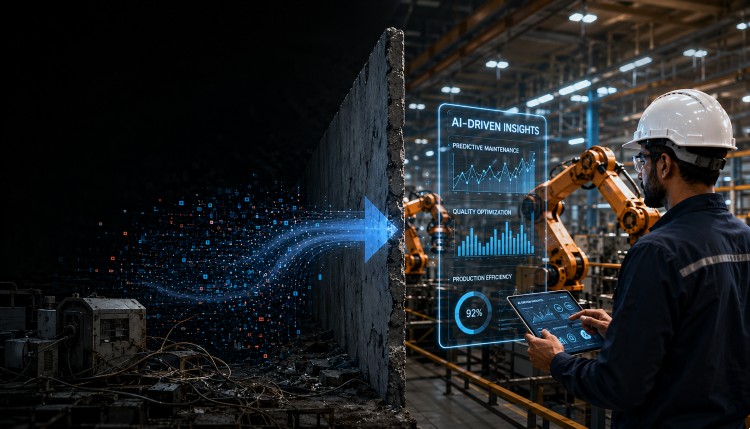

For much of the past three years, enterprise AI in manufacturing was a story about obstacles. Plants lacked data science talent, legacy systems resisted integration, and business cases were hard to prove. Those barriers shaped budgets, pilots, and vendor pitches alike.
According to Rootstock Software’s 2026 State of AI in Manufacturing Survey, that story is changing. Skills, integration, and cost, the top hurdles when the company ran its previous survey in 2024, have all eased. What has replaced them is a harder question for CIOs to answer: whether AI’s output can be trusted.
From pilots to production
The numbers show a sector past the experimentation phase. Nearly two-thirds of manufacturers surveyed (64%) report that AI initiatives have moved beyond exploration into pilots or into live operation, where they are integrated with or broadly supporting business processes. Looking ahead, 77% plan to increase budgets or resources for AI tools over the next 12 to 18 months.
That figure is slightly below the 82% recorded in 2024, which is worth reading as normalization rather than retreat. Only 3% expect to cut spending, and 20% plan to hold steady. Among those increasing investment, more than half anticipate a rise of 10% to 25%, and almost a quarter expect 26% to 50%. This looks less like a hype cycle peaking than a technology settling into the operating budget.
The mix of technologies is also shifting. Automation remains the most widely deployed form of AI at 52%, followed by generative AI at 49% and predictive AI at 40%. Agentic AI, meaning systems that can independently plan and execute tasks with minimal human intervention, is already in use at 31% of respondents deploying AI. For a category that was largely conceptual not long ago, that is a meaningful foothold, and it raises the stakes on everything else in the survey.
The one-in-a-thousand problem
If agents are going to act on behalf of the business, the reliability of their decisions becomes an operational risk rather than a technical curiosity. Ohad Idan, VP of Product at Rootstock, argues that the danger lies in near-perfection. An AI that errs once in a thousand answers, he said, can be more hazardous than one that fails more often, because people come to trust its output and stop checking it. By the time the error surfaces in inventory counts or the books, the cost has already been incurred.
Anyone who has run a production planning or procurement process will recognize the pattern. Visible failures get fixed quickly. Rare, plausible-looking ones propagate quietly through purchase orders, work orders, and financial close.
Idan’s prescription is not to slow down. AI can now connect to almost any system to build a fuller picture of the business, he said, but when it is time to act, those actions should run through an enterprise-grade platform with appropriate permissions, a clear audit trail, and expert-defined business logic for decisions that must be consistent and repeatable. In practice, that means letting AI read widely while constraining how it writes.
Humans stay in the loop
Respondents appear to share that instinct. Some 73% prefer either human-directed AI or AI that operates autonomously within defined limits and escalates when needed. Only 13% want fully autonomous systems. The appetite is for agents with guardrails, not agents with free rein.
Governance, however, has not caught up with that preference. Employee training is the most common responsible-AI practice, adopted by 40% of respondents, and a quarter report using none of the practices the survey listed. For CIOs, that gap between stated preference for oversight and actual oversight mechanisms is arguably the most actionable finding in the data.
The workforce question
The human side of the equation is not purely about controls. While 41% of respondents expect AI to make them more productive, 61% are at least somewhat concerned it could limit their career opportunities. Rick Berger, Rootstock’s CEO, framed adoption as a people problem as much as a technology one, saying that realizing AI’s value takes vision, training, and a commitment to keeping human judgment at the center of key processes.
Optimism and anxiety coexisting in the same workforce complicates rollout. Employees who fear displacement have little incentive to scrutinize AI output carefully, or to flag its mistakes, which feeds directly back into the trust problem Idan describes.
ERP as the proving ground
Where agents act, and through what, brings the conversation back to the ERP. Eighty-six percent of manufacturers say they are at least somewhat confident their ERP can keep pace with AI-driven change, but only 43% are very or extremely confident. ERP remains among the top four enterprise technologies expected to influence how well organizations can adopt and integrate AI tools, and supply chain management ranks first, cited by 46% of respondents as the technology most likely to drive further AI adoption.
Supply chain pressure is clearly part of the motivation. Seventy-seven percent are already using AI, piloting it, or planning investment within the next year to manage disruption and trade uncertainty.
There is also notable interest in consolidation. Fifty-nine percent currently run separate, specialized AI capabilities across applications, or have not adopted AI broadly enough for cross-system integration to matter. Yet 88% see at least some value in a single, unified agent that works across business applications, and 58% rate the idea very or extremely valuable. Today’s patchwork of embedded assistants may be a transitional state.
Taken together, the findings point to a shift in what separates leaders from laggards. Access to models and tools is no longer the differentiator. The advantage will go to organizations that can answer a few unglamorous questions with confidence: which systems an agent may read from and write to, how its actions are logged and reviewed, who owns the business rules behind consequential decisions, and whether the ERP underneath is ready to serve as a dependable system of record.
Manufacturers have largely cleared the barriers that held AI back in 2024. The next phase will test whether their governance, platforms, and people are ready for the trust problem that remains.