



By Pawan Kumar, IPS
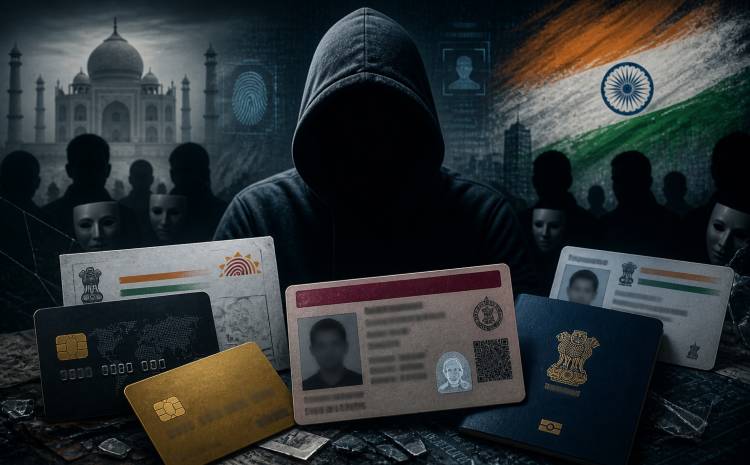
Across societies and systems, one of the greatest challenges to governance, security, and public trust is the problem of fake identities. They manifest in multiple forms: bogus firms that exist only on paper, counterfeit products that erode consumer trust, duplicate SIM cards and bank accounts that enable crime, manipulated welfare records that siphon resources, and forged ownership documents that spark endless disputes. This long list reveals a troubling reality—these are not isolated irregularities. Together, they form an ecosystem of deception, a parallel world of falsehoods that corrodes institutions, distorts economic activity, and leaves citizens vulnerable. Fake identities and the networks that sustain them enable corruption, organized crime, economic leakages, and even acts of violence and terrorism.
The digital age has only magnified this problem. Cyberspace, with its vast reach and relative anonymity, has become a fertile ground for deception. In India alone, more than one crore people have fallen victim to cybercrimes linked to impersonation, fraud, and fake profiles. Globally, fake social media accounts mislead individuals, fraudulent websites lure investors, and anonymous mobile numbers or email addresses are exploited for extortion, misinformation, and the coordination of illegal activities.
What already exists offline in the form of fraudulent identities now finds more powerful expression online, multiplying risks at an unprecedented scale. The critical insight here is that cybercrime is not separate from the wider ecosystem of fakes—it is an extension of it. To secure both our societies and our digital future, we cannot afford to treat the cyber problem in isolation. We must address the root cause: the unchecked proliferation of fake identities across domains.
One way forward is the creation of a Master Agency for Identity Verification, envisioned as a central institution with the mandate to establish, authenticate, and maintain the legitimacy of identities in both physical and digital spheres. This agency would combine technological solutions such as artificial intelligence, biometrics, blockchain, digital forensics, and big-data linkages with manual oversight through regulatory checks, field verifications, and audits. Its scope would be comprehensive—ensuring each individual has a unique and verifiable presence across systems, authenticating properties and vehicles to prevent fraudulent ownership, tying mobile numbers, SIM cards, and bank accounts to legitimate users, verifying companies and businesses against false registrations, and even securing supply chains against counterfeit goods. Importantly, this effort would not stop at isolated verification.
By mapping the interlinkages between identities—how a SIM connects to a bank account, how a property is tied to its legitimate owner, or how a digital account corresponds to a real person—the system would make it increasingly difficult for fake entities or fraudulent linkages to survive.
The implications for cybersecurity and crime prevention are profound. Phishing and impersonation frauds would decline if email IDs and websites were verified. Fake social media manipulation, harassment, and stalking would be curtailed if accounts were authenticated. Financial cybercrimes would reduce sharply once every wallet, bank account, and digital transfer was tied to a traceable identity.
Darknet activities, which thrive on stolen or fabricated credentials, could be disrupted by tracing identity trails. Even cross-border crimes and terror financing would face stronger resistance if digital and physical identities were tied to verifiable nodes.
The benefits, however, extend far beyond the realm of cybercrime. Eliminating fake identities would bring systemic reforms of lasting value. Governance would gain integrity as welfare benefits reached only genuine beneficiaries, reducing leakages. Economic transparency would improve as shell firms, benami assets, and duplicate accounts found no place to hide.
Citizens would enjoy greater trust in their interactions, knowing that their counterparts—whether institutions, businesses, or individuals—were authentic. Institutions themselves would become more resilient, basing decisions on verifiable data and thereby strengthening both governance and justice systems.
Fake identities are not minor inconveniences; they are the root cause of systemic vulnerabilities that stretch from corruption and fraud to cybercrime and terrorism. If left unchecked, they will continue to undermine governance, economies, and citizen security. The proposal for a Master Agency for Identity Verification is not a rigid blueprint, but a visionary starting point—a call to rethink how we confront deception at its very core.
By blending technology with oversight and fostering international collaboration, societies can move toward authentic ecosystems where both digital and physical interactions are rooted in trust. Ultimately, identity is the common denominator. By securing it comprehensively, we do not just fight cybercrime—we dismantle the broader ecosystem of fakes and lay the foundation for safer cyberspace, stronger institutions, and more resilient societies.
– Views expressed by the author are personal. He is author of the book, “Dear, The People – Let’s make our country better’