


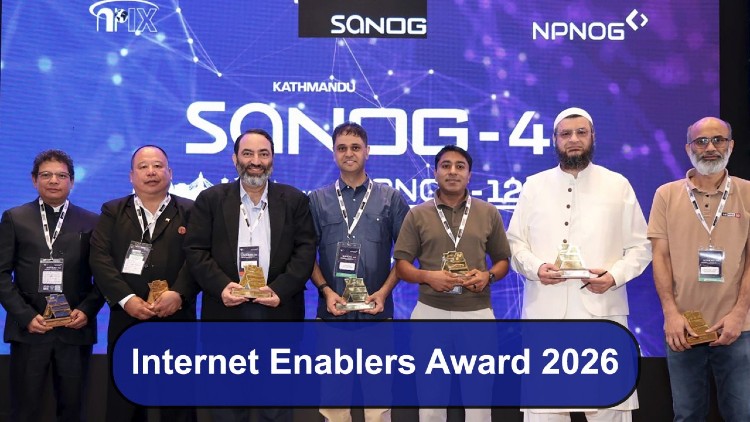

Indian technology visionaries Suchit Nanda and Neeraj Sonker have been conferred with the inaugural Internet Enablers Awards at the 44th South Asian Network Operators Group (SANOG 44) conference held in Kathmandu, Nepal. The awards recognize seven outstanding individuals across five South Asian nations whose early technical leadership, infrastructure deployment, and community-building laid the groundwork for the modern Asia-Pacific Internet.
Internet Enablers recognises individuals whose vision, leadership, technical expertise, and commitment have helped build, strengthen, and expand the Internet across Asia-Pacific.
From network infrastructure to developing technical communities, advancing policy, and enabling digital inclusion, these individuals have played a significant role in shaping the Internet ecosystem we rely on today.
Long before commercial Internet access was launched in India, Suchit Nanda introduced thousands of early adopters to digital communications via his Live Wire! Bulletin Board System (LWBBS). A key catalyst in India’s networking history, Nanda brought FidoNet to the country. Alongside his partner Sharad Sanghi, Nanda consulted for Videsh Sanchar Nigam Limited (VSNL) to design and execute India’s historic Gateway Internet Access Service (GIAS)—the nation’s first public Internet deployment launched on August 15, 1995.
Nanda subsequently founded LWNET, one of India’s earliest private Internet Service Providers (ISPs), and developed JadooNet STB, the country’s first set-top box designed to deliver Internet access over television sets. Beyond infrastructure, Nanda played an active role in policy and regional knowledge sharing, serving on the Editorial Board of the Digital Review of Asia Pacific on behalf of Canada’s International Development Research Centre (IDRC). Currently, he serves as an Advisor to the Chairman at Reliance & Jio and sits on the Board of the SAGE Foundation.
Neeraj Sonker played a critical engineering role at VSNL during the rollout of Gateway Internet Access Service (GIAS) in 1995. Sonker’s technical direction and network deployment strategies were pivotal in overcoming severe early bandwidth constraints, establishing international Internet gateways that enabled Indian enterprises, research institutions, and households to connect to the World Wide Web for the first time. As a core member of the engineering and operations team, he helped design, deploy, and operate the infrastructure that introduced commercial Internet access to India. Over the following decades, he contributed to the evolution of India’s Internet backbone, Metro Ethernet, MPLS networks, and global IP infrastructure, while continuing to document and celebrate the people whose collective efforts transformed the country’s digital landscape.
“Before the Internet became an essential pillar of everyday life, these pioneers were building foundational networks, connecting remote communities, and sharing open technical knowledge,” noted the committee during the ceremony.
Engineers and advocates from India, Nepal, Bangladesh, and Bhutan, who contributed to expanding public access to Internet services, were recognized at the event. The honorees include Neeraj Sonker and Suchit Nanda from India, Dilip Agrawal from Nepal, Sumon Ahmed Sabir from Bangladesh, and Jichen Thinley from Bhutan. Internet Enablers had previously recognized Nepal’s Gaurab Raj Upadhaya as a pioneer in the Asia-Pacific region. Upadhaya is the founder of SANOG.
The Internet Enablers Awards also mark the formal launch of a broader regional initiative dedicated to preserving the history of the Asia-Pacific Internet and documenting the human stories behind its transformation.
Supported by APNIC Foundation (Brisbane, Australia), Internet Enablers initiative extends beyond recognition to serve as a regional movement dedicated to documenting the technical history and human stories behind the growth of the Asia-Pacific Internet.