

Panache Digilife sees opportunity in India’s shift towards higher-value electronics manufacturing


India’s electronics manufacturing story is beginning to move into a new phase. The focus is gradually shifting from simply assembling products in the country to building deeper capabilities across design, engineering, components and high-value manufacturing. Panache Digilife believes this transition could create a larger opportunity for Indian ESDM companies.
The company’s performance in the first quarter of FY27 provides an indication of that opportunity. Panache Digilife reported a 73.1% year-on-year increase in total income to ₹515.4 crore for the quarter ended June 30, 2026. More significantly, EBITDA rose 173.8% to ₹59.1 crore, while profit after tax increased 338.5% to ₹38.1 crore.
The improvement in profitability is notable because it points to a shift in the nature of the business. EBITDA margin increased to 11.5% from 7.2% in the year-ago quarter, while PAT margin increased from 2.9% to 7.4%. The company attributes the improvement to operating leverage, product mix and a growing contribution from value-added manufacturing and design-led engagements.
India’s electronics opportunity is getting deeper
Panache’s growth comes at a time when India’s electronics manufacturing base is expanding rapidly.
According to the Ministry of Electronics and Information Technology (MeitY), production of electronic goods increased from ₹6.41 lakh crore in FY2021-22 to ₹11.32 lakh crore in FY2024-25, representing a CAGR of 20.91%. Electronics products have also emerged among India’s top three export categories.
The next challenge is to increase the depth of the ecosystem. The government’s Electronics Component Manufacturing Scheme, notified in 2025, is aimed at attracting domestic and global investment, developing manufacturing capabilities and integrating Indian companies more closely with global value chains.
This creates a different opportunity for companies such as Panache. As more global and domestic companies look to diversify supply chains and localise production, the requirement is increasingly for partners that can contribute to product development, engineering and manufacturing rather than only production capacity.
From EMS to design-led manufacturing
Panache Digilife operates across Design-Led Manufacturing (DLM) and Contract-Led Manufacturing (CLM), with capabilities spanning product design, engineering, prototyping, manufacturing, quality assurance and lifecycle support. Its portfolio includes ICT, AIoT and digital infrastructure solutions.
That positioning is becoming increasingly relevant as electronics products become more software-defined and technology-intensive.
AI-enabled devices, IoT products, networking equipment and digital infrastructure are creating demand for tighter integration between product engineering and manufacturing. Panache says these are among the areas where it sees increasing opportunities, alongside the broader trend towards domestic manufacturing and localisation.
The larger industry movement also supports this direction. MeitY’s PLI 2.0 scheme for IT hardware, for example, is explicitly designed to deepen India’s manufacturing ecosystem by encouraging localisation of components and sub-assemblies and allowing time for domestic supply chains to develop.
Building capabilities, not just capacity
For Indian manufacturers, the opportunity now extends beyond adding production lines. The ability to design products, develop prototypes, manage quality and support products through their lifecycle could become an important differentiator as global OEMs look for more capable manufacturing partners.
Panache says it is therefore focusing on strengthening its design and engineering capabilities, expanding its customer and product portfolio and increasing its participation in high-growth segments.
 “We are pleased to begin FY27 on a strong note, with the Company delivering robust growth across key financial parameters,” said Amit Rambhia, Chairman and Managing Director, Panache Digilife. He added that the company’s investments in capabilities and strategic partnerships are intended to help it address increasingly complex and technology-intensive requirements.
For Panache, the immediate numbers provide a strong start to FY27. But the larger story is about where the Indian electronics manufacturing industry is heading.
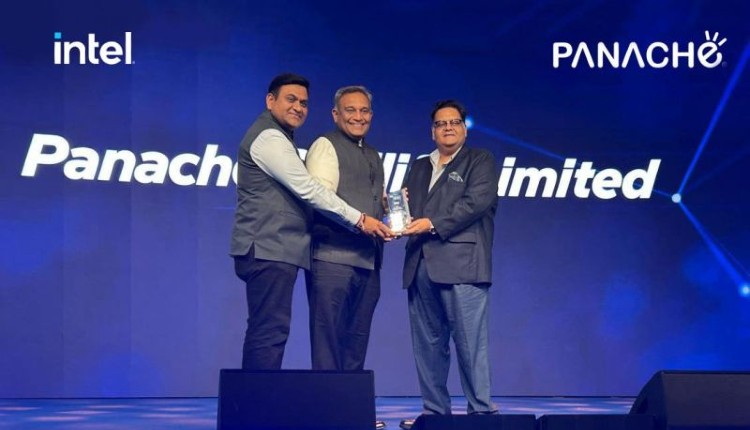
Panache’s growing focus on technology-led capabilities has also received recognition from the industry. The company was recently presented with the Innovation & Excellence Award by Intel at Industry Solution Builders Connect 2026 in Bengaluru. The recognition highlights Panache’s work across technology, product innovation, engineering and execution, as it expands its capabilities across AI PCs and computing platforms, networking, connectivity, IoT and intelligent devices. The company is building these capabilities around design, engineering and manufacturing in India, while also strengthening its technology and ecosystem partnerships across Taiwan and the US. For Panache, the longer-term ambition is to move beyond the traditional “Make in India” narrative towards building locally engineered products and solutions that can compete in global markets. This approach reflects a broader opportunity emerging for Indian ESDM companies: combining AI, hardware, connectivity, software and manufacturing to deliver complete technology solutions rather than operating purely as manufacturing partners.
India has already established significant scale in electronics production. The next phase will depend on how much of the value chain can be built within the country — from components and product design to engineering, manufacturing and global supply-chain integration.
For ESDM companies, that could mean that the next competitive advantage will not simply be “Made in India”, but how much of the product can be designed, engineered and built in India.