

9,481 elephant crossings, zero deaths: How AI made one railway stretch safe

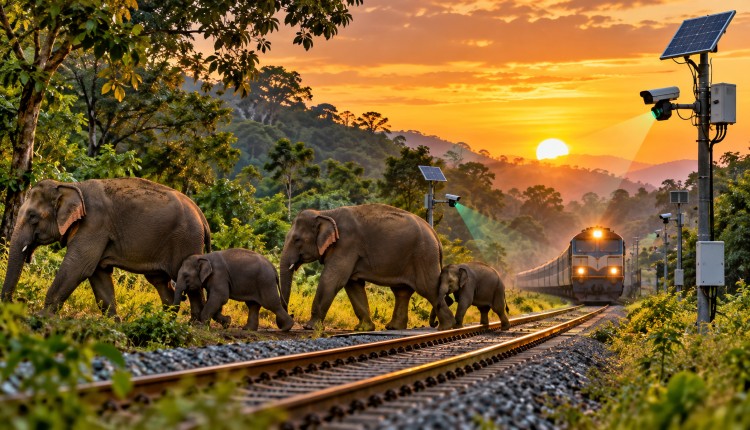

Picture the forest at night. A herd that has walked this route for generations moves toward a railway line that came much later. The elephants’ memory of the path is older than the rails.
For decades, the only warning a driver got was the headlight. A loaded train can need around 1.6 km to stop after emergency braking, according to a loco-pilots’ association in 2024. By the time a driver spots a herd in the beam, it is often too late.
The stakes are high across the country. India has an estimated 22,446 wild elephants, nearly 60% of the world’s wild Asian population, and 150 identified corridors where they travel. Government data shared in Parliament in July 2025 put train-collision deaths at 81 over five years.
The stretch that decided to try something different
The Madukkarai Forest Range, near Coimbatore, sits on one of those routes. The Tamil Nadu Forest Department put AI-enabled thermal cameras along a vulnerable railway stretch near Puthupathi. They watch around the clock. Thermal imaging picks up a warm body in the dark long before a driver could see it, and the AI flags when animals approach the line.
The cameras are only the first link. When elephants near the tracks, alerts reach forest teams and railway officials, who coordinate with station masters and loco pilots. A government test of the system, summarised in March 2026, described tower-mounted cameras that detect movement within 100 metres of the track and automatically alert officials, so trains can slow down.
Two and a half years, one number that matters
Over roughly two and a half years, the system generated more than 7,100 real-time alerts. Officials say the coordinated response helped facilitate around 9,481 safe elephant crossings. There were zero elephant deaths on that railway stretch during the period. Tamil Nadu has since added AI-enabled drones to extend surveillance beyond the fixed cameras.
Each crossing was a moment when a herd and a train could have met. Each alert was a call that went out, and a crew that slowed and waited.
The same idea, listening instead of looking
While Madukkarai watches with cameras, Indian Railways has been developing a different approach. It is called Gajraj Suraksha, roughly “protection of the king of elephants,” and it listens.
The idea hides in plain sight. Railways already runs optical fibre cables beside its tracks for communication and signalling. Engineers realised those cables could work as a microphone. In a technique called distributed acoustic sensing, a pulse of light travels down the fibre, and footsteps nearby disturb it. A single fibre can be monitored over 100 km or more. An AI system analyses the signals to pick out patterns that look like elephant movement, and it can detect and locate moving elephants up to 5 metres from the cable.
When it hears a herd, the system alerts loco pilots, station masters and control rooms, so they can slow or stop approaching trains while the animals are still on their way to the track. Where a camera needs a clear view, a buried cable simply listens along its whole length.
From a pilot to a national plan
The Northeast Frontier Railway introduced the system in December 2022 in 11 elephant corridors, five in Alipurduar division and six in Lumding. Railways developed it in association with start-ups, and the NFR said it helped eliminate train-related elephant deaths in those corridors. That is the railway’s own claim.
The Railway Minister told the Lok Sabha on 4 February 2026 that the system is operational over 141 route kilometres on the Northeast Frontier Railway. Works are sanctioned in several other zones, covering more than 1,100 route kilometres in total, including East Coast Railway (368.70 route km), Western Railway (115) and North Eastern Railway (99.18).
It is also economical. The cable was already in the ground, so the investment goes into the sensing and the intelligence.
Why both approaches point the same way
Gajraj Suraksha and the Madukkarai cameras use different sensors and are run by different teams. They share a principle. Neither technology saves an elephant by itself. The AI buys time, and the people at the other end of the alert use it. In Madukkarai, that chain has been tested for two and a half years. Gajraj Suraksha is now extending the same idea across more of the country’s tracks.
They are also part of a bigger effort. Railways and forest authorities have surveyed 127 sensitive stretches covering more than 3,450 km, and prioritised 77 stretches spanning nearly 1,965 km across 14 states. They have recommended 705 interventions, including underpasses, overpasses and ramps, with intrusion detection, seismic sensors and thermal cameras alongside them.
The lesson here is beyond just elephants. AI tends to make the biggest difference where a problem is narrow and painful, where it can detect danger earlier than people can, and where a team is ready to act on the warning. For one stretch of track near Coimbatore, that combination has meant thousands of safe crossings. Indian Railways is now trying to bring the same early-warning idea to other elephant-prone stretches
– This story is part of The Quiet Algorithm, a series on AI that works without making noise. This series is about what’s quiet. It looks at algorithms doing useful work in the background: a cable that listens for elephants, a forecast that reaches farmers weeks before the rain, an X-ray that finds disease before symptoms do. Each story follows the same rule: a real problem, a real result, and a source to back it up.
If you know a project with proven results in health, farming, safety, finance or anywhere else, I’d love to hear about it. Send us the problem it solves, who is behind it, one number that shows the impact. The best ones will be featured