


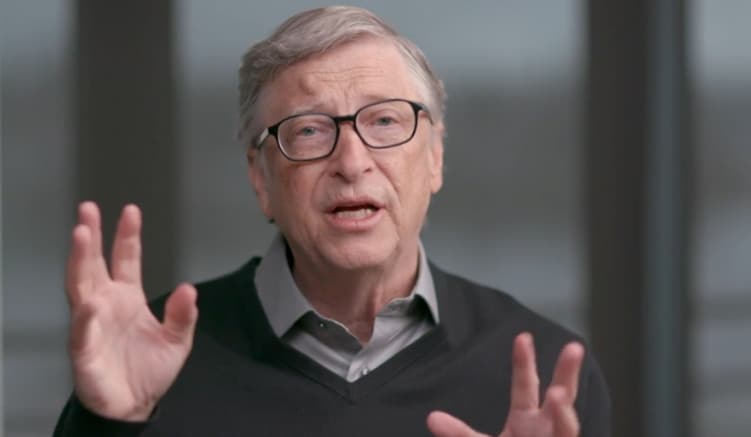

Bill Gates just asked governments to tax the thing that’s about to replace millions of workers — and it’s the third time in a decade the tech world has heard some version of this pitch, minus the memorable turn of phrase this time around. In an essay published on August 26, Gates Notes, “The Turbulent AI Era Is Here. The Choices We Make Now Are Critical,” the Microsoft co-founder resurrects the robot tax he floated in 2017 and got laughed out of the room for, gives it a new, more enforceable unit of measurement — the AI “token” — and folds it into a broader case that the world is sleepwalking into a decade of disruption it has no plan for.
The tax proposal is getting the headlines. It’s also the part of the essay with the longest paper trail of failure.
Gates’s logic hasn’t changed since 2017: hire a $50,000-a-year worker and the government collects payroll tax, Social Security tax, and income tax on that hire. Buy a robot to do the same job and it gets depreciated as a capital expense. “The tax system nudges you toward replacing people with machines,” he writes. His fix, then and now, is to tax the substitute the same way you’d tax the person.
What killed the idea in 2017 was that nobody could define what was being taxed. A conveyor belt with a sensor? A spreadsheet macro that eliminates a data-entry job? The category collapsed under its own vagueness, and economists piled on. Harvard’s Lawrence Summers called it “seriously astray” and accused Gates of “protectionism against progress.” NYU Stern’s Robert Seamans agreed the tax code needed rethinking but concluded a robot tax specifically would discourage investment, slow growth, and — since robots often complement rather than replace labor — end up costing jobs and wages rather than saving them.
Tokens solve the definition problem robots never could. A token is already counted, invoiced, and metered inside the billing systems of a small number of AI companies. For the first time, Gates has a proposal with an actual meter attached — one built, notably, by the industry it would tax. He’s told MIT Technology Review the rate could run as high as 50% of a company’s token revenue. That specificity is new.
Whether it survives contact with the same economic objections that killed the 2017 version is not yet tested — and Gates seems to know it. His response to the efficiency critique isn’t a rebuttal so much as a shrug: critics, he writes, are “not considering the broader value of work for individuals and society,” and with all the growth AI will generate, “we’ll be able to afford a little inefficiency as the price for keeping people employed.” That’s a values argument dressed as a policy argument, and it’s likely to satisfy exactly nobody who wasn’t already convinced.
The idea isn’t just theoretical anymore. Rep. Greg Casar’s AI Tax and Work Protection Act, introduced in Congress on August 6, taxes large AI firms on the higher of their token revenue or product revenue and funnels the money into a Department of Labor program explicitly modeled on the WPA. Gates has company on this, too — Dario Amodei has called for more aggressive AI-company taxation, and OpenAI has floated its own automation-linked tax scheme. A decade ago this was a lone billionaire’s pet idea. Now it’s a live bill with a new deal reference attached.
Strip away the tax proposal and what’s left is a document considerably more alarmed than anything Gates has previously put his name to. This is the same person who wrote “The Age of AI Has Begun” in 2023 comparing his excitement to the arrival of the PC. Three years later, he’s opening with lines like “I don’t see evidence that leaders, experts, and communities are confronting the challenges adequately” and “there is no plan to ease the entry into the AI era.” He’s not calling for a slowdown — he explicitly says he’d support one if a credible global plan existed, but doesn’t think the geopolitical and economic incentives will allow it — which makes the essay less a brake pedal and more a demand that someone, anyone, build guardrails while the car is still moving.
Two other pieces of the essay deserve as much scrutiny as the tax:
“Human Reserved” jobs. Gates wants society to deliberately wall off certain categories of work — elder care, basic education, mental health support — from automation, even where machines could do it cheaper, the same way a nature reserve protects land from development regardless of its market value.
He puts a ceiling on this at roughly 40% of jobs in the most aggressive version. It’s a strikingly interventionist idea for someone who spent decades as a poster child for market-driven tech disruption, and it raises a question Gates himself concedes he can’t cleanly answer: who draws the line, and how do you separate an AI that invents a life-saving drug from one that just eliminates a job? A “reserve” implies enforcement — inspectors, penalties, definitions of what counts as reserved work — none of which Gates sketches out. It’s a compelling metaphor in search of a regulatory mechanism.
Kids, chatbots, and the erosion of critical thought. The essay’s most quietly unsettling section isn’t about jobs at all — it’s about children forming attachments to AI companions that are engineered to be endlessly agreeable, and research he cites showing heavy reliance on AI for writing and problem-solving correlates with weaker critical-thinking performance, especially among younger users. This is the part of the essay hardest to solve with a tax or a legal carve-out. You can meter tokens. You can’t easily meter a teenager’s relationship with a chatbot that never disagrees with them.
The gauge
Gates has effectively bet that giving the robot tax a meter — the token — will let it succeed where the 2017 version failed on a technicality. That’s a real, structural improvement to the proposal, and it’s already shown up in actual legislative text. But the underlying economic argument against it hasn’t moved: taxing the substitute for labor still risks taxing the productivity gains that are supposed to pay for the transition in the first place, and Gates’s own answer to that critique is closer to a moral appeal than an economic rebuttal. The “Human Reserved” concept is the more genuinely novel idea in the essay and also the least specified — a name for a policy that doesn’t yet have a mechanism. And the material on children and critical thinking may be the hardest problem in the piece precisely because it’s the one Gates offers no numerical fix for at all.