

DXC’s AI test in India is whether the technology can change the services model


AI is creating a difficult question for the technology services industry. If AI changes how enterprises build, operate and consume technology, what happens to the services models that have been built around doing much of that work?
For DXC Technology, the question is particularly relevant. The company has decades of experience running and modernising enterprise systems, while much of the technology services business continues to depend on infrastructure and application work. The arrival of AI creates opportunities, but it also puts pressure on some of the work that has traditionally supported the industry.
That tension is increasingly relevant to India’s technology services ecosystem as well. India’s technology centres are moving beyond their traditional role as large-scale delivery engines, taking on greater responsibility for engineering, cybersecurity, data and increasingly AI. The question now is whether that expanded mandate changes the nature of the work itself or simply adds new capabilities around an existing delivery model.
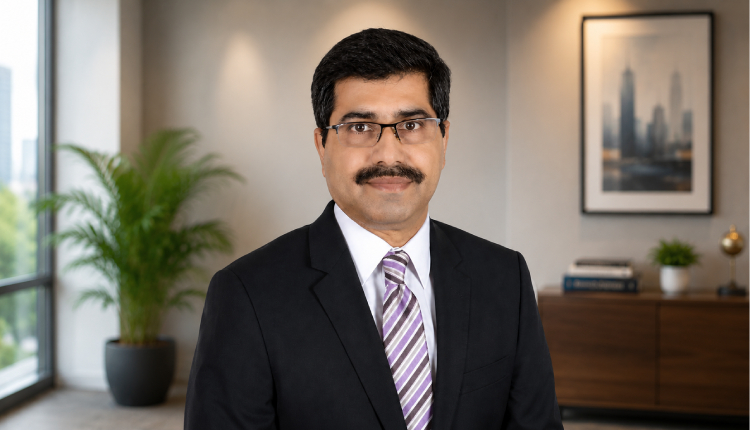
Bhushan Sharma, Managing Director for DXC Technology in India, says the answer lies in moving AI into the operational fabric of businesses rather than treating it as another technology layer.
“The real differentiator will be the ability to engineer AI into how businesses operate, not as an add-on,” Sharma adds.
That shift sounds straightforward. In practice, it is considerably harder. Enterprise environments bring with them existing systems, security requirements, governance obligations and operational dependencies. AI has to work within those constraints if it is to move beyond experimentation.
The transition from experimentation to adoption
Sharma sees AI as another technology transition that can change how businesses operate. He points to the internet, cloud and SaaS as earlier shifts that created opportunities for organisations to rethink their operating models.
“Technology shifts, be the internet, cloud, or SaaS, all have created new opportunities for businesses to rethink how they operate. We see AI in a similar light,” Sharma says.
The difference now is the breadth of the disruption. AI can affect productivity, software development, security and the operation of existing technology environments at the same time.
Sharma points out that DXC is focused on applying AI to modernise operations, improve productivity, strengthen security, accelerate software delivery and help clients derive more value from existing technology investments.
That approach puts the emphasis on existing enterprise environments rather than on AI as an isolated proposition. It also raises a more uncomfortable question for services companies. If AI can make technology delivery more efficient, providers will eventually have to apply those efficiencies to their own operations.
DXC is doing that as well. “We are applying these capabilities within our own operations as well, giving us first-hand experience of what it takes to move from experimentation to enterprise-scale adoption,” he says.
The significance of that approach is less about demonstrating that DXC uses AI internally and more about the learning involved. Those experiences provide practical lessons that can be taken into client environments.
For India’s technology centres, this distinction matters. A centre that only executes AI-related work for the parent organisation remains a delivery operation with a new technology focus. A centre that uses AI to rethink its own processes and then feeds those lessons back into the global organisation begins to acquire a different kind of strategic relevance.
Bengaluru’s value lies in the bridge to scale
DXC’s Bengaluru operation is its innovation hub and Customer Experience Centre, and is part of a wider network of innovation and experience centres across its global operations. Sharma does not describe India’s role as being separate from those locations. Instead, he points to the combination of technical talent, large-scale delivery experience and connectivity with global operations.
“What makes our presence in Bengaluru notable is the combination of deep technical talent, large-scale delivery experience, and close connectivity with DXC’s global operations,” Sharma adds.
For India, the distinction is increasingly important. The country’s traditional advantage in technology services has been closely associated with scale and talent. AI is making another capability more important, which is the ability to take emerging technologies from experimentation into large enterprise environments.
“India’s strength lies in its ability to combine innovation with execution at scale,” Sharma says. That is also where the role of India’s technology centres is changing. The value of an India centre increasingly depends on whether it can move from being an execution arm to becoming part of the organisation’s capability-building process.
Bengaluru gives clients access to teams involved in designing, building, securing and operating technologies that support enterprise transformation around the world. The facility also fits into DXC’s Customer Zero approach, through which capabilities can be applied and refined within the company’s own operations before being scaled more widely.
The distinction between capability and ownership will be important. The more global organisations depend on India for technology decisions rather than simply technology execution, the more consequential the India centre becomes.
Cybersecurity makes trust the harder test
The credibility of an India-based technology operation becomes more difficult to establish when the work involves cybersecurity and sensitive client information.
DXC’s Bengaluru operation brings together AI, cybersecurity, cloud, data and industry expertise. For activities such as breach forensics and cyber simulations, however, technical capability is only one part of the proposition. Global clients also have to be comfortable with how sensitive operations and information are governed.
Sharma points to India’s established role in running critical technology operations for global organisations. He also says the Digital Personal Data Protection Act strengthens the country’s framework around accountability, privacy and responsible data management. Yet regulation alone cannot establish confidence. “For clients, confidence comes from a combination of deep expertise, strong governance, mature operating practices, and adherence to globally recognised security standards.”
That puts the emphasis on operating discipline. As India’s technology centres take on work closer to the core of global operations, the trust threshold rises with the responsibility. Running technology processes at scale is one proposition. Handling sensitive cyber operations is another.
For India, the ability to combine technical expertise with governance and operational maturity will increasingly determine how much responsibility global organisations are willing to place with their technology centres.
The measure of success remains deliberately broad
Sharma does not identify a single revenue target or a specific number of new customers as the defining measure for the Bengaluru facility over the next three years.
Instead, he talks about continuous improvement. “Every quarter, we aim to be in a stronger position than we were in the previous one, whether through deeper client engagement, new capabilities, or better outcomes,” he says.
Each engagement, Sharma adds, should provide lessons that can be applied to the next. The objective is to create a cycle in which innovation, practical experience, client feedback and execution reinforce one another.
For the India centre model, that learning cycle may be more important than the physical expansion of another technology facility. The real change comes when experience accumulated in India begins influencing how the wider global organisation develops and operates technology. That is ultimately the harder AI test.
An India-based technology centre can build AI expertise without fundamentally changing its role. It can create new teams, support new technologies and still remain primarily a delivery organisation.
The more consequential shift occurs when AI changes what work is performed in India, how it is performed and how much ownership the India organisation has over technology decisions.
Sharma’s emphasis on internal application, enterprise-scale adoption and continuous learning points in that direction. But the evidence will have to come from what happens beyond the Bengaluru facility.
For India’s technology centre ecosystem, the next phase is unlikely to be defined simply by greater scale or more specialised technology teams. It will be defined by whether these centres can take responsibility for increasingly complex technology outcomes and use what they learn to influence the global organisation.
For DXC’s India operation, AI provides that opportunity. The harder question is whether it becomes a genuine change in the role of the India centre, rather than another layer of capability added to an established services model.
