

Flipkart taps crowdsourced AI to help untangle Bengaluru’s traffic problem

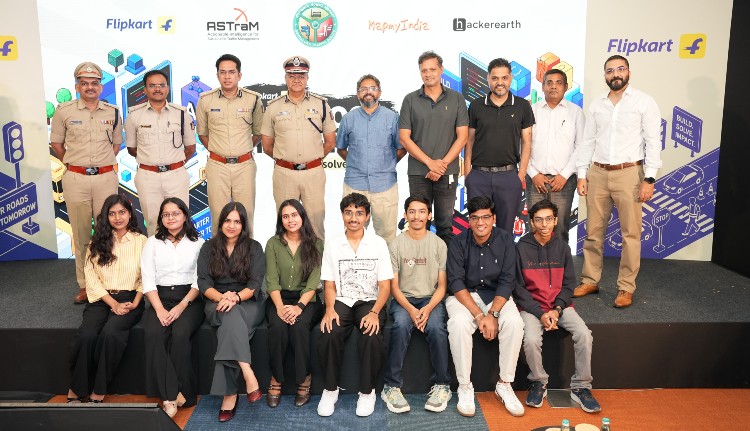

Bengaluru’s chronic traffic congestion has long been a case study in how fast urban growth can outpace infrastructure — and now it’s becoming a proving ground for applied AI. Flipkart, working with the Bengaluru Traffic Police and a set of technology partners, has wrapped up Gridlock Hackathon 2.0, an initiative that pulled in 33,600 registrations from students, developers, and working professionals to build machine learning solutions aimed at the city’s mobility problems.
The scale of participation, and the more than 1,100 prototypes it produced, points to a broader trend among large enterprises: treating internal or partner data as a platform for external innovation rather than a closely guarded asset.
A data platform built for controlled access
Central to the hackathon was ASTraM (Actionable Intelligence for Sustainable Traffic Management), a platform designed and implemented by engineering and design consultancy Arcadis for the Bengaluru Traffic Police. ASTraM gave participants access to curated, anonymized traffic datasets for model development while enforcing data privacy and security controls — an approach that mirrors how many enterprises now stand up sandboxed data environments to let external developers experiment without exposing sensitive systems.
Flipkart ran the competition alongside MapmyIndia and HackerEarth in addition to Arcadis and the traffic police, combining mapping data, hackathon infrastructure, and domain expertise from urban-mobility engineers. The competition followed a two-stage structure: an initial online machine learning challenge, followed by prototype development for shortlisted teams.
Three winning approaches to a hard optimization problem
The results reflect distinct angles on the same underlying challenge — allocating scarce traffic-management resources in real time:
Gridlock Oracle (first place) uses a Hawkes Process model — a statistical technique for modeling events that trigger further events — to predict how a single traffic incident can cascade into city-wide gridlock. The system feeds a live control-room dashboard so officers can reposition resources before congestion spreads, rather than reacting after the fact.
PRAHAR (second place), short for Predictive Resource Allocation for High-Impact Area Response, is a software-only platform that layers multiple machine learning models to forecast congestion severity, junction-level risk, incident resolution time, and downstream cascade effects. It then recommends where to deploy officers, barricades, diversion routes, and dispatch stations.
ParkSight (third place) took a narrower but practical angle, mining parking violation records to identify enforcement hotspots and forecast congestion tied to illegal parking, with its predictions validated against ASTraM’s live congestion data.
The three teams split a prize pool of ₹5,00,000 (roughly $6,000), with ₹2,25,000 for first place, ₹1,75,000 for second, and ₹1,00,000 for third.
Speaking at the finale, held at Flipkart’s Bengaluru headquarters, Rajneesh Kumar, Chief Corporate Affairs Officer at Flipkart Group, framed the effort as a case for cross-sector collaboration on problems too complex for any single organization to own. He argued that pairing public-sector data and domain knowledge with outside technical talent produces approaches an internal team alone might not reach, and pointed to the scale of participation as evidence that opening real-world problems to a broader developer community has value.
Bengaluru Police Commissioner Seemant Kumar Singh and Joint Commissioner of Police (Traffic) Karthik Reddy attended as chief guest and guest of honor, respectively, alongside Flipkart CFO Ravi Iyer and senior technology and supply chain executives — a signal of how seriously both the company and city law enforcement are treating the initiative’s outputs.
This is Flipkart’s second run at the format. The first Gridlock Hackathon, in 2017, drew close to 3,000 registrations and produced a dynamic traffic-signal-switching approach that, when tested at Bengaluru’s Silk Board Junction, cut wait times by roughly 17%. The jump from 3,000 to 33,600 registrants — and from a single winning concept to over 1,100 working prototypes — illustrates how much deeper the pool of AI/ML talent and tooling has grown in under a decade, and how much more comfortable both companies and government agencies now are opening real operational data to external innovators.