

The Internet is becoming machine-first. Are enterprises ready?

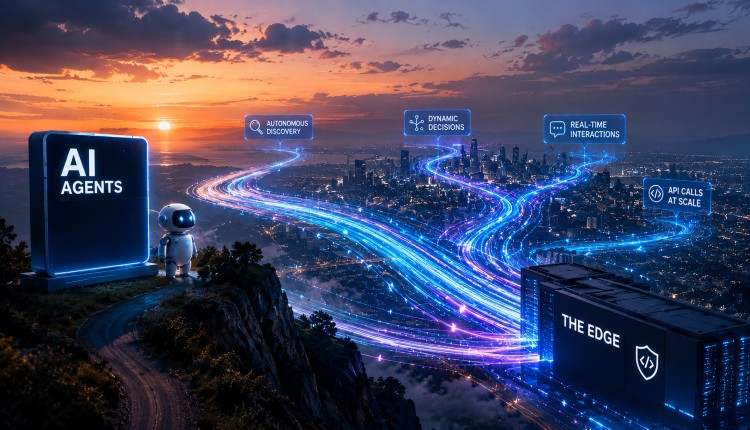

For decades, the Internet was designed around a relatively simple assumption: people are the users. People open applications. People search websites. People stream video. People buy products. People interact with digital services. That assumption is rapidly becoming outdated.
AI agents are emerging as a new class of internet users—ones that can make requests continuously, access multiple sources simultaneously, compare information and take actions on behalf of humans.
The implications go far beyond the AI model itself. They reach into the network, cloud infrastructure, cybersecurity, application architecture and, ultimately, the economics of running digital businesses.
That was one of the most striking themes to emerge from a recent media roundtable with Fastly executives Artur Bergman, Founder and CTO; Scott Lovett, President, Go To Market; Smita Satyavada, Area Vice President, India; and Nicola Gerber, Vice President, Asia Pacific & Japan. Fastly’s own research published in June 2026 found that AI requests on its network grew about 30% between January and May, approximately 6.5 times faster than human traffic. The company also said autonomous machine-to-machine traffic was approaching half of all internet requests.
The numbers point to a fundamental change: the next major Internet traffic surge may not be caused by millions of new human users. It may be caused by billions of machine interactions.
AI is changing the shape of Internet traffic
The difference between human and machine traffic is important. A human typically waits for a page, reads it and decides what to do next.
An AI agent can send requests to multiple sources at once, retrieve information, compare responses and make another set of requests almost immediately.
That creates a much more dynamic workload. “The world is moving faster, it’s harder to predict, so we need to become more flexible,” said Artur Bergman, Founder and CTO, Fastly, during the roundtable.
That flexibility may become one of the defining characteristics of AI-era infrastructure.
Traditional capacity planning often relied on historical traffic patterns and relatively predictable growth. AI changes that equation because demand can suddenly accelerate in ways that are difficult to forecast.
Fastly’s own data reinforces the point. The company says AI traffic grew 30% between January and May 2026, 6.5 times faster than human traffic. More than half of AI requests in May required access to origin infrastructure, compared with less than 9% of human requests.
For CIOs, this raises a difficult question: What happens when the infrastructure built around human traffic has to suddenly accommodate an internet increasingly populated by machines?
The edge moves from delivery layer to decision layer
The answer may not simply be more cloud infrastructure. One of the strongest arguments emerging from the discussion is that the edge could become a much more important component of the AI infrastructure stack.
Today, many enterprises still think of the edge primarily as a way of delivering content faster.
That definition is becoming too narrow.
“The edge becomes more important because that is the cheapest place to serve your application or your bot,” Bergman said. He also argued that it is an effective location to secure and rate-limit traffic and determine which cloud should receive different types of requests.
That suggests a significant architectural shift.
The edge is evolving from a delivery mechanism into an orchestration and control layer.
AI agents could make latency even more important
There is another counterintuitive consequence. Many expected AI to make traditional web performance less important because users would increasingly interact with AI assistants rather than individual websites.
The opposite may happen. An AI agent that is searching multiple websites or APIs can compare response times. If some sources respond quickly and others are slow, the agent may favour the faster ones. That makes latency a competitive variable—not simply a user-experience metric.
“I don’t think agents will make performance less relevant,” Bergman said. “I think in fact, it will make it even more important.”
For enterprises, that has a profound implication. A slow application may not simply frustrate a human customer.
It could increasingly become invisible to the machines making decisions on behalf of that customer.
India is an unusually important test case
India brings an additional dimension to this transformation. The country combines a massive digital population with rapid mobile adoption, growing 5G usage, a large startup ecosystem and increasing AI experimentation.
Fastly executives described India as a particularly attractive market because of its young, digitally native population and the number of companies being built in the country to serve customers globally.
Smita Satyavada, Area Vice President, India, Fastly, sees the opportunity as extending beyond simply serving Indian users. “We want to democratise the experiences for India,” she said, describing the company’s ambition to provide users with secure, reliable access to digital services wherever they are. That ambition is being accompanied by infrastructure investment.
Fastly said its Indian network expanded from four points of presence roughly 18 months earlier to 62, while capacity increased from approximately 2.2 Tbps in early 2025 to around 28 Tbps. The company says peak utilisation can approach 100% during major events, with normal utilisation around 60%-65%. The implication is bigger than Fastly’s own network.
India’s digital economy is creating exactly the kind of environment in which the next generation of distributed infrastructure will be tested: large-scale mobile consumption, real-time services, digital-native businesses and increasingly machine-generated traffic.
The economics of performance are changing
There is another shift CIOs should pay attention to: performance is increasingly being evaluated as a business outcome rather than a technology specification.
For years, infrastructure decisions could revolve around price per gigabyte, bandwidth costs or cloud consumption. That calculation is becoming more complicated.
Scott Lovett, President, Go To Market, Fastly, argued that customers are increasingly moving away from viewing price as the sole determinant. “Customers have shifted back from price being the number one driver to performance.”
The reason is simple. A cheap infrastructure service that creates outages, poor latency or inadequate scalability can ultimately cost the enterprise much more than the infrastructure savings.
Smita Satyavada framed the issue in terms of total cost of ownership. Enterprises need to consider origin offload, downtime, resiliency and the impact of latency—not simply the price of delivering a gigabyte. She noted that some organisations are seeing edge cache offload of up to 95%.
And perhaps the most striking formulation from the discussion was: “Latency is akin to downtime.”
In an always-on digital economy, that distinction is becoming increasingly difficult to maintain.
Security and AI traffic are becoming the same conversation
The growth of AI traffic also introduces a new security challenge. Not every machine request is necessarily beneficial to an enterprise.
AI crawlers may gather information to train models. AI fetchers may retrieve information to answer individual user questions. Agents may interact with applications to complete transactions.
Some of these activities can create value. Others can consume infrastructure, scrape content or undermine the economics of digital businesses. The challenge for enterprises is therefore not simply to block bots. It is to understand them.
Fastly’s latest research makes a similar point: the company argues that businesses increasingly need to distinguish between machine interactions that should be accelerated, managed, challenged or stopped.
At the roundtable, Bergman said Fastly’s approach is to give customers the tools to make those decisions themselves, including its AI Bot Manager and Content Guard offerings.
That points to a future where security policy, traffic management and performance optimisation converge at the edge.
The infrastructure planning cycle is getting shorter
Perhaps one of the most consequential changes is less visible. It concerns how CIOs plan infrastructure. Historically, large infrastructure investments could be planned years ahead. Traffic patterns were sufficiently predictable to make long-range forecasting useful.
AI makes that increasingly difficult.
Fastly executives said network planning is now becoming more responsive to observed traffic patterns, with capacity being added where demand actually appears rather than relying solely on long-term forecasts.
That is a model CIOs across industries may increasingly have to adopt. Instead of asking: “What will our infrastructure requirements be three years from now?” the more useful question may become: “How quickly can our architecture respond when our assumptions are wrong?”
That is a very different way of thinking about resilience.
Sovereignty will add another constraint
AI is also making data sovereignty and regulatory compliance more complicated.
India’s evolving data protection environment means enterprises increasingly need to understand not just where data is stored, but where traffic is processed, where controls are applied and how infrastructure decisions are made.
Satyavada said Fastly is examining how to support customers with localised control and data planes and potentially sovereign cloud capabilities alongside CDN services.
For CIOs, the lesson is straightforward: Distributed architecture does not eliminate regulatory complexity. It makes understanding the location and flow of data even more important.
Fastly’s India expansion is therefore part of a much larger technology story. The Internet is entering an era in which machines will increasingly consume the internet on behalf of humans. The architecture built for that world will have to be faster, more distributed, more observable and more capable of making decisions close to where requests originate. India—with its combination of digital scale, mobile adoption, AI experimentation and rapidly growing technology businesses—could be one of the most important markets in which that transition plays out.
For CIOs, the strategic question is no longer simply how to support more users.
It is how to build an infrastructure that can support an Internet where the users themselves may increasingly be machines.