




By Shrikant Umrikar
The bots work. Organisations haven’t come to a consensus on what they are worth, who owns them or how to bill for them. That is the real state of enterprise AI.
An Indian services firm was working with a European client on a time and materials contract. People, hours, a rate. A decades old, standard arrangement.
Over the engagement the firm built several bots. Repetitive work, automated properly and it kept running in production.
Look at what that meant commercially. The billable hours that built those bots were spent removing billable hours. The firm was charging the client for the labour needed to reduce the labour it could charge for. No firm does that by choice. It happened because the contract was written for one kind of work while a different kind of work was being delivered underneath it.
Then the ownership question came up. The firm wanted to treat the bots as its own software and take them to other clients. The client refused. Built on our engagement, our processes, our time. Our proprietary software.
The contract had nothing on this. No clause on ownership of automation. No line separating the firm’s underlying framework from the client’s deployment. No licensing terms. When the contract was signed nobody expected the deliverable to be a thing instead of a person’s time.
The firm had nothing to point at. It conceded.
This is a real engagement. The details are anonymised and neither party is named.
That argument is not a contract curiosity. It is where enterprise AI value is actually going missing.
Almost nothing written about the subject looks there.
This has happened before
Marc Levinson wrote the standard history of the shipping container. His central point is not the one people repeat.
The box was ordinary. Levinson describes it as having all the romance of a tin can. Ship lines and railroads had been experimenting with containers for half a century before Malcolm McLean. What mattered was not the object.
Levinson’s argument is that containerisation took decades to pay off for the same reason electrification did. Edison had the incandescent bulb by 1879. Twenty years later, 3% of American homes had electric lighting. The technology was proven long before the benefit arrived.
His explanation for the container is specific. Transportation companies were ill-equipped to exploit it. And their customers had built their operations around a different set of assumptions about cost. Savings on the dock did not become savings in the total cost of transport. Everything around the dock was still arranged for the old method.
The numbers show where the money actually sat. Around 1960, shipping one truckload of medicine from Chicago to Nancy in France cost about $2,386. Roughly half of that, $1,163, was port cost. One expert of the period put it plainly: a four thousand mile voyage could spend half its total cost on two ten-mile movements through two ports.
Levinson is also honest that the freight data from the 1950s to the 1970s is too poor to prove much. He says so directly. Worth noting, because the AI market is currently being described using survey numbers that are not much better.
The point he lands on, crediting the economists Erik Brynjolfsson and Lorin Hitt, is that the economic benefit comes from the organisational changes firms make to use a technology. Not from the technology.
The pricing tells it best. Shipping conferences set rates the way railroads did. A separate rate for each commodity, sometimes two, one measured by weight and one by volume. For break-bulk cargo that had a logic. Some goods were harder to load. Some took more space on board. Different rates recognised different costs.
Applied to containers it made no sense at all. A line’s cost to move a forty-foot container of bicycle tyres was identical to its cost for a forty-foot container of table lamps. The box did not care what was inside it.
The conferences kept the commodity rates anyway. They were run by firms still sailing break-bulk ships. On the North Atlantic, the per-ton rate for a commodity shipped in a container was the same as if it went break-bulk, with a 5 to 10 percent discount for a full container of a single commodity. An acknowledgement that something had changed, applied to a rate card built for the old method.
Mixed cargo was worse. When the Europe-Australia conference set container rates in 1967, a year before containership service opened on that route, it ruled that each commodity in a mixed container would be charged the per-ton rate for that commodity.
Enterprise AI is at the same stage. The models work. The commercial arrangements around them do not.
The double squeeze
Back to the services firm. The ownership fight was only the first problem.
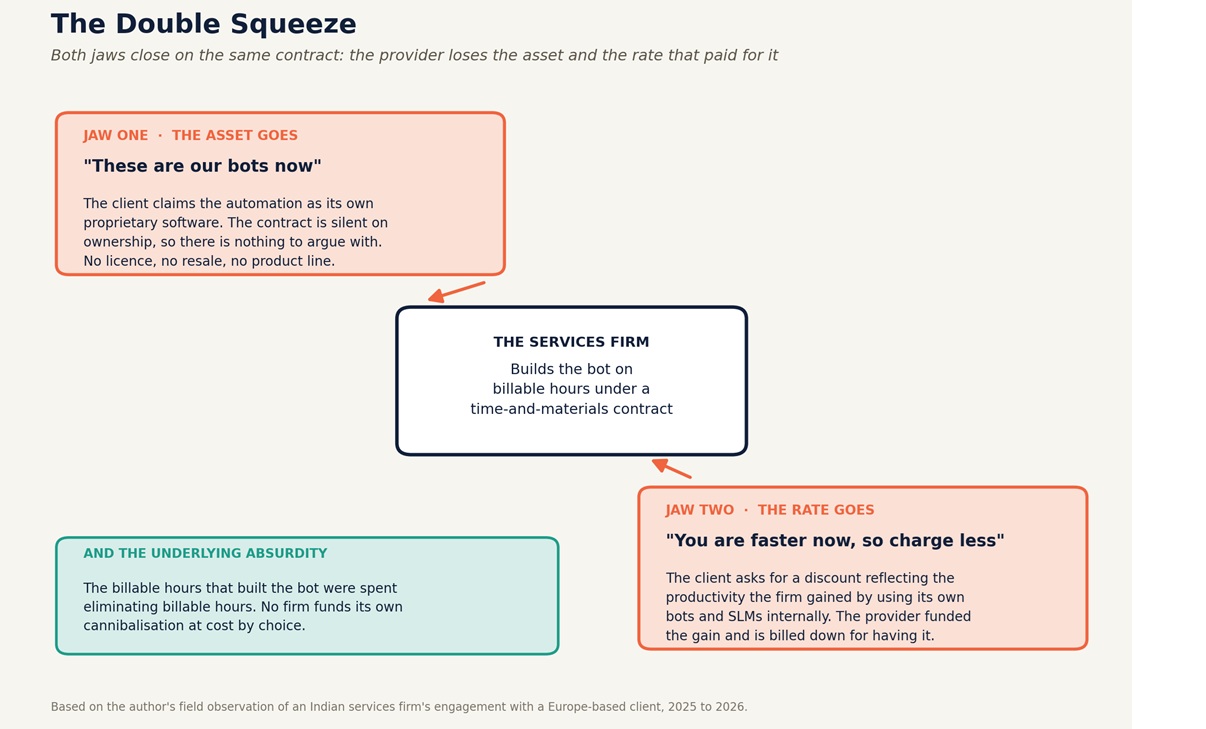
While that argument ran, the same client started asking for rate reductions. The reasoning was that the firm had become more productive. That is true. The firm uses its own bots and its own small language models internally and the delivery is faster.
That request is the 5 to 10 percent discount. An acknowledgement that something has changed, applied to a rate card built for the old method.
So the firm loses the asset it built. Separately, it loses the rate that funded the building. It paid for the productivity gain and is being billed down for having it.
There is no clean way out while the old commercial model holds.
If the bots are to be the provider’s software, licensed back, the client has to agree explicitly. Clients do not hand back something they already hold.
If the provider is to charge on outcomes instead of effort, someone has to define the outcome. This is where it stalls. The client cannot say what improvement the automation will deliver. Not “will not”, Cannot. There is no baseline.
Mixing a services business with a product business is hard. The definitions take months. Both sides are negotiating something neither has done before. It needs pilots, measurement and a negotiated middle ground. That is a multi-quarter exercise.
The Indian services market is now doing this twice over. Frontier models are expensive and compute is expensive, which is why Indian firms did not try to build their own. They are distilling open-source models into small language models tuned for narrow domains instead. These run at a fraction of the cost. Technically it works. The same pricing question then arrives from a second direction, still unanswered.
Nobody can measure it
In the same quarter, analysts asked the heads of two of India’s more AI-forward listed services firms to quantify their AI revenue. Both said they could not.
Coforge’s Sudhir Singh, on the July 2026 call, said the firm cannot call out a number that is AI only or AI standalone. Coforge publishes a figure of 86% of revenue from AI-led engineering, data and integration and cloud. Singh described that figure as an umbrella surrogate. A stand-in for a number that does not exist.
Indegene’s Manish Gupta gave the same answer days later for a different reason. AI is embedded in everything the company does. There is nothing to separate out.
Neither was being evasive. Both were describing a measurement problem honestly.
Now put that next to the statistics everyone quotes about AI failing to deliver.
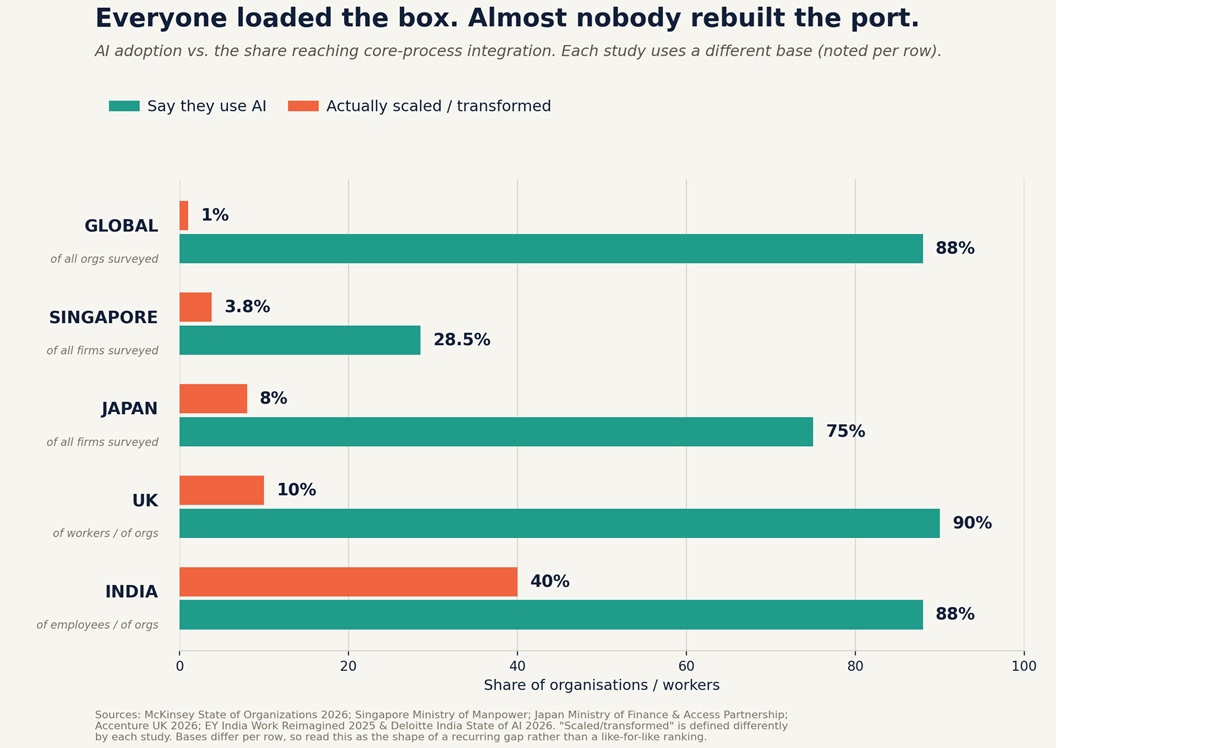 Adoption versus core-process integration, by region
Singapore’s Manpower Research and Statistics Department reports that 28.5% of firms have adopted AI in some capacity. Only 3.8% have fully integrated it into core business processes. Japan’s Ministry of Finance surveyed over eleven hundred companies and found AI use at 75%, up from around 11% five years earlier. McKinsey surveyed more than ten thousand senior executives: 88% experimenting, 81% reporting no meaningful bottom-line gains, 1% calling their rollout mature.
The bases differ across these studies. Anyone using them as a league table is misusing them. What survives is a shape, not a ranking.
MIT’s Project NANDA produced the most quoted figure of all, that 95% of generative AI pilots show no measurable profit and loss impact. That one is contested. The sample is modest. A later working paper argues the headline rates are descriptive rather than inferential. Use it with the caveat attached.
Hold the surveys against the two chief executives. The firms best placed to measure AI’s contribution say the number cannot be isolated. So what is a survey capturing when it asks ten thousand executives whether AI delivered bottom-line impact?
Some of the 81% is real. AI has genuinely not moved the needle in plenty of organisations.
There is a second possibility worth testing. Value gets created in the outsourced middle. The client does not attribute it at organisational level. The provider cannot convert it into differentiated revenue.
Nobody books it, so no survey finds it.
How much of the 81% that accounts for, I cannot say. Nobody can yet, which is itself the problem. But if part of the enterprise AI disappointment is an accounting failure, the fix is different from the one being prescribed everywhere.
Three tiers and which one your contract can see
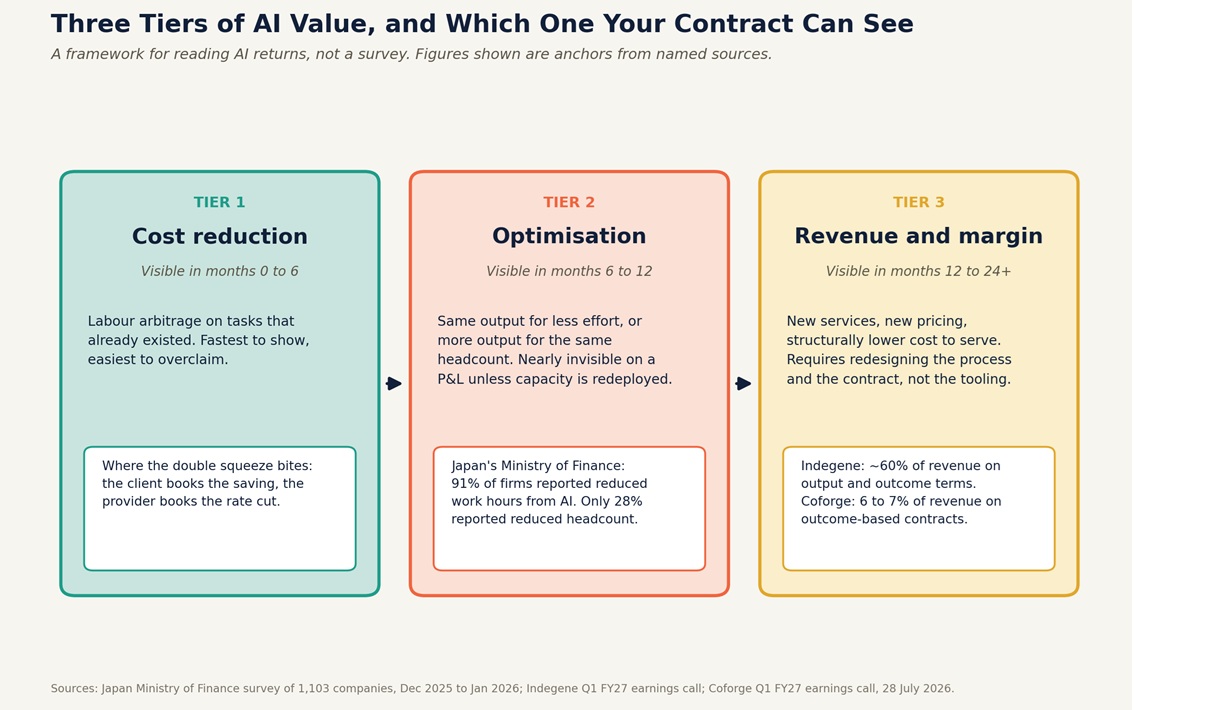
Three tiers of AI value
Tier one is cost reduction on work that already existed. Fastest to show, easiest to overclaim. This is where the double squeeze operates. The client books the saving. The provider books the rate cut.
Tier two is optimisation. Most organisations are sitting here without knowing it, because it barely registers on a spreadsheet. Japan’s government survey caught it exactly. 91% of firms reported reduced work hours from AI. Only 28% reported reduced headcount. The value exists and stays as slack unless somebody deliberately redirects it.
Tier three needs a redesigned process and a redesigned contract, not a better tool. That is the only tier that shows up as durable margin.
Most of the frustration in this market is tier confusion. A board asks tier three questions of a programme resourced for tier one, measured with instruments that cannot see tier two.
What is actually working
Three listed firms are solving different parts of this. Their earnings calls are more useful than most of the analyst commentary.
Genpact is solving the ownership problem by not building bespoke. BK Kalra was direct about it on the August 2026 call. These are not bespoke agents. Genpact builds productized offerings on its own IP, deployed across clients, sold as multi-year annuitized revenue with a minimum volume commit attached.
Agentic bookings are tracking above $1 billion of total contract value in 2026, five times the prior year. More than half of that is from new clients. Note that this is bookings rather than revenue. The CFO said plainly that very little agentic revenue has landed yet.
The mechanism matters more than the number. Build a bot inside a client’s engagement and you lose it. Build a product on your own IP and license the access. It stays yours. Genpact also said the quiet part clearly: they own the stack, so efficiency gains flow to them. That answers the second jaw.
Their commitment shows in what they are walking away from. Work priced per hour that cannot be converted is being transitioned back to clients, costing roughly two points of revenue growth this year. A firm choosing to shrink rather than stay in the squeeze.
The result is now visible in the accounts. Non-FTE revenue crossed 50% of total revenue for the first time this quarter. Headcount fell around 3% year on year while revenue grew 7%. Gross margin has expanded for thirteen consecutive quarters.
Indegene is solving it by changing which budget it sits in. Manish Gupta’s argument is structural. An IT vendor sits on the cost side of a client’s budget, is bought by the technology organisation, is measured on efficiency and arbitrage and is therefore permanently exposed to cost-cutting. Indegene sits on the commercial side, tied to the products the client wants to grow.
The consequence is the useful part. When AI makes Indegene more efficient, the saving does not disappear into the client’s margin as a discount demand. It gets redeployed as more volume, more content, more channels and comes back as more work.
Roughly 60% of Indegene’s revenue is priced on outputs and outcomes rather than headcount. Gupta’s argument is that efficiency gains then flow to Indegene’s own bottom line, which gives the firm a reason to adopt new technology faster than its peers. Compare that with building bots on billable hours.
Indegene also handles the IP question as standing practice rather than as a fight. Each contract sets out that its systems may learn from client data while the data stays the client’s. Its legal team is trained specifically for it. In the case at the top of this piece, the failure was contractual silence, not genuine dispute.
Coforge is solving the unit problem. Outcome-based contracts are only 6 to 7% of Coforge’s global revenue on a run-rate basis. That is the honest state of the market, at a firm that talks about AI more than most.
What it does with the rest is more interesting. Sudhir Singh described three constructs. Risk-sharing on legacy modernisation. The firm takes less than its effort warrants and earns disproportionately if the programme succeeds. Outcome deals pegged to technology or business measures. And a monthly subscription to what Coforge calls Mod Squads: hybrid pods of people and agents, where the client flexes between named staff and a library of around 130 agents.
That third one is somebody inventing the missing unit.
Coforge announced the model publicly in April. Clients assemble a squad from a library of more than 130 agents. Industry agents handle work like claims triage and fraud detection. Engineering agents handle legacy code reverse engineering and incident tickets. Senior engineers oversee the squad and correct it at decision points. The client pays a fixed monthly subscription.
The pricing basis is the part to read twice. Not hours. Not headcount. Not resolutions. The number of agents deployed, their complexity and how autonomous they are. Coforge’s own operating chief described it as moving from effort-based pricing to an outcome-focused subscription.
That is a new commercial unit. The old services unit was people multiplied by hours. What the work has become is agents and people together, producing capacity against an outcome. Somebody has to put a price on that combination. This construct removes the question of whether an employee or an agent did the work, which is the exact question a rate card cannot answer.
Whether this particular design survives contact with the market is a separate question. The attempt is what matters.
What this still needs
None of these are free.
Outcome pricing moves working capital from the provider to the client. Indegene’s largest pure outcome deal, over $10 million in annual contract value, went live with no fee-for-effort component. Revenue recognition was deferred roughly three quarters while the costs sat in the P&L. EBITDA margin fell to 16.9% against a historical band of 19 to 20%. The mechanism is simple. Costs land as the work is delivered. Revenue waits until the client accepts the outcome. The gap between the two shows up as a margin hit. Somebody has to be able to carry that.
Productizing takes years of investment before it can be sold as a product. Genpact’s flywheel is the output of several years of acquisitions and platform spend.
And one problem is genuinely open. Per-resolution pricing works in customer service because a resolution is discrete, countable and already instrumented. There is no equivalent unit for application maintenance, infrastructure management or claim processing in revenue cycle work. Somebody has to define that unit before the model can travel.
For anyone signing a services contract this year, three things are worth fixing now rather than arguing about later.
Write the ownership split into the contract before any automation is built. Three categories. The provider’s pre-existing framework. The model trained for this client. The outputs. Silence is what cost the firm in the opening example.
Agree what gets measured before agreeing what gets paid. If the client cannot state the baseline, that is the first piece of work, not a reason to delay.
Decide which side of the client’s budget the engagement sits on. Cost side and effort pricing together is the squeeze. Anything else is a way out of it.
The container took fifteen years. Ports had to be rebuilt, ships redesigned and rate structures rewritten before the dock savings became total cost savings. The firms that won were not the ones with the best boxes. They were the ones that worked out what business they were in, then repriced accordingly.
The models are working now. The contracts are not. That is the gap to close.
– Shrikant Umrikar leads India business for JobCTRL, which builds workforce and operations intelligence software. He has spent over a decade in enterprise software sales and delivery across BPO, IT services, GCC and healthcare operations. He is based in Mumbai.