



 By Dr. Amutha Arunachalam, Former Government and CSIR professional
What time is it in India?
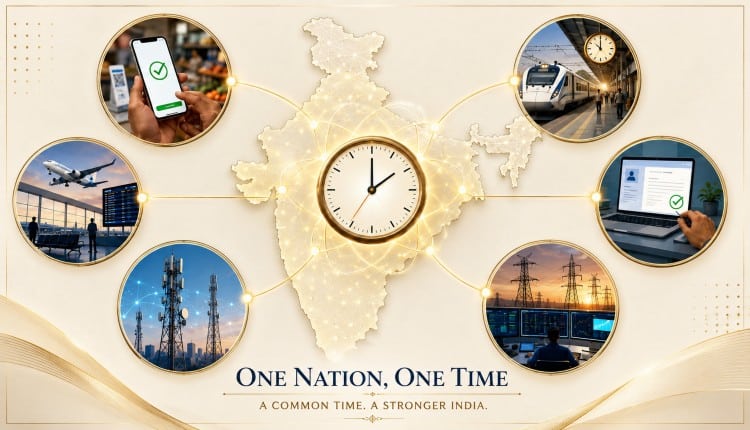
For most of us, the answer appears obvious. We look at a mobile phone, wristwatch, railway timetable or television screen and assume that all of them are showing Indian Standard Time, or IST. In the digital world, however, the question is more complicated. A bank server may obtain time from one source, a telecom network from another, and a computer system from an overseas internet server. Even a small difference between those clocks can matter when millions of digital transactions and records are being created every second.
Recognising this need, the Government of India has notified the Legal Metrology (Indian Standard Time) Rules, 2026. The rules establish IST as the common reference for legal, administrative, commercial and official purposes. They take effect after a 180-day transition period, allowing organisations time to align their systems. For an ordinary citizen, this may sound like a technical regulation. Its real purpose is simpler: to build one trusted national clock for an increasingly digital India.
This need was visible well before today’s rule. In my 2017 Express Computer article, ‘Why a national accurate traceable legal time is crucial for India’s digital economy’, I explained that communications, power grids, financial networks, e-governance, transport and emerging digital technologies all require dependable synchronisation. The notified rules now give that long-standing national requirement a formal legal and operational framework.
Time is now part of our digital identity
Think about an ordinary day. You make a UPI payment, book a railway ticket, submit an online government application, receive your salary and buy something online. Each activity creates a digital record containing a timestamp. That timestamp tells a computer not only what happened, but when it happened.
The sequence can be decisive: was money debited before or after a transaction was cancelled? Was an application submitted before the deadline? When did a banking instruction reach the server? A common, traceable time reference makes such records clearer and more reliable.
Greater protection for banking and digital payments
India’s digital-payment ecosystem processes an enormous number of transactions. Behind every UPI transfer, ATM withdrawal, online purchase or electronic fund transfer is a timestamp. Normally, nobody notices it. When something goes wrong, time suddenly becomes important. If a customer reports an unauthorised transaction, the bank, payment gateway, telecom operator and merchant may each hold separate records. When their clocks are synchronised to an authorised national reference, investigators can reconstruct the order of events with greater confidence. A trustworthy timestamp cannot settle every dispute by itself, but it creates a clearer audit trail and improves accountability for the citizen.
Railways, airports and public services
The same principle applies to transport and public spaces. Railway operations, airline schedules, signalling systems, ticketing platforms and passenger-information systems all depend on coordinated time. The rules require major public locations, including railways, airports and government offices, to display IST synchronised with a traceable source. For a passenger, the benefit is straightforward: the official clock should mean the same thing across connected systems. A few seconds may seem unimportant on a platform, but precise synchronisation can be critical inside a modern signalling, communication or safety network.
A stronger foundation for digital government
Citizens increasingly deal with government through online systems. Income-tax filings, certificates, licences, registrations, welfare applications and grievances all create electronic records. The rules state that references to time in legal, administrative and official documents should use IST unless another reference is specifically permitted.
This supports a basic principle of digital governance: when an official record says that an action took place at a particular time, there should be a nationally recognised and technically traceable reference behind it. Over time, that can strengthen confidence in electronic records and reduce avoidable disputes about deadlines or sequence.
Who keeps India’s official time?
India’s official time is not simply the reading on an ordinary clock. The CSIR-National Physical Laboratory maintains the country’s primary time scale, known as UTC(NPLI). Indian Standard Time is derived by adding five hours and thirty minutes to that scale. The rules provide for accurate time to be disseminated through authorised sources, including CSIR-NPL, Regional Reference Standards Laboratories, ISRO’s NavIC system and other approved services. Developing dependable Indian timing sources also reduces unnecessary reliance on external servers and improves the resilience of critical national systems.
Time is also a cybersecurity issue
Modern cyberattacks do not always target money or data directly. They may also disturb the services on which networks depend. Timing signals can be affected by jamming, spoofing, configuration errors or attacks on servers. If the clocks of critical systems are manipulated, digital logs can become unreliable and operations may be disrupted.
The new framework therefore emphasises security, monitoring, backup arrangements and authorised timing references for important sectors such as banking, telecommunications, power, transport, broadcasting and data centres. Citizens may never see these safeguards, but they use the protected services every day.
You do not need an atomic clock at home
The reform does not mean that families must worry because a wristwatch is two seconds slow. Most changes will happen behind the screen. Banks, government departments, telecom operators, transport networks, data centres and other organisations will need to ensure that time-dependent systems follow an authorised and traceable Indian reference. Citizens receive the benefit without having to master the technology, much as they benefit from electricity standards or internet protocols that remain largely invisible in daily life.
From standard time to trusted time
India has used IST for generations, but the importance of time has changed. In the analogue age, a difference of a few seconds often meant little. In the digital age, millions of transactions, messages and records may be created within those seconds. Time has therefore become part of the country’s digital infrastructure.
A secure Digital India requires not merely the same time, but trusted time: accurate, traceable, resilient and legally recognised. For the common citizen, ‘One Nation, One Time’ ultimately means greater confidence that when India’s systems say something happened at a particular time, that time can be trusted.
Official references
Gazette: Government of India, Legal Metrology (Indian Standard Time) Rules, 2026, G.S.R. 761(E), notified on 27 August 2026.
Government release: Press Information Bureau, ‘Rules to establish Indian Standard Time as common time reference across the country’, 30 August 2026.
Earlier article: Amutha Arunachalam, ‘Why a national accurate traceable legal time is crucial for India’s digital economy’, Express Computer, 23 August 2017.