

The rise of AgriTech 2.0: Why India’s next agriculture revolution will be driven by technology

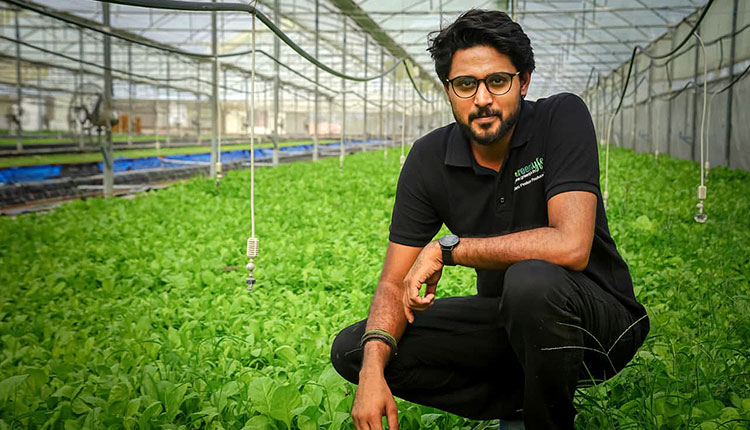

By Arvind Narayanan, Co-founder, Growize Farms
Imagine someplace in India: a farmer is in a field, looking up at the sky and hoping that the monsoon gods will decide to help this year. We’re all used to that situation, but the risks are now higher than ever. In the 1970s, the typical farmer had more than two hectares of land to work; nowadays, however, they have only about one hectare, and that figure is decreasing. At the same time, Indian agriculture uses over 80% of our freshwater resources and drains more groundwater than any other country in the world. Two-thirds of our districts are seeing their water tables fall in a way – this is a surprisingly bad plot twist. With smaller farms, greater thirst, and fewer resources – that’s the new reality for farming in India. It’s no surprise that people have stopped talking simply about producing more and are now concerned about surviving the next major shock.
Just when you thought it might not get any more difficult, climate change is making the situation worse. Recent studies (for example, looking at five decades of data from hundreds of districts) indicate that for every degree the temperature rises, crop yields drop by about 8%. In some bad areas, nearly 40% have been lost! Wheat, rice and maize – things that form the foundation of our diets and our household budgets – are suffering the most. This is not a doomsday scenario for the 2080s. It’s happening now. Adaptation made possible by technology is no longer a luxury; it’s a matter of survival.
The first wave, and its limits
We should acknowledge that India’s initial surge in applying technology to farming, covering tractors, high-yield seeds, drip irrigation, and online marketplaces, has greatly improved life for millions of people. Fintech has finally enabled small farmers to obtain loans and insurance. However, the straightforward truth is that we have mainly made the distribution systems smarter, not the farms themselves. And yet, a huge amount of ₹1.53 lakh crore worth of food is lost each year between harvest and the point it reaches your plate due to leaky cold storage and disorganised logistics. That’s not merely waste; it’s a warning signal. We cannot simply focus on producing more; we have to start by stopping the loss of what we already grow.
What AgriTech 2.0 actually means
That’s the arrival of AgriTech 2.0 – not just a single exciting new gadget, but a complete set of tools. Smart sensors now monitor soil conditions in real time. Drones and satellites survey the land from above, detecting problems before they occur. AI analyses the data to alert farmers about pests or to forecast either a good or a bad harvest. In these advanced greenhouses, hydroponics and aeroponics are used to grow crops using only a small amount of water and land. The real trick is that, rather than being forced to respond to each unexpected situation, we’re learning to avoid them by designing farms that can outwit drought, severe weather, and anything else nature might throw our way.
Capital with a longer memory
Regarding the money: AgriTech hasn’t merely given investors a wild and exciting ride. Of course, more than $6 billion has been invested over the last ten years, but after the euphoric peak of 2021–22, funding dropped by almost 80% in 2023 before slowly recovering. However, that might not be so bad. The gold rush is now over, and only the most capable and resourceful startups are receiving funding. Rather than jumping on the next fashionable idea, investors now want evidence – actual revenue and real results. Growing food is different from developing an app; crops take time, there is genuine risk, and patience is a valuable trait. That is what maturity means.
Where controlled-environment farming fits, and where it doesn’t
Now please don’t worry; traditional open fields are not being phased out. For the majority of India, they will continue to supply the nation for many decades to come. Most new technology will act more as an assistant than a hero. While sleek hydroponics or aeroponics are excellent for growing fashionable vegetables close to large cities (and a great help for delicate crops which usually rot before getting to your fridge), wheat and rice won’t be grown this way on a national level. The real issue isn’t which method is best; it’s using the right technology for the specific crop in the right location. In a country as varied as India, a one-size-fits-all approach is just a myth.
The road ahead
Certainly, gadgets and apps by themselves won’t be enough to solve the problem. High-tech farms require a real investment of money, and many small farmers are still getting started. Just as much as attractive equipment does, training, trust, and clearly established policies matter. The true progress comes about when technicians, bankers, those who draw up rules, and most important of all, farmers – the original innovators. The value of technology depends entirely on the hands (and minds) that put it to use.
India has now demonstrated to the rest of the world how to expand the use of digital payments and public health technology. Isn’t it reasonable that agriculture, being our main source of livelihood, should also receive a similarly ambitious and bold vision? The farmer keeping a close eye on the sky this week isn’t expecting a magic solution; instead, what is emerging is a new kind of resilience: an age in which the weather will still be a factor but won’t determine everything.