




By Mohan Ananthanarayanan, Executive Vice President, Digital Engineering at Indium
Outdated systems drain decision-making momentum instead of crashing the business all at once. They slowly add reverse-engineering tax and technical debt. Before you realize it, that tax compounds, and you’re losing IT budgets that were meant to improve the systems.
In this article, we’ll look at how enterprise debt builds and the steps to fix it in a way that reduces risk without creating more disruption.
When Stable Systems Start Slowing the Business
In large enterprises, outdated digital systems are hard to change, and the friction is structural. Governance spreads ownership across multiple layers, so decisions move slowly.
Funding models prioritize short-term stability. Security and compliance requirements raise the stakes of getting it wrong. These constraints make delay feel safer than progress. Over time, that caution turns a working system into a business constraint.
The Forces That Keep Outdated Systems in Place
Most enterprises keep outdated systems because the cost of change is visible, while the cost of staying the same is scattered and harder to measure. These delays typically fall into three grouped causes:
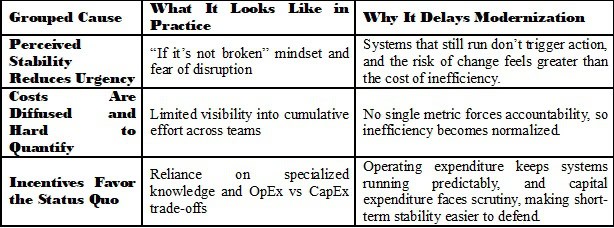
Enterprise Debt: The Price of Deferred Modernization
Outdated systems require custom integrations that are brittle and expensive to maintain. Data often lives in silos that resist modern analytics and automation. This compounding mix of challenges is what turns outdated systems into enterprise debt.
Early Signs of Enterprise Debt
Routine changes trigger layers of approvals and escalations.
Coordination consumes more time than actual delivery.
Progress hinges on availability, not on repeatable processes.
Even clear priorities move slowly once execution begins.
6 Types of Enterprise Debt & The Consequences They Create
Enterprise debt doesn’t stay confined to IT. These categories matter because they affect how debt compounds across multiple layers.
1. Process Debt: Process debt forms when work depends on manual steps and approvals required by system limitations.
2. Architecture and Technical Debt: Tightly coupled systems and custom fixes makes even small changes risky, slow, and difficult to test.
3. Data Debt: Scattered and unreliable data forces teams to validate information instead of using it to make confident decisions.
4. Operating Model Debt: Misaligned roles and ownership create silos, making coordination heavy and change harder to execute.
5. People and Talent Debt: Critical system knowledge concentrated in a few individuals increases dependency, onboarding time, and operational risk.
6. Customer Experience Debt: Internal complexity surfaces as delays, errors, and limited self-service, weakening customer trust over time.
Impact on Enterprise Performance & Growth
When core systems are fragmented, the economic impact shows up as higher operating costs, slower time-to-market, reduced margin flexibility, and stalled growth initiatives.
For example, in manufacturing, disconnected production and supply data leads to poor visibility, inventory imbalance, and missed commitments.
In financial services, outdated systems require manual data consolidation across business units. This increases the risk of reporting inconsistencies.
Enterprises need to adopt a product mindset, treating core platforms as evolving assets with clear ownership, measurable outcomes, and long-term accountability.
AI-driven automation delivers value only when data context and semantic integrity are stable and intact.
Practical Next Steps for Transformation Teams
Before modernization starts, teams need clarity on system behavior, gaps, and dependencies to reduce risk.
Map critical dependencies across systems and data to expose hidden risk.
Focus on one or two priority capabilities first to create measurable progress.
Establish clear ownership to expedite approval cycles and prevent decision bottlenecks.
Capture manual effort and cycle time to quantify inefficiencies.
Align engineering, data, security, and operations early to avoid rework and downstream conflicts.
What Does a Modernization Roadmap Look Like?
Modernization works best when it follows clear progression:
Understand → Stabilize → Decouple → Modernize → Optimize
Understand dependencies, data flows, and embedded business logic before changing anything.
Stabilize priority systems to maintain availability and business continuity during change.
Decouple tightly integrated components so changes in one area do not trigger unintended consequences elsewhere.
Modernize platforms, workflows, and data foundations in coordinated phases to reduce rework and downstream defects.
Optimize by shifting from reactive fixes to planned improvements where impact is assessed before release.
This structure creates the conditions where a product mindset and AI can succeed together.
Your Way to Enterprise Modernization
Understand how your systems run and where they create friction. It reduces risk before change begins and gives leaders confidence in what to fix first. Then move in phases. Prioritize the capabilities that increase business value and build systems that can evolve as fast as the business demands.