


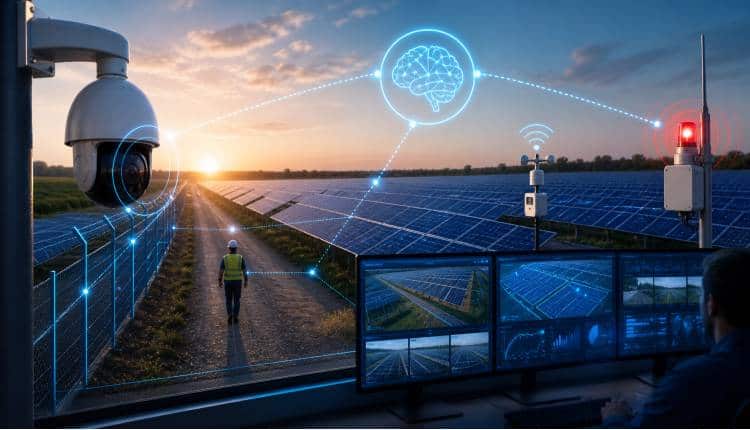

As solar infrastructure scales across India, the focus is rapidly shifting beyond generation to protection, performance, and control. Solar plants today are large, distributed, and often located in remote areas—making them highly exposed to risks such as theft, operational inefficiencies, and safety hazards.
Traditional surveillance systems, built around static cameras and manual monitoring, are no longer sufficient. The real challenge is not visibility—it is the ability to respond in real time and prevent losses before they occur.
 AIVID.AI is addressing this gap by transforming conventional CCTV setups into intelligent, response-driven systems. By integrating AI-powered video analytics, PTZ cameras, and IoT-enabled deterrence into a unified architecture, the company is enabling solar operators to move from passive monitoring to active prevention and operational control, shares Dhaval Vora, CEO and Co-Founder, Aivid.AI
Some edited excerpts:
What are the key risks solar plants face today?
Solar plants combine high-value assets with high exposure. Equipment such as panels, copper cabling, and electrical infrastructure is expensive and spread across large, open environments, often in remote locations.
This creates multiple challenges. Theft is a major concern, with panels and cables being targeted due to their high resale value. At the same time, operational issues such as vegetation growth on panels can reduce energy generation efficiency. Safety risks, including fire hazards, also remain a constant concern.
The challenge is amplified by the fact that these sites are difficult to monitor continuously through manual means, making them vulnerable to both security and performance-related losses.
What is fundamentally broken in current surveillance systems?
Most existing systems are designed to observe, not to intervene. They rely on fixed cameras, generate alerts, and depend on human teams to take action.
In large solar environments, this leads to delays. By the time an incident is verified and addressed, the damage is often already done—whether it is stolen equipment, reduced performance due to vegetation, or escalation of a safety risk. In addition, constant movement of personnel results in excessive alerts, making it harder to identify real threats.
The core issue is simple: systems can see, but they cannot act in time.
How does AIVID.AI address these challenges differently?
AIVID.AI redefines surveillance by embedding response directly into the system. It combines AI, PTZ cameras, and IoT systems into a single, coordinated architecture that enables real-time intervention.
AI continuously analyses live video feeds to detect events such as intrusion, theft attempts, vegetation growth, or fire risks. The moment a threat is identified, AI automatically tracks the activity through PTZ cameras,, and alerts IoT-enabled devices trigger immediate, zone-specific deterrence.
For example, in the case of a theft attempt, the AI can identify the movement in a specific zone and instantly activate a hooter or siren in that area. This immediate response often deters the individual before the act is completed. Similarly, if vegetation begins to obstruct solar panels, the system generates real-time alerts, allowing teams to take corrective action quickly and maintain optimal energy output. In the event of a fire risk, early detection and instant alerting enable faster intervention, reducing potential damage. This creates a closed-loop system where detection is immediately followed by action.
Why is the combination of AI, PTZ, and IoT so critical?
Each component plays a distinct role, but the real value comes from how they work together.
AI acts as the intelligence layer, identifying risks in real time. PTZ cameras provide dynamic coverage, ensuring that once a threat is detected, it is tracked continuously across the site. IoT systems enable immediate on-ground response through alarms or deterrence mechanisms.
Individually, these technologies are limited. Together, they create a seamless flow—detect, track, and act to deter—within seconds. This is what allows the system to move beyond monitoring and become a prevention-driven solution.
How does this impact day-to-day operations at solar sites?
The biggest change is the removal of delay. In traditional systems, alerts are generated and then verified manually, which takes time. With AIVID.AI, the first level of response is automated. Whether it is a theft attempt, unauthorized movement, or operational issue, the system initiates action instantly.
This reduces dependence on human intervention during critical moments and ensures that incidents are addressed before they escalate. It also improves operational visibility, allowing centralized monitoring of multiple sites in real time.
How does the solution improve solar plant performance, not just security?
This is an important shift. The system is not limited to security use cases. It also monitors operational conditions that directly impact performance. For instance, vegetation growth on solar panels can reduce exposure to sunlight and lower energy output.
By detecting such issues in real time and triggering alerts, the system ensures timely maintenance and improved efficiency. This connects surveillance directly to energy generation outcomes, not just risk mitigation.
How does AIVID.AI optimize cost and infrastructure?
Traditional surveillance models rely on deploying a large number of fixed cameras and maintaining dedicated monitoring teams. AIVID.AI replaces this with a more efficient approach. PTZ cameras provide wider coverage, reducing the number of cameras required. AI reduces the need for continuous human monitoring, and IoT automates response mechanisms on the ground.
Importantly, the system works on existing CCTV infrastructure, enabling organizations to upgrade without heavy capital investment. The result is lower infrastructure cost, reduced operational overhead, and improved effectiveness.
How does AIVID.AI handle false alerts in such dynamic environments?
Solar plants have constant movement of employees, contractors, and visitors, which can lead to a high volume of irrelevant alerts. AIVID.AI addresses this through identity-aware analytics and silent face recognition. The system distinguishes between authorized personnel and unknown individuals, ensuring that alerts are triggered only when necessary. This significantly reduces noise and allows teams to focus on genuine risks.
How widely has this solution been deployed?
The solution is already operational across multiple solar sites, with around 15 sites currently live. Deployment is scaling rapidly, with over 200 additional sites expected to go live in the next six months.
Installations span key regions including UP, Rajashthan, Bihar, Maharasthtra, Karnataka, and Gujarat, reflecting adoption across diverse geographies and operating conditions.
Why are financing partners and stakeholders increasingly pushing for such solutions?
As solar investments grow, so does the need for risk assurance and compliance. Given the high value of assets and the remote nature of these sites, financing partners are increasingly insisting on intelligent monitoring systems that can ensure better control, traceability, and risk mitigation. Solutions like AIVID.AI provide real-time visibility, auditability and improved safety and security. This not only protects assets but also strengthens confidence among investors and stakeholders.
Why is this shift becoming critical now?
Solar infrastructure is scaling faster than traditional monitoring models can support. The gap between asset value and protection capability is widening. Enterprises now need systems that can operate autonomously, respond instantly, and scale across multiple locations without increasing manpower.
This makes the transition from passive surveillance to intelligent, automated response systems essential.