


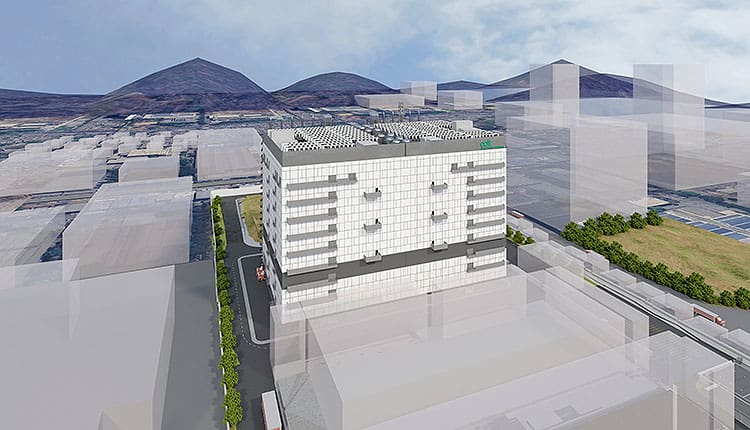

Colt Data Centre Services (Colt DCS) and RMZ have commenced construction of Mumbai 3, a 64MW AI-ready data centre at their Navi Mumbai campus, as demand for high-density computing infrastructure grows with the adoption of artificial intelligence (AI).
The facility has secured its first hyperscale customer and is fully pre-let, according to the companies. It forms part of a $1.7 billion joint venture announced in 2024 to develop data centre capacity in India. The partners have committed to developing 250MW of capacity across Mumbai and Chennai.
Ground preparation for Mumbai 3 began in December 2025, with construction now underway. The facility is designed to support high-density computing and AI workloads through enhanced power infrastructure and a hybrid cooling architecture.
“The nature of data centre demand is evolving rapidly, with customers requiring larger deployments, higher rack densities and infrastructure capable of supporting increasingly intensive AI workloads,” said Pratap Mane, country head, DCS, India, Colt DCS.
“Mumbai 3 is designed to address these needs, further strengthening our Navi Mumbai Campus as a scalable and future-ready digital infrastructure platform,” he added.
Infrastructure designed for high-density AI workloads
Mumbai 3 will combine conventional air cooling with direct liquid-to-chip cooling to support higher rack densities and the thermal requirements of AI and high-performance computing workloads.
The facility will also be supported by a 220kV gas-insulated switchgear (GIS) substation located on campus, designed to provide power resilience and scalability. Carrier-neutral connectivity and access to high-capacity fibre routes will support connectivity requirements for hyperscale customers.
Mumbai 3 will join the existing Mumbai 1 and Mumbai 2 facilities at the Navi Mumbai campus. The campus has the potential to accommodate up to 148MW of capacity at full development. Once Mumbai 3 is completed, the site’s operational capacity is expected to reach 86MW, according to the companies.
The project reflects the growing infrastructure requirements of hyperscalers and emerging cloud providers, which are seeking larger deployments, greater power availability and cooling systems capable of supporting increasingly intensive computing workloads.
Deepak Chhabria, president, RMZ Digital Infrastructure, said the development is intended to help hyperscalers and neo-cloud providers expand as their capacity and computing requirements evolve.
“This investment reinforces our commitment to building advanced data centre and AI infrastructure that meets global standards and supports the rapidly evolving demands of the digital economy,” he said.
Renewable energy and water-efficient cooling
The facility is designed to operate entirely on renewable energy and incorporate a closed-loop cooling system intended to bring wastewater from the cooling process close to zero.
The companies said sustainability and local economic impact are key considerations in the development. Mumbai 3 is expected to create more than 700 jobs across construction and operations, while generating opportunities for local suppliers, contractors and service providers.
The closed-loop system is intended to reduce water discharge associated with cooling, while the hybrid architecture supports the facility’s high-density computing requirements.
Part of a wider India expansion
The Mumbai 3 development builds on the partnership between Colt DCS and RMZ, combining Colt DCS’ data centre development and operational expertise with RMZ’s experience in Indian real estate and infrastructure.
Under their joint venture, the companies plan to develop a combined 250MW of data centre capacity across Mumbai and Chennai. The broader investment is aimed at expanding infrastructure to support India’s growing digital economy and demand for AI-ready capacity.
Colt DCS operates data centres for hyperscalers and large enterprises, with facilities across the UK, Europe and the Asia-Pacific region. RMZ develops and operates real assets and digital infrastructure across India.