

Inner Sky Labs Launches India-Built Foundation Models to Help Physical Machines See, Think and Move Safely Around People

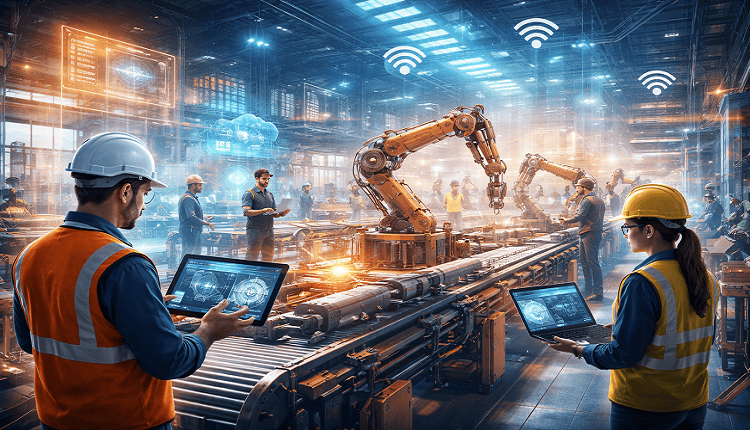

Inner Sky Labs today announced the launch of a comprehensive stack of foundation models designed to enable physical machines to perceive their surroundings, make decisions and act safely around people. Developed in India over more than a decade of research, the platform brings together perception models, action intelligence and an independent safety layer, Kavach, to help machines operate reliably in environments where human safety is paramount.
From construction sites in Delhi and warehouses in Bhiwandi to farms in Punjab and automotive manufacturing facilities in Stuttgart, physical AI has the potential to transform how people work alongside machines. While language models have advanced rapidly, physical environments demand additional capabilities: machines must understand the world around them, anticipate the consequences of their actions and operate within clearly defined safety boundaries.
Inner Sky Labs’ platform addresses these requirements through three integrated capabilities: sensing, decision-making and independent safety enforcement.
Teaching Machines to See, Hear and Feel
Before a machine can act safely, it must understand what is happening around it. Inner Sky Labs’ perception models are designed to help machines interpret their environments across multiple sensory inputs.
The Drishti series of vision models enables machines to interpret visual scenes. The Shruti series of audio models processes sounds, including spoken instructions and environmental events. The Sparsh series of tactile models is designed to give machines a functional sense of touch, helping robotic systems distinguish between objects that require different handling approaches, such as an egg and a wrench.
Together, these models aim to move machines beyond basic sensor inputs towards a more comprehensive understanding of the environments in which they operate.
Enabling Machines to Decide, Act and Anticipate
Perception alone is not enough. Machines must also determine what to do next and anticipate the potential consequences of their actions.
Inner Sky Labs’ action intelligence models — Kriya, Prana and Karma — provide generative intelligence for planning and executing physical movements, including reaching, gripping, walking and flying. They are also designed to support predictions about what might happen as a machine acts, helping it account for changing surroundings and the potential effects of movement on nearby people and objects.
By incorporating anticipation into the decision-making process, the models aim to help machines plan actions with greater awareness of their physical context.
Kavach: An Independent Layer for Safety Enforcement
Even a machine that accurately perceives its surroundings and makes informed decisions can still select an unsafe action. Inner Sky Labs has developed Kavach, named after the Sanskrit word for ‘shield’, to address this challenge.
Kavach is designed as an independent safety layer that evaluates a machine’s proposed actions before they are executed. It can enforce defined safety rules and block actions that do not meet the applicable conditions, regardless of the decision made by the machine’s other models.
For example, before a robotic arm moves across a factory floor, Kavach can check whether the intended operating space is clear of people, whether the proposed speed is appropriate for the area and whether the movement remains within its authorised operating zone. If an action violates the applicable rules, the system is designed to prevent that action from proceeding.
This approach places safety enforcement before execution, rather than relying solely on alerts or reviews after an action has taken place.
A Decade of Building Trust, Now Applied to Physical AI
Inner Sky Labs is the company behind Miko, the companion robot that has spent the past decade engaging and educating children to support the development of their social-emotional skills. Miko is now present in more than 140 countries.
The experience of building safety systems for a robot designed to interact with children has informed the company’s broader approach to physical AI. The underlying principle is that machines operating close to people must function within clearly defined boundaries and be subject to enforceable safeguards.
In an independent evaluation conducted by BDO’s cyber security practice, Miko’s safety system identified every unsafe prompt across seven public AI safety benchmarks and ranked first in flagging unsafe AI responses, outperforming four widely used commercial AI models in the evaluation.
Building on this experience, Inner Sky Labs is extending its safety approach to a wider range of physical machines, including industrial robotic arms, delivery robots and drones.
Enabling Local Control Over Machine Safety
As machines become more prevalent in hospitals, factories, public spaces and homes, the rules governing their behaviour will become increasingly important. Different countries, industries and operators may have distinct legal requirements, operating conditions and expectations for safety.
Inner Sky Labs’ platform is designed to allow end customers and relevant authorities to define their own safety rules, including rules expressed in their own legal and operational contexts. The aim is to enable machines to operate according to locally defined requirements without relying entirely on the judgement or policies of an external technology provider.
Developed in Mumbai through more than a decade of research by IIT Bombay alumni, the platform reflects the company’s ambition to build physical AI technology in India for deployment around the world.
The full stack is already running in factories, classrooms and consumer products used in millions of homes, according to the company.
“Every robot company will eventually have to answer one question: why should anyone trust this machine near a person? For ten years, our answer was Miko — a robot trusted enough to be left with a child. Today, we’re answering that same question for every kind of machine, with technology built, tested and proven in India,” said Sneh Vaswani, co-founder and chief executive of Inner Sky Labs.
“I’ve advised Sneh and the team since 2016, when they first shared this multi-decade vision with me — long before ‘Physical AI’ was even a category. Today, Physical AI is being called a $50 trillion opportunity. I am proud to see this built in India for the world. Miko was the proof point. This is the scale-up,” said Keshav R. Murugesh, early investor and adviser to Inner Sky Labs, and former chairperson of NASSCOM.
Availability
The Inner Sky Labs platform is available today to qualified partners by invitation. Deployment options include cloud, on-premises and on-device configurations, including fully offline, air-gapped environments for operators that cannot depend on external network connectivity.
The perception models, action intelligence models and Kavach safety layer are also available individually, allowing partners to adopt the capabilities relevant to their requirements.
Inner Sky Labs has raised more than US$80 million to support its frontier research, with investors including Chiratae Ventures, IvyCap Ventures, YourNest Venture Capital and 360 ONE