

Express Computer’s 2nd edition of the GCC Conclave captures India’s shift from execution hubs to global decision engines

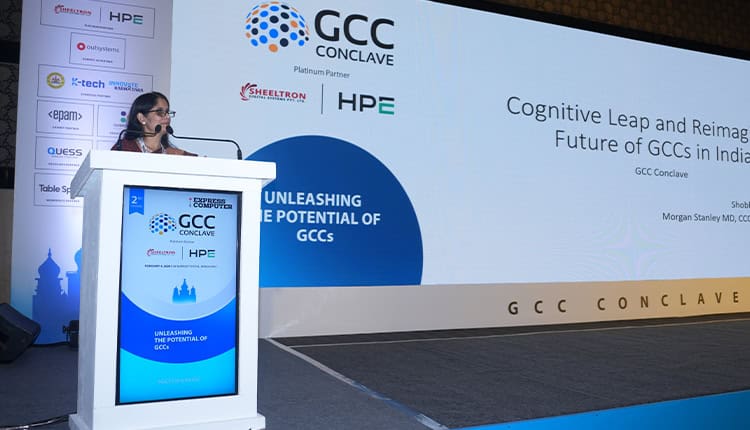

The second edition of Express Computer’s GCC Conclave held earlier this week on 4 February, 2026 at JW Marriott, Bengaluru, captured the essence of India’s GCCs as the face of India’s innovation capability and capacity. The conclave brought together leaders from top GCCs to explore how India is moving from a delivery-focused model to one that drives global business strategy. What dominated the conversations was no longer scale or efficiency, but ownership, influence, AI-led transformation, and IP creation.
Setting the context, Shobha Jagatgpal, MD & India CISO, Morgan Stanley, made it clear that the traditional execution narrative has run its course. “India must transition from being a GCC execution hub to becoming a business-leading, revenue-generating, innovation-driving force in global technology sectors,” she said, framing the day’s discussions around ambition rather than optimisation.
That ambition found resonance in Malahar Pinnelli, VP & Country Leader, 7-Eleven Global Solution Center – India, who spoke about how GCCs evolve when leadership and ownership are intentionally built. He noted that the journey mirrors India’s IT services success, combining talent depth, strong business processes, and an innovation mindset to move from cost efficiency to strategic relevance.
Leadership relevance itself emerged as a subtle but powerful theme. Aditya Guthey, AI and Leadership Speaker and Trainer at WhoWeAreLLC, argued that presence and context-setting define global influence. “Mastering ‘demowitz’ for relevance elevates you from a participant to a room leader,” he said, underscoring how GCC leaders can shape decisions rather than merely execute them.
As the discussion moved toward enablers of this shift, technology infrastructure took centre stage. Ranganath Sadasiva, CTO, HPE India, explained how enterprises are rethinking cloud choices. “Our private, full-stack cloud delivers a public cloud experience with sovereignty, compliance, cost benefits, and seamless hybrid connectivity across 24-plus clouds,” he said, highlighting how infrastructure decisions increasingly underpin business agility.
Operational resilience was equally critical. Rahul Parekh, Marketing Head, Sheeltron Digital Systems, spoke about the need for scale with reliability, pointing to Sheeltron’s pan-India footprint, 24/7 support model, and deep engineering bench servicing sectors ranging from BFSI and healthcare to telecom and hyperscalers.
AI dominated the discourse, but with realism. Krishna G, Country Head – Solution Architecture, OutSystems India, cautioned against assuming GenAI is enterprise-ready by default. “GenAI is probabilistic, but enterprise applications demand predictable, rule-based outcomes,” he said, highlighting a gap that organisations must consciously design around.
At the same time, Krishnaji Desai, VP of Engineering, Epsilon India, highlighted how AI is accelerating innovation within India teams. He observed that faster, AI-enabled development cycles and role convergence are dramatically increasing speed and impact, making quality, not volume, the defining metric of success.
This transition from delivery to ownership was explored deeply in the panel “From Project Delivery to IP Creation – How GCCs Can Build Patents, Platforms and Products for Global Revenue Impact” moderated by Srikanth RP, Editor, Express Computer.
Pawan Choudhary, CTO, Zinnia India, emphasised focus and intent. “Successful GCCs thrive by prioritising quality over scale and empowering teams with autonomy and long-term career paths,” he said.
For Lalit Mittal, VP – IT, State Street Investment Management, the shift is fundamentally cultural. He noted that GCCs are moving toward value creation models where deep business understanding and architectural leadership become sources of competitive advantage.
Srinivas Chamarthy, SVP Engineering & India Site Lead, Diligent, added that innovation emerges only when teams move from task execution to end-to-end ownership, deeply understanding customer needs and outcomes. Complementing this view, Guru Thiagarajan, Head of India Technology Centre & CIO at Deutsche Bank, described India’s growing role as a scalable global hub building platforms that operate across markets and time zones.
The panel “AI-Native GCCs – Redesigning the Enterprise Around AI, Not the Other Way Round,” moderated by Nagalaxmi Shetty, VP Clinical Data Science & India Country Head, ICON, explored how AI is reshaping enterprise power structures.
Pooja Singh, VP & Head of India & Global Business Services, Teva Pharmaceuticals, observed that as AI-driven decisioning moves closer to data and models, GCCs are becoming strategic thinking arms of the enterprise.
George Inasu, MD & Country Head, Fidelity National Financial India, pointed to a deeper shift. “AI changes software from deterministic to probabilistic, democratising creation beyond coders,” he said, stressing the need for domain expertise and risk-aware collaboration.
According to Arun Kundra, SVP, Encora, this is why AI-native GCCs are emerging first as experimentation hubs rather than scale engines. GNV Subba Rao, Global Head of Operation Center, Process Automation, ABB, added that sustained success in AI-driven environments requires deep domain expertise combined with continuous cross-skilling.
The human impact of AI took focus in the panel “Human + AI Workforce Model – Redesigning Roles, Skills and Career Paths for an AI-Augmented Future,” moderated by Sreedevi Hegde, MD & Board Member, Vervent.
Vybhava Srinivasan, Managing Director, Availity India, summed it up succinctly: “AI should automate routine work while humans focus on judgment, decision making, and creativity.”
Rency Mathew, MD India & APAC ANZ People Leader, Sabre Corporation, reinforced that AI is redefining human value rather than replacing it, while Prakash Kumar, Head of Corporate IT, Carl Zeiss India, highlighted the mindset shift needed to clearly separate machine tasks from human judgment.
Extending this human-centric view, Nilesh Dipak Karani, MD – Capability Center, Waters Corporation, highlighted that GCC effectiveness depends on decentralised empowerment. He observed that GCCs succeed when mindset change happens at the grassroots rather than around a single leader, enabling developers and teams to work directly with customers and business functions to deliver truly customer-centric innovation.
Rengarajan Thiruvengadam, Senior Director – Operations, TransUnion GCC India, spoke about AI freeing teams from repetitive work, and Nithya Subramanian, Sr Director – Data & AI COE, Best Buy, stressed that accountability and ethical responsibility must always remain with humans.
Looking ahead, speakers converged on a shared vision. Manu Dhir, Global Head of GCCs, StoneX Group, stated that “the future GCC is not a delivery centre, but a global enterprise decision and product platform.”
Rajasundaram Subramanian, Vice President of Technology, Avekshaa Technologies, highlighted how performance engineering and observability are now foundational to revenue protection. Arun Kalyanaraman, VP – Engineering, Target in India, pointed to India’s growing credibility, noting that global companies now visit Indian GCCs to learn how to build and transform operations.
From an ecosystem lens, Jamshed Taraporwala, Executive Director – Enterprise Sales & BD, Table Space, spoke about India’s evolving real estate and workspace models enabling large-scale GCC expansion. Kapil Joshi, CEO, Quest IT Staffing, observed that AI-led GCCs will win only when experimentation translates into execution, while Aditya Jayaraman, Sr VP & Country Head – India, Hexaware, highlighted Tier-2 cities as the next growth engines. Closing the loop, Kamal Sharma, Digital Transformation Leader & Head, Carrier Digital Hub India, reminded that AI delivers value only when expectations, execution, and outcomes are aligned.
The 2nd edition of Express COmputer’s GCC Conclave ultimately underscored a decisive shift: India’s GCCs are no longer just supporting global enterprises, they are increasingly owning outcomes, shaping strategy, and driving innovation on the global stage.