

Agentforce World Tour: Public sector financial enterprise dialogue spotlights how agentic AI and cloud could redefine the future of Indian enterprises

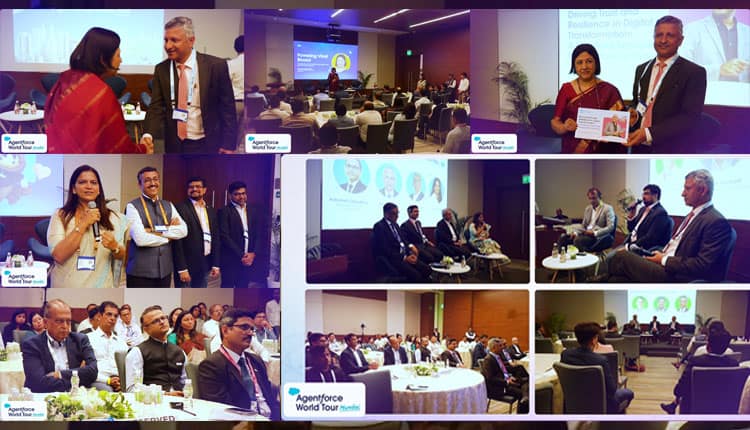

Leading public sector financial enterprise executives had gathered in Mumbai recently to deliberate upon the role played by AI, cloud technologies, and agentic technologies to define the operating model of Indian financial institutions. The discussions, held as part of Salesforce’s Agentforce World Tour, focused on the future of public sector enterprise, cloud confidence, customer experience, and the transition towards agentic enterprises.
The event featured keynote sessions and strategic discussions led by Arundhati Bhattacharya, CEO & President, South Asia, Salesforce, along with senior Salesforce leaders, including Sonali Kalyanikar, AVP – Financial Services, Salesforce India; Deepak Pargaonkar, VP – Solution Engineering, Salesforce; Chetan Sansare, Senior Director – Security and Regulatory Compliance, APAC, Salesforce; and Mithlesh Razdan, Director, Solution Engineering Salesforce who led the technology demonstrations around agentic banking workflows. The discussions also brought together senior banking leaders, including Abhay Pandey, CIO, State Bank of India; Ashutosh Choudhury, Executive Director, Indian Bank; and Sharad Saxena, banking advisor and consultant, alongside Kunal Pande, Partner, KPMG.
What emerged through the sessions was a strong consensus that banking and financial services in India is approaching a structural transformation, not merely through digitisation, but through a rethinking of how banks operate, interact with customers, process decisions, and scale services in an AI-first era.
Setting the tone, Arundhati Bhattacharya drew parallels between the evolution of autonomous systems and the future of enterprises. Using the example of self-driving vehicles in San Francisco, she explained how technology fundamentally changes not only the experience layer but also the entire operating architecture underneath. The message was clear: agentic enterprises would not simply automate existing financial workflows but transform the very structure of organisations themselves.
The discussions repeatedly returned to one central point: agentification would happen far faster than traditional digital transformation cycles. Unlike previous digitisation journeys that took decades, it was seen by the leadership team that an AI-based enterprise transformation journey could be achieved in months, compelling firms to re-evaluate their processes, governance, infrastructure, and interactions with customers simultaneously.
Another critical issue discussed at the discourse was cloud adoption for highly regulated industries. The senior leadership from Salesforce, along with members of KPMG, shared a discussion paper on regulatory alignment for Salesforce cloud services in accordance with the regulations of RBI, SEBI, and IRDA. It was aimed at providing an answer to one of the key questions raised by public sector organisations: can clouds offer the required levels of security, compliance, and governance?
There was quite a bit of challenge thrown to the long-held assumption of on-premise solutions having inherent advantages when it comes to security. The point raised by various speakers was that security issues of the current age were not hardware-based but involved logical aspects and continuous threat management and security measures. They highlighted how hyperscalers and SaaS companies have global security operations running 24×7 that can spot any loopholes, enabling faster detection and response to vulnerabilities.
Another aspect of the discussion highlighted that AI in the coming years would increasingly rely on cloud-based infrastructure. It was mainly driven by the compute and storage demands and the scalability of the solution. Speakers emphasised that organisations seeking to build agentic capabilities would eventually need infrastructure models capable of supporting continuous AI workloads and real-time decision-making.
At the same time, the sessions acknowledged the hesitation many public sector institutions continue to face around cloud adoption. Kunal Pande, Parner, KPMG and Chetan Sansare, Sr. Director, Salesforce explained that Indian regulations do not prohibit cloud usage but instead place emphasis on data localisation, risk management, auditability, and shared responsibility frameworks. The discussions reinforced that security in cloud environments must be viewed as a partnership model where both cloud providers and regulated entities operate within clearly defined responsibilities.
The concept of “shared responsibility” became one of the central themes of the afternoon. Salesforce security leaders explained the distinction between “security of the cloud” and “security in the cloud”. Even as the cloud service provider retains responsibilities for infrastructure, platform security, patching, and operational resiliency, regulated entities retain governance over access controls, policies around data, and the handling of customer data.
This conversation also addressed some common misconceptions about multi-tenant architectures in the regulatory context. Executives at Salesforce spoke extensively about the rigorous approach to threat modelling, penetration testing, and security engineering that goes into developing such an architecture and explained how modern multi-tenant solutions are engineered with significant security isolation features and continuous validation practices.
Going beyond infrastructure and regulatory concerns, the conversation soon veered towards customer experiences and operational transformation in financial services.
As Mithlesh Razdan and the Salesforce team pointed out, agentic AI can transform the end-to-end lifecycle of banking, right from the processes of customer onboarding, lead management, service operations, underwriting, contact centre, grievances management, etc. This was demonstrated through various scenarios wherein conversational AI agents can guide customers through the entire journey of onboarding, process documentation, create relevant customer conversations, and provide insights for front-line banking agents.
The discussion made it clear that the banking of tomorrow will be all about engaging customers through conversational, contextual, and personalised interaction.
In particular, one interesting debate arose around financial inclusion and the extent to which agentic AI can help achieve better market penetration among previously untapped customers.
According to Abhay Pandey, CIO, State Bank of India, even public sector banks have continued to function at an unprecedented scale, with their customer base being very diverse, encompassing everything from branch-dependent clients to digitally born individuals. Pandey highlighted that SBI was currently undergoing transformation through the use of process re-engineering and modernisation efforts, such as expanding its private clouds, adopting public clouds for certain workloads, and making investments in state-of-the-art data centres.
However, at the same time, Pandey stressed that organisations should avoid being misled by buzzwords. The future is undoubtedly associated with AI and agentic solutions; however, their goal is not hype but rather improved customer experience, efficiency, profitability, and reduced cost of servicing.
Ashutosh Choudhury, Executive Director, Indian Bank, brought to the conversation a wider banking perspective. He said that the public sector banks should move from a ‘branch-first’ to a ‘language-first’ mode in which AI systems would be able to communicate with customers in their natural language.
He demonstrated how agency-based systems could help in creating financial inclusiveness by studying customer behaviour, analysing the cash flows, predicting the liquidity requirement, and suggesting relevant financial services. Taking small businessmen and agricultural entrepreneurs as examples, he explained how an agency-based system could help move banking services from a mode of service delivery to a mode of wealth creation.
Sharad Saxena described agentic AI as more than a technology upgrade, it represented a fundamental operating model change comparable to the transition from branch banking to core banking decades earlier. According to him, merely layering AI agents over existing processes would not deliver meaningful transformation. Instead, banks would need to rethink workflows, organisational structures, process engineering, governance models, and adoption strategies. He strongly emphasised that future technology projects must become outcome-driven and measurable rather than lengthy infrastructure-heavy implementations with delayed business value.
A major concern during the discussions was organisational adoption. Leaders repeatedly stressed that successful AI transformation would require change management driven from the top rather than isolated technology deployments. Adoption, they argued, could not remain an afterthought once systems were implemented; it had to evolve simultaneously with implementation itself.
The conversations also highlighted how AI could narrow the technology and service gap between private- and public-sector banking over time. Nevertheless, it was warned that for the organisations working within the public sphere, quick actions had to be taken, and they should not let themselves get bogged down by their conventional bureaucracy if they wanted to keep up in such an environment.
Over the course of the discussion, a general concept started to take shape: Banking could well become increasingly invisible over the next decade. The leaders saw that the field of financial services was already integrating itself very deeply within the lives of people through digital payments, QR payments, conversational experiences, and automation.
The Salesforce public sector financial services dialogue ultimately captured a critical inflection point for Indian organisations. The conversations made it clear that the next phase of transformation would not simply be about digitising existing systems but about reimagining financial services around AI-native operating models, cloud-enabled scalability, contextual customer engagement, and real-time intelligence. As agentic AI continues to evolve, public sector institutions now face a defining challenge: not whether transformation will happen but how quickly they can adapt to remain at the centre of India’s financial future.
