



India’s next phase of telecom growth will depend on its ability to build capabilities across artificial intelligence (AI), semiconductors, cloud infrastructure, and advanced manufacturing, according to a new report by KPMG in India.
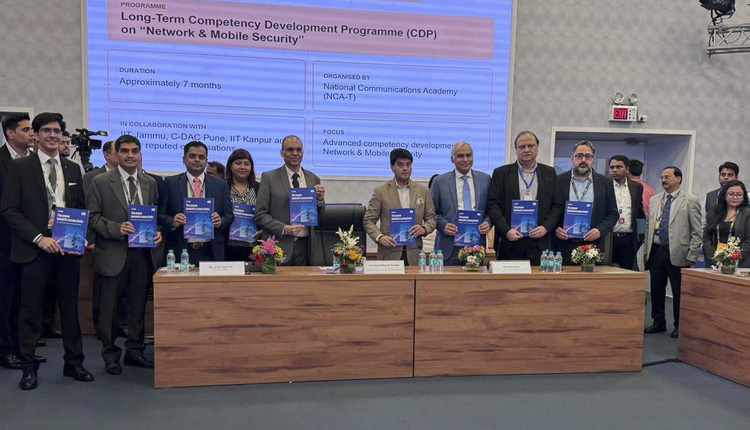
Titled The Power Beneath Connectivity: India’s Path to Telecom Technology Leadership, the report was released at the 10th edition of the India Mobile Congress (IMC) 2026 by Jyotiraditya M. Scindia, Minister for Communications and Development of the Northeastern Region, Government of India. It examines how India can strengthen its position in the global telecom technology value chain.
The report highlights a growing gap between network demand and revenue generation. Mobile network traffic is projected to increase by approximately 17% annually between 2025 and 2030, while telecom operator revenues are expected to grow by just 2.7% a year.
At the same time, India’s telecom equipment market is forecast to expand from $25 billion in FY25 to $50 billion by FY32, growing at nearly twice the rate of the global market.
India has also made progress in domestic manufacturing. Handset production reached ₹6,270 billion in FY26, while import substitution in telecom equipment stood at approximately 60%, reflecting the expansion of local manufacturing capabilities.
Building the telecom intelligence stack
The report introduces the concept of a Telecom Intelligence Stack, which brings together semiconductors, computing infrastructure, telecom networks, data, AI software, models, autonomous operations and applications. This framework highlights the technology layers expected to shape future value creation and competitive advantage in the telecom sector.
According to KPMG, India has developed strong capabilities in software, network platforms and data-driven intelligence. However, further investment is needed to strengthen domestic capabilities in advanced semiconductors and critical hardware.
Initiatives such as the proposed Telecom Manufacturing Zone (TMZ), aimed at developing capabilities in manufacturing, testing, research and innovation, could support India’s ambitions to become a global telecom technology and manufacturing hub.
Akhilesh Tuteja, Partner and National Leader – Clients and Markets and Technology, Media & Telecommunications, KPMG in India, said the convergence of telecom, AI, semiconductors, cloud and digital infrastructure is changing how value is created across the global technology ecosystem. He highlighted the need for sustained investment in innovation, advanced manufacturing and collaboration to help India develop globally relevant technologies, platforms and intellectual property.
Purushothaman K.G., National AI Leader and Head – Technology Transformation, KPMG in India, said India has an opportunity to strengthen its position across the Telecom Intelligence Stack by advancing innovation, expanding domestic capabilities and building a resilient technology ecosystem.
Focus on high-value technology capabilities
The report notes that telecom is increasingly becoming interconnected with AI infrastructure and industrial capabilities. While India has established scale in digital infrastructure and manufacturing, it needs to expand its participation in higher-value segments, including semiconductors, software, radio systems, optical technologies and intellectual property.
KPMG recommends greater investment in research and innovation, stronger domestic technology and component ecosystems, increased intellectual property creation, and deeper collaboration among industry stakeholders.
The report suggests these measures will help translate India’s expanding telecom market and manufacturing base into long-term innovation, greater strategic resilience, and a stronger position in the global technology ecosystem.
