

The weakest link and the greatest asset: Why humans still decide the AI age


On 12 November 2026, Nvidia announced that Jensen Huang had resigned as chief executive. Many press reports have described the departure as following an affair with an alleged Chinese spy, and other outlets reported further allegations of additional relationships. Colette Kress, the chief financial officer, stepped in as interim CEO, and the company’s shares fell.
While these facts are still to be proven, and accounts differ on details, what is not in doubt is the shape of the event: the head of the company that supplies much of the world’s AI hardware left his post not because of a technical failure, a competitor, or a regulatory ruling, but because of a personal vulnerability that created national-security concerns.
This is a lesson we keep relearning: in an age of extraordinary machines, the most consequential vulnerabilities are still human.
The trap that no firewall can close
Nvidia has spent years protecting its chips, its models, and its supply chains with some of the most sophisticated security available. None of it addresses a leader whose private conduct can become leverage. A compromised executive does not need to be hacked. He or she can simply be approached, flattered, entangled, and eventually pressured.
This is the oldest technique in intelligence work, and it predates computers by millennia. In 2012, David Petraeus resigned as director of the CIA over an extramarital affair, a reminder that even the people trained to think like counterintelligence officers are not exempt. What has changed is the value of what a single person can open the door to. Today, one individual’s judgment may sit atop export-controlled technology, trillion-dollar supply chains, and models that shape economies.
The anatomy of a human trap
Whether the target is a CEO or a payroll clerk, human-targeted attacks lean on the same handful of levers:
Trust. We cooperate with people who appear to belong.
Authority. We comply with those who appear to be in charge.
Urgency. We skip verification when we are told there is no time.
Intimacy. We lower our guard with those who seem to care about us.
Shame and secrecy. Once someone has something to hide, they can be controlled by the threat of exposure.
The last lever is the most underestimated. organisations often punish mistakes so severely that people conceal them, and concealment is exactly what a manipulator needs.
Four cases worth studying
Arup, 2024. Employees at the engineering firm Arup’s Hong Kong office were reportedly drawn into a video conference in which the chief financial officer and several colleagues appeared to be present. They were all synthetic. A finance worker authorized transfers totaling roughly 25 million US dollars before the fraud was discovered. The lesson was not that the employee was careless. It was that seeing and hearing a person is no longer proof that the person is real.
Twitter, 2020. Attackers telephoned employees while posing as colleagues from internal IT, obtained credentials, and gained access to administrative tools that let them take over the accounts of prominent public figures. The company’s technology was not breached in any exotic way. Its people were persuaded.
MGM Resorts, 2023. Widely reported accounts described attackers impersonating an employee in a call to a help desk, which led to a disruption of the company’s operations that lasted days. A routine process, a password reset, became the entry point.
Nvidia, 2026. Here the target was not a procedure but a person’s life. The attack surface was personal, and the potential damage was strategic.
The pattern across all four is that the weakness was not stupidity. In each case, ordinary human qualities such as courtesy, helpfulness, deference, and desire were turned into the instrument of the breach.
What the data says
Security researchers have been measuring this for years. Verizon’s annual Data Breach Investigations Report found the human element present in about 68 percent of breaches in 2024, 60 percent in 2025, and 62 percent in 2026, according to published summaries. The figure has barely moved in a period when security technology has improved enormously. The same research reports that third parties were involved in 48 percent of breaches in the latest edition, a 60 percent rise from the year before, meaning your exposure now includes your vendors’ employees.
Why AI sharpens the threat
Generative AI has not invented new forms of deception so much as made old ones cheap. Verizon’s latest findings describe the typical malicious actor using AI across about fifteen documented techniques, mostly to improve the speed, polish, and scale of familiar attacks. A convincing phishing email, a cloned voice, a plausible persona maintained over months: each once required skill and time, and each now requires neither.
The economics are what matter. When the cost of a tailored deception falls toward zero, attackers can afford to target thousands of people with the care once reserved for one. The human being on the other end has not been upgraded, and cannot be.
The other half of the story
If the argument ended there, it would be a counsel of despair. It does not, because human beings are also the best defense we have ever had, and sometimes the only one.
In September 1983, Soviet officer Stanislav Petrov was on duty when his early-warning system reported an incoming American missile strike. The protocol was to escalate. Petrov judged the alert to be a false alarm, reasoning that a genuine first strike would involve far more than a handful of missiles and that the new system could not yet be fully trusted. He was right. A machine reported certainty; a human supplied doubt.
In 2024, the engineer Andres Freund noticed that remote logins on his machine were slower by a fraction of a second. Most people would have shrugged. He investigated, and uncovered a carefully planted backdoor in the widely used XZ Utils compression library, the product of a persona who had spent years earning the trust of the project’s maintainers. The case is instructive twice over: the attack succeeded through patient human manipulation, and it was caught through human curiosity.
The qualities these cases share are not computational. They are skepticism toward one’s own instruments, attention to anomalies that no one asked about, and the willingness to act on a feeling that something is off before it can be proven.
What human intelligence still does better
Human strengths are easy to romanticize, so it helps to be specific. Four of them recur in documented cases, including cases where an AI system did exactly what a person would have caught.
Contextual doubt. In July 2024, a Ferrari executive received WhatsApp messages that appeared to come from CEO Benedetto Vigna, followed by a call in a convincing imitation of his voice. The caller pushed a confidential deal. According to Bloomberg’s reporting, the executive noticed slightly mechanical intonation and asked the caller the title of a book Vigna had recently recommended. The call ended. WPP’s chief executive, Mark Read, was targeted by a similar deepfake attempt that spring, and it also failed. Ferrari’s defense needed no software, only a person asking why is this request arriving now, and in this way?
Judgment under novelty. On 15 January 2009, US Airways Flight 1549 lost both engines to a bird strike soon after leaving New York’s LaGuardia airport. The standard procedures for losing both engines assumed far more altitude and time than the crew had. Captain Chesley Sullenberger and First Officer Jeffrey Skiles had minutes to decide, and they landed the aircraft on the Hudson River. All 155 people aboard survived. A system trained on past patterns has little to go on when a situation has no precedent, while a pilot can reason from physics, experience and what is outside the window.
Accountability. When a machine gets something wrong, someone still has to answer for it, and courts have so far insisted on that. In 2023, two New York lawyers filed a brief citing cases that ChatGPT had invented, and the chatbot had even assured them the cases were real. Judge P. Kevin Castel fined them $5,000 and found they had abandoned their responsibilities, partly because they stood by the fake cases after the court questioned them. In February 2024, a British Columbia tribunal rejected Air Canada’s argument that it could not be held liable for what its website chatbot told a grieving customer, and ordered the airline to pay CA$812.02 in damages and fees. In both cases the model produced the error, and a person or an institution paid for it.
Values and purpose. Machines pursue the objectives they are given, and people decide when an objective is no longer worth pursuing. In October 1962, at the height of the Cuban Missile Crisis, the Soviet submarine B-59 was being pressed by US Navy ships near Cuba. Historians’ accounts say that launching its nuclear-armed torpedo required agreement among the three senior officers aboard, and that the captain and the political officer were in favor. Vasili Arkhipov refused. The outcome turned on one officer’s judgment of what a launch would mean, not on any procedure.
Humans are not the only ones who can be manipulated. Security researchers have repeatedly shown that AI agents reading web pages or emails can be steered by instructions hidden in them, a flaw known as prompt injection. A world that swaps fallible people for systems fooled in different ways is not obviously safer. The manipulation has simply moved.
Designing for people as they are
The practical answer is not to train people harder or to blame them when they fail. It is to build organisations that assume fallibility and make human strengths count. Each of the six measures below has a real precedent.
1. Verify through a second channel. Arup lost about HK$200 million in 2024 after an employee acted on a video call full of deepfaked colleagues, while Ferrari escaped with a personal question. Turn the Ferrari move into policy: call back on a number you already hold, agree a code word in advance, or ask something only the real person would know. Never treat a voice or a face as proof.
2. Split critical authority. In 1995, Nick Leeson, a derivatives trader in Singapore, was also in charge of the back office that settled his own trades. He hid his losses in a secret account, and the total, about £827 million, destroyed Barings, a bank founded in 1762. The missing control was not technology but a second person. Banks, and nuclear weapons crews, now treat dual control as basic hygiene, and no one, including the chief executive, should be able to cause catastrophic harm alone.
3. Hold leaders to the strictest standard. The most senior people carry the widest access and the least day-to-day oversight, which is why they are both the best targets and the hardest to question. Petraeus in 2012 and Huang in 2026 were each at the very top of their organisations, and the Ferrari and WPP attempts both impersonated chief executives. Executives should follow the same verification rules as everyone else, and boards should treat a leader’s exposure to coercion as a governance matter, not a private one.
4. Make it safe to speak up. In 1974, TWA Flight 514 crashed on approach to Washington, killing all 92 people aboard, after an earlier near-miss on the same approach had taught one airline a lesson that never reached the others. In 1976 NASA began running the Aviation Safety Reporting System, which lets pilots report errors and close calls confidentially, with limited protection from penalties. Security needs the same channel: people who are approached, pressured or entangled must be able to disclose early, because secrecy is the raw material of coercion.
5. Treat vetting as continuous. Aldrich Ames of the CIA and Robert Hanssen of the FBI both sold secrets to Moscow for money, Ames from 1985 until his arrest in 1994 and Hanssen, on and off, until 2001. Both went undetected for years inside institutions built to catch spies, and Ames passed polygraph tests along the way. A clearance granted once says little about a person’s circumstances years later, which is why governments have been moving toward ongoing monitoring of changes in finances and circumstances.
6. Keep a human decision where mistakes cannot be undone. In August 2012, a botched software release at the trading firm Knight Capital sent unintended orders into the market, and the firm lost about $440 million in roughly 45 minutes, nearly ending it. Automation had outrun anyone’s ability to intervene.
Automate the routine, build kill switches into anything that moves money or data at machine speed, and reserve a human sign-off for the novel, the irreversible and the high-stakes.
A closing thought
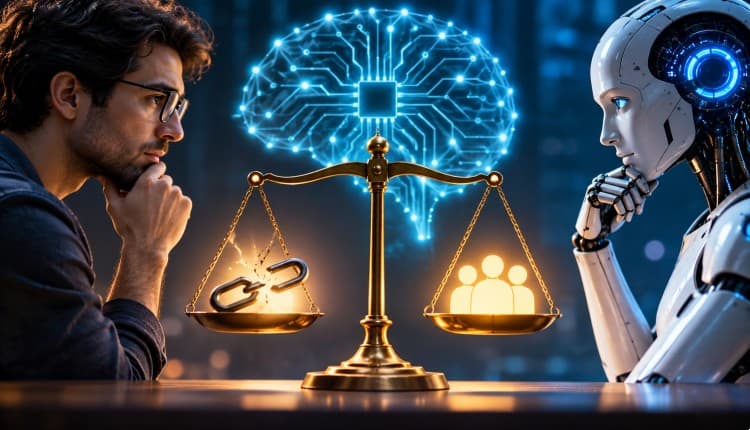
The Nvidia episode will be read by some as proof that people are the problem. A better reading is that people are the point. The same capacities that make us manipulable, such as trust, loyalty, curiosity, and desire, are inseparable from the ones that make us creative, accountable, and wise. We cannot remove the first without losing the second.
The task of the AI age is therefore not to engineer humanity out of the loop but to build systems worthy of the people in them: systems that protect us from our worst moments and rely on us for our best. Machines will keep getting more capable. The question of who they serve, and who is responsible when something goes wrong, will remain a human one.