

What we provide cannot be measured in money: Jayesh Ranjan on why Hyderabad is winning the GCC race



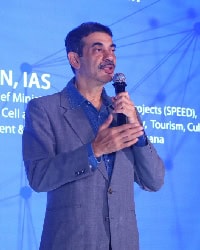
During a conversation with Jayesh Ranjan IAS, Special Chief Secretary, Chief Minister’s Office, Special Projects (SPEED), Investment & Industry (I&I) Cell and Special Chief Secretary, Tourism, Culture, Heritage, Youth Advancement & Sports Department, Government of Telangana, a clear picture emerges of why Hyderabad continues to attract GCCs and why its growth story looks far from slowing down.
A growing talent pool
One of Hyderabad’s biggest strengths lies in its expanding workforce, not just from Telangana but also from neighbouring states. Ranjan points out that while regions such as Bengal, Odisha, Chhattisgarh, Madhya Pradesh, northern Karnataka, and eastern Maharashtra struggle to create large-scale opportunities, students and young professionals from these areas are increasingly moving to Hyderabad.
Local industry associations estimate that for at least the next two decades, there will be no shortage of opportunities in the city. Beyond that horizon, the nature of work itself is expected to change, with routine jobs giving way to automation and emerging technologies.
Social infrastructure as a differentiator
What truly sets Hyderabad apart, Ranjan explains, is not financial incentives but the quality of life and urban planning. “If you stand atop any high-rise building in Cyberabad, you’ll see how thoughtfully the area has been developed. The offices alongside affordable apartments, high-end gated communities, international schools, hospitals, sports facilities, and reliable transport,” he says.
Commuting remains easy, with the airport just 30 minutes away from the IT hub via a signal-free route. The cost of living is affordable compared to other metros. “In Bengaluru, you end up paying double the rent for half the infrastructure. Plus, Hyderabad is cosmopolitan, people from across the country feel welcome here without facing language barriers,” he adds.
Cultural inclusivity reinforces this. When Ranjan moved to the city in 1992, there were only two Durga Puja celebrations; today, there are more than two dozen, celebrated with the same vibrancy as in Kolkata. “This shows how the city has embraced diversity while offering high living standards,” he observes.
Beyond incentives: Building an ecosystem
Unlike states that compete with subsidies or tax breaks, Telangana has focused on building a strong ecosystem. Ranjan highlights the role of T-Hub, the various CoEs (in quantum computing, cybersecurity, and more), and leading research institutions such as IIIT-Hyderabad, IIT-Hyderabad, and the University of Hyderabad among others.
“These ecosystem benefits far outweigh traditional financial incentives,” he says. For example, Hyderabad’s CoE on Cybersecurity is working on solutions for some of the most pressing vulnerabilities in BFSI, one of the city’s strongest sectors alongside pharmaceuticals. The presence of regulators such as IRDA, and over 75 major BFSI players including Morgan Stanley, Goldman Sachs, and Wells Fargo among others, reinforces Hyderabad’s status as a hub for critical industries.
Many companies moving out of Bengaluru are diversifying across cities like Pune, Chennai, Gurugram, and increasingly Hyderabad. “We always ask GCCs to involve the government early in their India plans. Once we explain the total picture, beyond just cost savings, leaders see the long-term value,” he asserts.
From services hub to innovation hub
Reflecting on Hyderabad’s evolution, Ranjan traces the turning point back to 2014, when Telangana was formed as a new state. “At that time, Hyderabad was still seen largely as a services city, good for quickly hiring thousands but not recognised for specialised talent,” he recalls.
The government took a three-pronged approach. First was the policy push through The 2014 IT policy that emphasised products, and not just services. Second are the supporting product companies where the government actively engaged with product firms, attending meetups and encouraging growth. And last but not the least was the curriculum upgrade where colleges were asked to update coursework, then focused on SMAC (Social, Mobile, Analytics, Cloud), the big technologies of that time.
“Just as AI is the buzzword today, analytics was the frontier then. We pushed hard to make Hyderabad a hub for it. Over time, the local ecosystem matured, aided by the presence of the world’s biggest tech firms,” states Ranjan.
With its cosmopolitan culture, affordability, strong social fabric, and deep-rooted ecosystem, Hyderabad is well-positioned to lead India’s GCC and innovation story for years to come. As Ranjan sums it up: “What we provide cannot be measured in terms of money. It’s the accessibility, the ecosystem, and the quality of life. That’s why companies are choosing Hyderabad.”
