

Inside ZEISS’s Factory of the Future: Why quality is becoming the new operating system of manufacturing

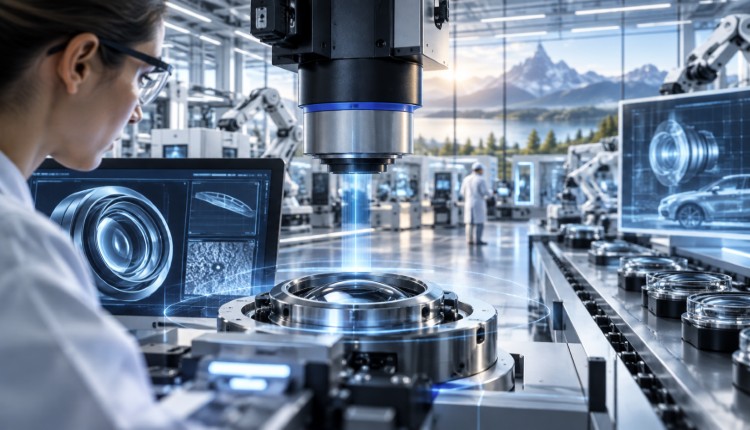

For decades, quality control in manufacturing has played a defensive role: parts are built, then checked, and defects are caught — often too late to prevent scrap, rework, or costly downstream failures. That model is being quietly dismantled. At ZEISS, the 180-year-old optics and optoelectronics giant best known for lithography systems that power the global chip industry, quality is being repositioned as the nerve center of production itself — a real-time signal that steers machines, not just a report card issued after the fact.
 We spoke with Krishna Khandelwal, Head – Logistics & Supply Chain, ZEISS India & Neighbouring Markets, about what the Factory of the Future actually looks like inside ZEISS’s own operations, where AI is already paying off, and why the company believes autonomous manufacturing — while real — is still further away than the industry’s marketing might suggest.
A €12 Billion Innovator Betting Big on Smart Production
ZEISS is not a typical manufacturing case study. The company generated nearly 12 billion euros in annual revenue last fiscal year across four segments — Semiconductor Manufacturing Technology, Industrial Quality & Research, Medical Technology, and Consumer Markets — and reinvests 15% of that revenue into R&D, a level of sustained investment the company describes as “a long tradition.”
With roughly 46,600 employees spread across almost 50 countries, 30 production sites, and 27 R&D facilities, ZEISS occupies a unique position: it both builds the precision measurement technology that other manufacturers rely on, and uses that same technology to run its own factories.
That dual vantage point makes its internal transformation especially instructive for other industrial leaders watching the smart-factory conversation move from hype to hard implementation.
From Passive Checkpoint to Active Control Loop
Ask Khandelwal to define the Factory of the Future, and he doesn’t start with robots or dashboards — he starts with what quality control stops being.
“The factory of the future is a fully networked, data-driven operation where quality control shifts from a passive checkpoint to an active, real-time function,” Khandelwal explains. “Rather than inspecting products after the fact, quality data directly guides production machinery, enabling automatic corrections before defects occur.”
That shift is enabled, he says, by inline metrology equipment embedded directly on the shop floor, paired with analytics software that flags flaws the instant they occur — “eliminating material wastage and scrap generation at the source,” rather than discovering it downstream.
Inside ZEISS’s own facilities, that philosophy is already under construction. “We are developing a data-driven assembly environment where quality is embedded at every station across the shop floor,” Khandelwal says. The approach layers several technologies together: non-contact and camera-based sensors inspect sub-assemblies before they’re integrated into larger units, digital twins flag misaligned or incorrectly assembled parts in real time, and ZEISS’s own PiWeb software pulls all of that quality data onto a single platform with live reporting. The result, he says, is that teams get “a continuous, connected view of production performance” instead of fragmented, after-the-fact inspection reports.
The Benchmark: A Lighthouse Factory in China
Given the breadth of ZEISS’s business — from high-volume lens manufacturing to low-volume, high-mix assemblies in metrology and medical technology — Khandelwal is careful to note there’s no single template applied uniformly across the company’s global footprint. But one facility stands out as the clearest proof point.
“The ZEISS Vision factory in China stands as a global benchmark,” he says. “It is part of the World Economic Forum’s recognized Global Lighthouse Factory network and is the first optical lens manufacturing site in the world to receive this distinction.”
The recognition, Khandelwal notes, reflects excellence across three dimensions: “customer-centric digital transformation, intelligent automation, and sustainable green manufacturing” — a combination he calls representative of “the highest standard of what a future-ready factory can achieve.”
Chasing the Sub-Micron: AI Meets Tolerance Engineering
As components shrink and engineering drawings grow more complex, tolerance requirements are outrunning what conventional measurement tools can reliably deliver. This is where Khandelwal sees AI-powered metrology doing some of its most concrete work today.
“Increasing miniaturization has pushed components and sub-assemblies to tolerances that many manufacturers struggle to consistently achieve,” he says. “The complexity of modern engineering drawings demands measurement capabilities that go far beyond conventional tools.”
ZEISS’s Industrial Quality Solutions portfolio is built to close that gap, combining precision hardware with AI-powered software to hit sub-micron accuracy. But Khandelwal is emphatic that technology alone isn’t the differentiator — execution is. “Our application support teams work closely with manufacturers at the local level to help them not only measure to tight tolerances but consistently achieve them in production,” he says, “turning precision measurement into a genuine competitive advantage.”
Smart vs. Autonomous: A Distinction the Industry Keeps Blurring
Perhaps the most pointed moment in the conversation comes when Khandelwal draws a hard line between two terms often used interchangeably in industry marketing: “smart” and “autonomous.”
“A smart factory focuses on collecting, aggregating, and presenting data in real time to support human decision-makers,” he says. “An autonomous factory goes further — it acts on that data independently, without human intervention, based on pre-assigned parameters and rules.”
His assessment of where the broader industry actually stands is candid. “Most of the industry today is still working towards becoming smart first, and rightly so,” he says. “Connecting all machines and consolidating data from diverse manufacturing platforms and software systems remains a significant undertaking.”
Within ZEISS India, that groundwork is already visible in the form of integrated quality dashboards that stitch together data “from every stage — from individual component measurements at supplier facilities to machine accuracy and calibration data on our own shop floor.” PiWeb again plays the connective role, Khandelwal says, “enabling us to receive part measurement data in real time the moment a component is manufactured and inspected at a vendor location.”
His verdict on true autonomy is measured rather than promotional: “True autonomy remains a horizon, but a clearly defined one” — an honest acknowledgment that’s rarer in industry commentary than it should be.
Where AI Is Already Paying Off — and Where It Isn’t
Rather than overselling AI’s current reach, Khandelwal grounds its impact in operational specifics. “From an operational point of view, ZEISS is focusing on automating many manual processes in order to speed track data-based decision making,” he says. The heaviest concentration of AI today lives inside ZEISS’s own software products, “embedded in the software features” rather than bolted on as a separate layer.
With the volume of data ZEISS’s systems generate, he says, AI’s core job right now is turning “Data to Insights” — and, in doing so, helping customers make faster decisions and lift productivity.
It’s a grounded, incremental picture of AI adoption — a useful counterweight to the more sweeping claims often made elsewhere in the industry.
The Real Bottleneck Isn’t Data Collection — It’s Translation
Ask most manufacturing leaders about their biggest data challenge, and collection is the usual answer.
Khandelwal reframes the problem. “All three are real challenges, but integration and translation remain the most critical bottlenecks,” he says. “Most manufacturers can collect data; far fewer can bring it together coherently and act on it in real time.”
This is the exact gap ZEISS built PiWeb to close. Khandelwal describes it as “a scalable, vendor-independent quality data management platform that centralizes and visualizes metrology data from across the factory floor.”
Rather than leaving measurement data trapped with individual inspectors or isolated inspection cells, PiWeb “consolidates information from diverse measuring systems into structured, real-time reports that drive engineering decisions.” The payoff, he says, is a fundamental shift — “from reactive reporting to proactive quality management where data informs action as production happens, not after problems have already occurred.”
Defining Success: Connectivity and Conscience, Together
Looking ahead, Khandelwal resists framing ZEISS’s Factory of the Future as a single technology milestone to be checked off. Success, in his view, is systemic.
“Success will be defined not by any single technology milestone, but by how comprehensively we can connect the entire manufacturing ecosystem — from suppliers to shop floor — while keeping our sustainability commitments firmly in focus,” he says. Ecosystem connectivity, embedded quality management, digital twin-enabled assembly, and automated correction systems, he argues, “must all advance together.”
But he closes on a note that reframes the entire conversation: none of it matters, he says, “if we lose sight of our responsibility to reduce waste, improve energy efficiency, and manufacture in a way that is genuinely sustainable.” For ZEISS, intelligence and responsibility aren’t competing priorities. “The factory of the future must be as responsible as it is intelligent,” Khandelwal says, “and for ZEISS, those two goals are inseparable.”
ZEISS’s approach offers a useful corrective to some of the more breathless narratives around Industry 4.0 and autonomous manufacturing. The company’s roadmap is deliberately sequenced: build connectivity and real-time data visibility first, embed AI into the software layer where it can compound value across customers, and treat full autonomy as a genuine but distant horizon rather than a near-term marketing claim.