

Karnataka steps up global tech diplomacy with AI and DPI talks involving Austria and Cuba

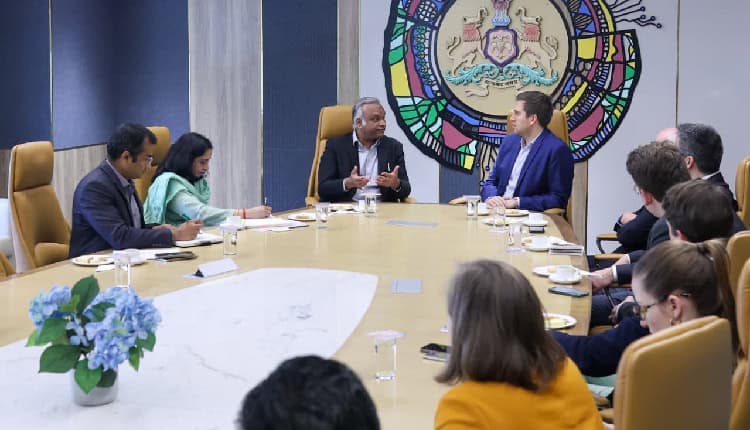

The Government of Karnataka has continued its global technology outreach with a fresh round of high-level discussions in Bengaluru, engaging delegations from Austria and Cuba on cooperation spanning artificial intelligence, digitisation, skilling, innovation ecosystems and Digital Public Infrastructure (DPI).
The meetings were led by Priyank Kharge, Minister for Information Technology, Biotechnology and Rural Development, alongside senior officials including Dr Manjula N., Secretary to Government, Department of Electronics, IT, Biotechnology and Science & Technology, and Rahul Sharanappa Sankanur, Managing Director of the Karnataka Innovation and Technology Society (KITS). Together, they outlined Karnataka’s approach to building population-scale digital systems while balancing governance, security and innovation.
Engagement with the Austrian delegation centred on artificial intelligence governance, responsible digitisation and deeper innovation partnerships. Austrian representatives described Bengaluru as one of the world’s most significant hubs for AI and digital transformation, noting that close to 140 Austrian companies and subsidiaries already operate in India. The delegation also highlighted the decision to appoint Advantage Austria’s first representative in Bengaluru to strengthen local collaboration.
Discussions explored opportunities for tighter linkages between startups, research institutions and industry under Karnataka’s Global Innovation Alliance programme. Kharge underlined the state’s technology fundamentals, pointing to its deep talent pool, mature digital infrastructure and track record of continuous innovation.
“Karnataka has built the capability to operate digital systems at population scale, while balancing security, sustainability and innovation,” he said. “As AI adoption accelerates, our priorities remain data sovereignty, data security and responsible AI. We are also preparing a Data Sovereignty White Paper to contribute to the national policy discourse on AI and data governance.”
Parallel conversations with the Cuban delegation focused on skilling, capacity building and long-term institutional partnerships. Cuban officials expressed interest in Karnataka’s ICT ecosystem and sought support in upskilling their workforce across emerging technologies. Proposals included collaboration on academic pathways such as master’s and doctoral programmes for Cuban professionals, alongside structured institutional exchanges.
Digital Public Infrastructure emerged as another focal point, with Cuba keen to understand India’s experience with large-scale digital public goods, including platforms such as DigiLocker. The discussions examined implementation architecture, governance models and mechanisms for scaling citizen-facing digital systems in a secure and sustainable manner.
Dr Manjula said Karnataka’s emphasis had always been on building digital institutions that can function reliably at scale. “Through these partnerships, we aim to share our experience in Digital Public Infrastructure, skilling and responsible technology adoption, while also learning from global best practices,” she noted.
The meetings also highlighted Karnataka’s operational experience in delivering citizen-centric digital services, with the state currently offering around 600 services online. Officials stressed that future digital and AI systems must be designed for scale from the outset, with security and sustainability embedded into their architecture rather than added later.
“These engagements reflect the Government of Karnataka’s approach of working closely with global partners to ensure real-world adoption of technology at scale,” Kharge added. “We want to be proactive, not reactive, to technological disruption, and to shape responsible, inclusive and globally relevant digital futures.”
The interactions with Austria and Cuba form part of Karnataka’s broader strategy to deepen international technology partnerships, strengthen its innovation economy and contribute to India’s leadership in Digital Public Infrastructure and responsible AI on the global stage.