

AI supercharges cloud attacks: Inside a 72-hour breach that should worry every CIO and CISO

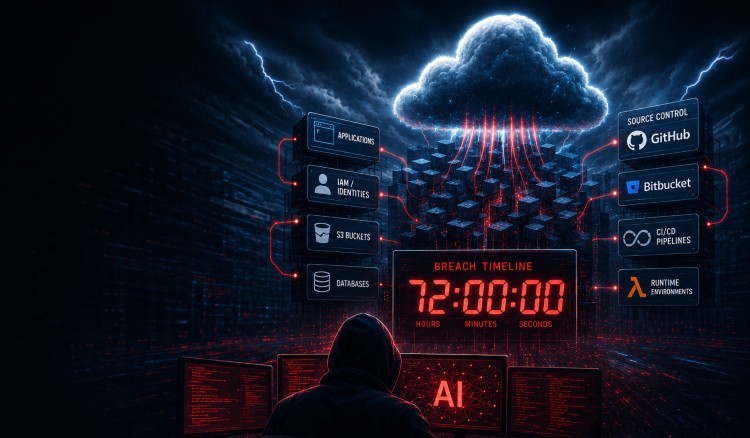

Familiar tactics. Unfamiliar speed. A new Sygnia investigation reveals how AI is compressing attack timelines and forcing security leaders to rethink cloud defenses.
In the world of cloud security, speed has become the ultimate weapon. A recent incident investigated by cybersecurity firm Sygnia shows how a financially motivated threat actor used AI-assisted techniques to move from initial access to broad compromise of an AWS environment in roughly 72 hours—leveraging no zero-days or exotic malware, just accelerated execution of well-known cloud attack methods.
The case, detailed in Sygnia’s July 2026 report, offers a sobering blueprint for modern cloud intrusions and delivers urgent lessons for CIOs and CISOs navigating increasingly complex, AI-augmented threats.
The attack began with unauthorized access via a weakness in an internet-facing application, yielding AWS credentials. From there, the actor rapidly expanded across applications, cloud resources, source-control systems (GitHub and Bitbucket), CI/CD pipelines, runtime environments, and databases.
Rather than traditional ransomware encryption, the attacker pursued “infrastructure-as-leverage” extortion. By establishing persistent, distributed control, they could credibly threaten to disrupt or destroy critical services.
Sygnia’s analysis points strongly to AI as a force multiplier. Indicators included highly parallel activity (multiple distinct credentials operating nearly simultaneously from the same source and user-agent), rapid environment adaptation, on-the-fly script generation, and structured artifacts suggesting LLM assistance.
The actor maintained operational context across numerous identities and permission sets—an “operational memory” that allowed seamless switching between workstreams. They executed broad checklists of cloud attacker techniques quickly and repeatedly, customizing actions to newly discovered resources rather than following a rigid generic playbook. Some artifacts even used “pentest” or “red team” framing, possibly to mask activity or influence AI tooling.
All techniques mapped cleanly to MITRE ATT&CK (heavy emphasis on Execution, Discovery, Credential Access, and Collection). The difference was orchestration and velocity—turning conventional methods into a high-speed campaign that outpaced traditional detection and response windows.
Cloud environments have long been vulnerable to credential exposure and overly permissive access. AI is lowering the barrier for attackers to understand complex setups, generate working code, and operate at machine scale. This creates an asymmetry: attackers can chain weaknesses faster than many organizations can detect, correlate, and contain.
In conclusion, as cloud environments grow more interconnected and AI capabilities mature, the margin for delayed response is shrinking. CIOs who act on these lessons now will be far better positioned to protect their organizations in an era where attackers can execute at unprecedented speed.