

Karnataka recasts data centre policy after confronting sustainability challenges

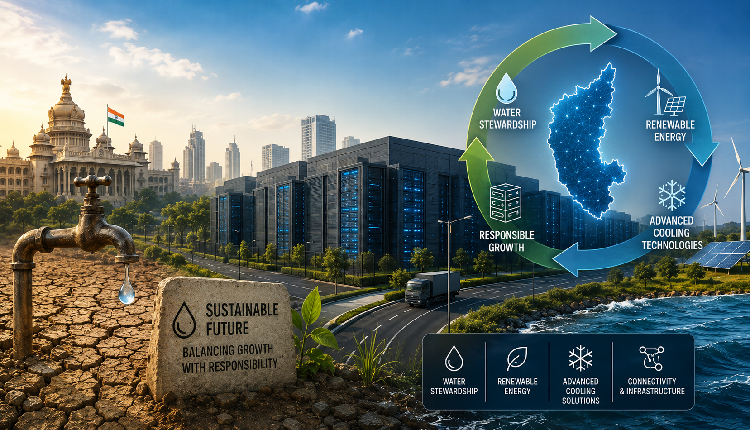

Karnataka has spent years positioning itself as a preferred destination for data centres. With the announcement of its Sustainable Data Centre Policy 2026 to 2031, the state is signalling that the next phase of growth will depend not only on attracting investments but also on addressing one of its biggest constraints, water.
The policy, announced at the Annual CEO Breakfast Meet in Bengaluru by Chief Minister DK Shivakumar, comes at a time when AI driven demand is reshaping data centre infrastructure. As computing densities increase, cooling systems are consuming more resources, making water availability an increasingly important factor in deciding where data centres can be built. For Karnataka, which has faced recurring water shortages and erratic monsoons in recent years, the challenge is particularly acute.
The scale of the ambition is significant. Karnataka’s earlier data centre policy had set a target of adding around 1,000 MW, or roughly 1 GW, of new capacity by 2031, spread across Bengaluru, Mysuru and coastal Karnataka, up from the state’s current installed base of about 400 MW. It is against that backdrop of rapid, water intensive expansion that the sustainability question has moved from an afterthought to a central design constraint.
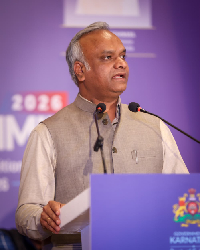
Speaking to Express Computer on the sidelines of the announcement, Priyank Kharge, Cabinet Minister for Home, IT/BT and E-Governance, Government of Karnataka, acknowledges that the government does not yet have a definitive solution.
“It is a very tough question to answer. I don’t have a ready answer for that,” says Kharge.
Kharge says Karnataka’s thinking had evolved after introducing one of India’s earliest data centre policies.
“We were one of the first ones to come up with a data centre policy, and then we realised the hazards that come with it. That’s why we are working on a sustainable data centre policy,” he adds.
On the cooling challenge itself, Kharge points to newer technology as the way forward. “There are newer technologies, like liquid cooling and other new technology, where they’re even using seawater apparently,” he says. He adds that site selection is being used as a lever too: “We are locating these data centres also where they have access to both renewable energy as well as water.” At the same time, he is clear that this is a stopgap rather than a solution. “We’ll have to wait and watch how the technology evolves. But right now, this is the only thing that anybody could do,” he adds.
Beyond cooling, Kharge says Karnataka is also evaluating future energy options for data centres, including small modular nuclear reactors. “I don’t think anybody in India is exploring that,” he says, adding that several companies claiming expertise in the technology, including through collaborations with a French company, have approached the state, but that the technology itself has yet to reach India. “We are talking to them, but I don’t think I have an affirmative answer for that now,” he adds.
Although the detailed policy document is yet to be released, the announcement suggests Karnataka intends to integrate considerations around water availability, renewable energy, land and connectivity into future data centre planning rather than treating sustainability as a secondary issue.
For Karnataka, the Sustainable Data Centre Policy will ultimately be judged not by the investments it attracts, but by whether it can enable AI era data centre growth without placing additional pressure on already strained water resources. That is a challenge every state competing for digital infrastructure is likely to face.
