

AI is collapsing enterprise reaction time — And most security teams are not ready

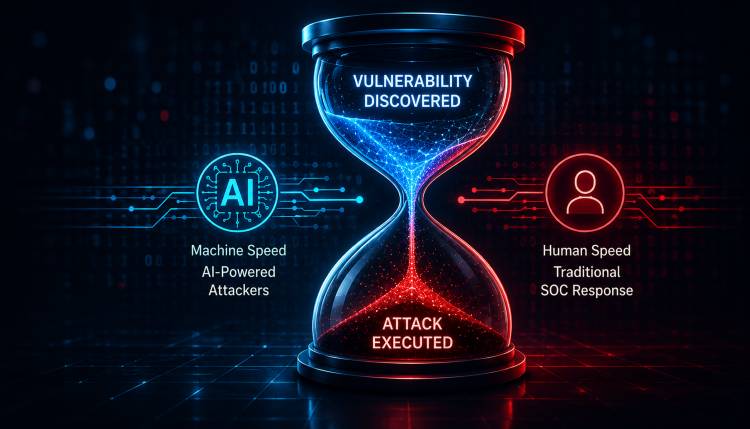

The cybersecurity industry is entering a phase where the speed of attacks may soon outpace the speed of human response.
Recent developments around AI-powered cybersecurity models such as Anthropic’s Mythos have triggered intense debate across the security ecosystem about how artificial intelligence could reshape both cyber defense and cyber offense. At the same time, companies including OpenAI and Microsoft are accelerating work on defensive cyber-AI systems designed to help enterprises detect, analyze, and contain threats faster.
The concern among enterprise security leaders is not necessarily that AI will suddenly unleash fully autonomous cyber warfare. Most experts agree that human expertise is still required for real-world exploitation and operational execution. The bigger shift is more immediate and practical: AI is dramatically compressing the time between vulnerability discovery and attack execution.
That shrinking response window could fundamentally change how enterprises think about cyber resilience.
 “The ecosystem is uneven,” says Diwakar Dayal, Managing Director & Area Vice President – India & SAARC at SentinelOne. “Large digital firms and top banks have started investing in AI-driven detection and richer visibility, but most mid-market and traditional companies still rely on fragmented logs, manual playbooks, and slow patching. That creates a dangerous timing mismatch because AI lets attackers discover and chain vulnerabilities in minutes, not days.”
The rise of machine-speed cyberattacks is rapidly changing the economics of cybersecurity. AI systems are already capable of assisting with reconnaissance, vulnerability identification, phishing personalization, malware modification, and exploit chaining. Security researchers globally are seeing how generative AI can reduce the effort required to scale attacks and adapt them dynamically against enterprise environments.
Recent discussions around Anthropic’s Mythos model highlighted how frontier AI systems are becoming increasingly capable in vulnerability research and offensive security testing. While researchers have cautioned against overstating fears of fully autonomous AI hacking in the near term, the broader industry takeaway is becoming clear: attackers are gaining access to tools that significantly accelerate the speed of cyber operations.
Governments are beginning to acknowledge the shift. The UK government recently warned that frontier AI cyber capabilities are doubling roughly every four months, underscoring how rapidly offensive and defensive AI capabilities are evolving.
For enterprise security teams, this acceleration is exposing the limitations of traditional security operations centers. Most SOCs were designed around human-led investigation models where analysts manually review alerts, correlate telemetry, escalate incidents, and initiate response workflows. That model becomes difficult to sustain when attacks unfold at machine speed.
“AI-powered SOCs will rapidly move from a competitive advantage to a business necessity,” says Dayal. “As adversaries adopt advanced models to automate reconnaissance, exploit chaining, and adaptive attacks, human-only SOCs will be overwhelmed.”
This is particularly relevant in India, where many enterprises are still operating with fragmented visibility across endpoints, cloud infrastructure, identities, and networks. In many cases, telemetry exists in silos, slowing down incident correlation and response.
“Many Indian SOCs lack consolidated logs and automated containment tools needed to respond quickly,” Dayal says. “Leadership must prioritize technology and process upgrades that centralize system logs and alerts and put rapid automated response playbooks in place so resilience keeps pace with modern attacks.”
The challenge is becoming especially serious for sectors managing sensitive data and critical infrastructure, including banking, telecom, healthcare, manufacturing, and government systems. As enterprises expand digital operations across hybrid cloud environments, APIs, remote work infrastructure, and connected systems, the attack surface continues to grow faster than traditional security operations can mature.
This is forcing organisations to rethink cybersecurity around speed and automation rather than perimeter defense alone.
“Organisations need to rethink cyber resilience around speed, automation, and continuous validation,” says Dayal. “In the AI era, enterprises must assume attackers can operate at machine speed and design security operations accordingly.”
That shift requires more than deploying additional tools. Enterprises are increasingly moving toward automated containment playbooks capable of isolating endpoints, restricting lateral movement, and initiating remediation before human analysts fully complete investigations. Threat hunting itself is also evolving from periodic exercises into continuous AI-assisted operations capable of correlating signals across endpoints, cloud environments, identities, and networks in real time.
According to Dayal, human analysts will not disappear from security operations, but their role will change significantly. AI systems will increasingly handle noise reduction, telemetry correlation, and initial response execution, while security professionals focus more on governance, adversary profiling, strategic defense, and incident oversight.
The larger concern, however, may not be technical preparedness alone. Many security leaders believe boards and leadership teams still underestimate the operational implications of AI-driven cyberattacks.
“Too often Indian boards treat cybersecurity as an IT or compliance issue rather than a core operational and reputational risk,” says Dayal. “That mindset must change now because AI shortens the time from compromise to impact.”
The business impact of cyberattacks is also changing because faster attacks can trigger larger operational disruptions before organisations can contain them. Ransomware propagation, downtime escalation, data theft, and reputational damage all become more difficult to control when attackers can automate reconnaissance and exploit weaknesses in near real time.
As a result, security leaders increasingly argue that boards should evaluate cybersecurity readiness using operational metrics such as time-to-detect, time-to-contain, downtime exposure, and business continuity impact rather than purely technical indicators.
“Boards should be briefed with simple, scenario-based metrics so risk decisions are tied to business outcomes, not technology,” Dayal says.
For him, the single biggest cybersecurity risk AI creates over the next year is straightforward: the collapse of reaction time.
“AI is collapsing the window between discovery and attack from days to minutes,” he says. “That loss of reaction time will let attackers scale and chain vulnerabilities far faster than many organisations can detect or contain.”
That may ultimately become the defining cybersecurity challenge of the AI era. Organisations that lack centralized visibility, rapid detection, automated response, and AI-assisted security operations may struggle not because they lack security tools, but because they cannot respond quickly enough once an attack begins.
The cybersecurity conversation is therefore shifting away from whether enterprises have defenses in place and toward a more urgent question: can they operate fast enough to survive machine-speed attacks?