

Duty rationalisation shifts focus to India’s electronics component ecosystem, but deeper manufacturing gaps remain

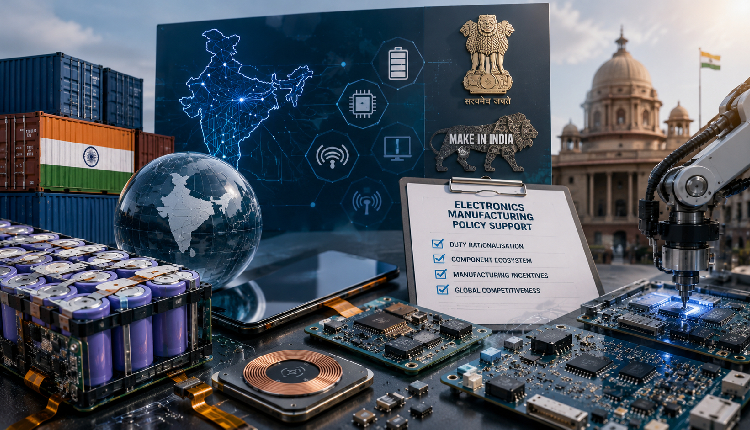

The Centre’s decision to rationalise customs duties on capital equipment and critical inputs used in lithium-ion battery cells, display assemblies and wireless charging modules marks another step in India’s attempt to move its electronics manufacturing ambitions beyond final-product assembly and towards a stronger domestic component ecosystem.
The move complements recent initiatives such as the Electronics Component Manufacturing Scheme (ECMS) and the Semicon India Programme, both of which seek to deepen local manufacturing capabilities at a time when India is positioning itself as an alternative destination in global electronics supply chains.
For India’s electronics industry, the significance of the announcement lies less in the immediate duty reduction and more in where the incentives are being directed.
Over the past decade, India’s manufacturing growth has largely been driven by assembling smartphones and consumer electronics under production-linked incentive (PLI) schemes. While production volumes have expanded rapidly, domestic value addition remains constrained because several high-value components, including batteries, display modules and advanced electronic sub-systems, continue to rely heavily on imports.
By lowering the cost of manufacturing equipment and select inputs for these segments, the government is signalling a gradual policy shift from encouraging finished-product manufacturing to building capabilities higher up the electronics value chain.
The impact could extend well beyond smartphones. Lithium-ion batteries underpin India’s electric vehicle and energy storage ambitions, while display assemblies and wireless charging modules are increasingly becoming integral to consumer electronics, industrial devices, telecommunications equipment, medical electronics and wearables.
Ashok Chandak, President of the India Electronics and Semiconductor Association (IESA), believes the policy is intended to strengthen India’s long-term manufacturing base rather than simply reduce import costs.
“This is much more than a customs duty rationalisation, it is a strategic investment in India’s manufacturing future. By reducing the cost of producing three of the most critical building blocks of modern electronics, advanced batteries, display assemblies and wireless charging modules, the Government is enabling higher domestic value addition, improving global competitiveness and making India a more attractive destination for electronics manufacturing investments,” says Chandak.
The policy also carries implications for India’s semiconductor ambitions, although it does not directly address chip fabrication.
Every expansion in electronics manufacturing increases downstream demand for semiconductor devices, packaging and testing. Strengthening domestic production of batteries, displays and electronic components therefore supports the broader objective of building an integrated semiconductor ecosystem rather than treating chip manufacturing as an isolated industry.
As Chandak notes, “Every smartphone, EV, telecom system, medical device and energy storage solution built in India creates demand for semiconductors. A stronger component ecosystem today lays the foundation for a stronger semiconductor ecosystem tomorrow.”
However, industry observers caution that customs duty rationalisation alone is unlikely to transform India’s manufacturing competitiveness. Countries that dominate global electronics supply chains have built integrated ecosystems over several decades, supported by supplier networks, logistics infrastructure, skilled talent, manufacturing clusters and policy consistency. While lower duties improve project economics, sustained investments across the broader component ecosystem will determine whether India can significantly increase domestic value addition and reduce dependence on imported sub-systems.
With India’s electronics market projected to exceed US$400 billion by the end of the decade and semiconductor demand expected to cross US$100 billion, policy measures aimed at strengthening upstream manufacturing are becoming increasingly important. The latest duty rationalisation reflects that strategic direction. Whether it delivers meaningful structural gains will depend on how effectively it is complemented by investments in manufacturing capability, supply chain development and technology ecosystems.
