

Technology Senate 2026, Lucknow: Focus on how India’s enterprise AI journey has entered the execution era

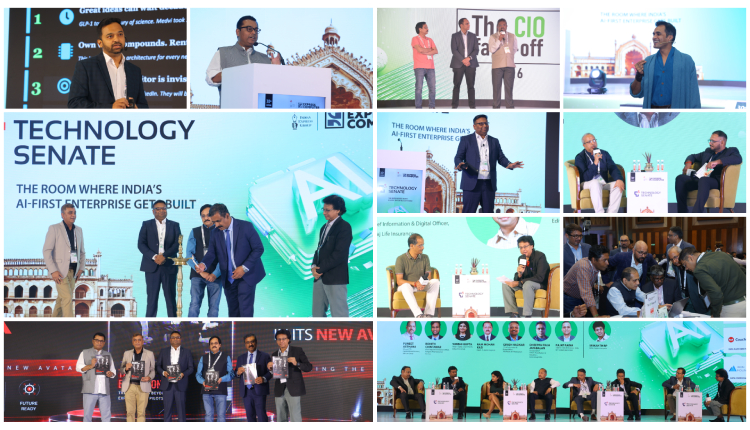

The 30th edition of Express Computer’s Technology Senate, held from July 17–19 at Ramada by Wyndham, Lucknow, brought together India’s foremost technology leaders to examine how enterprises were moving beyond isolated AI pilots towards building AI-native organisations. Across three days of keynotes, fireside conversations and panel discussions, CIOs, CDOs, CISOs and business leaders explored how artificial intelligence was reshaping enterprise architecture, cybersecurity, manufacturing, customer experience and boardroom decision-making. While AI dominated every conversation, the consensus was clear: the next phase of enterprise transformation would be defined not by experimentation but by disciplined execution, trusted data and measurable business value.
Powered by a strong partner ecosystem, the summit featured Freshworks, BenQ India and Versa Networks as Gold Partners; OutSystems as the Agentic AI Partner; Couchbase as the Data Platform Partner; Iron Mountain and NTT DATA as Data Centre Partners; ClickShare by Barco as the Wireless Conferencing Partner; and WD as the Exhibition Partner. Together, they showcased innovations spanning AI engineering, enterprise platforms, cybersecurity, hybrid workplaces and next-generation infrastructure, reflecting the breadth of technologies enabling India’s AI-native future.
During the lamp lighting ceremony of this premier summit, Express Computer relaunched its print magazine as a bimonthly print publication, not just as an IT publication, but as the place where enterprise technology leaders actually think out loud, because some conversations deserve more than a scroll.
This edition of the summit also introduced the CIO Face Off, which eventually went on to become the highlight of the event, where more than 100 technology leaders came together, formed groups and solved real life technology challenges and won prizes. It was interesting to hear from one of the juries lightly sharing, “If 10 CIOs can come together and solve a technology challenge in just 45 minutes as a group, then imagine how fast an entire industry can transform when leaders share their best ideas instead of working alone.”
Setting the tone for the summit, Dr Satya Ramaswamy, Chief Digital and Technology Officer, Air India, described AI as a transformational force that was redefining enterprise software development and operating models. “Agentic systems are having a compounding effect on the way we work,” he observed, adding that AI-assisted coding had become the default expectation across software development at Air India. He also stressed that every AI initiative was evaluated against strict financial criteria, underlining that sustainable AI adoption depended on measurable business outcomes rather than technology for its own sake.
The conversation naturally progressed from AI adoption to AI engineering. Parth Sharma, Senior Solution Architect, OutSystems, argued that enterprises no longer faced an application problem but an engineering challenge. “Code has become the cheapest commodity we have,” he remarked, explaining that organisations required unified engineering platforms capable of governing security, compliance, architecture and AI rather than simply generating code faster. His observations reflected a broader shift across industries, where governance and orchestration were emerging as equally important as AI capability.
Building on this theme, Tushar Zade, Chief Transformation Officer, Granules India, highlighted how AI was dramatically reducing the distance between business ideas and execution. “AI is collapsing the distance between ideas and outcomes,” he said, explaining that work previously requiring several months could now be completed within weeks when organisations redesigned workflows and embedded AI into day-to-day operations. However, he emphasised that success ultimately depended on delivering measurable improvements in revenue, productivity and operational efficiency.
Infrastructure emerged as another major pillar of enterprise AI. Bhargav Reddy Avula, Head of Regional Solution Engineering, Freshworks, argued that traditional infrastructure management was no longer sufficient for AI-enabled enterprises. “As enterprises move from on-premise to hybrid cloud and now into the AI era, infrastructure management needs to move beyond simply keeping records,” he observed. AI-driven ServiceOps, unified visibility and intelligent automation, he suggested, would become essential for organisations seeking resilience across increasingly complex hybrid environments.
The need for AI-ready infrastructure was echoed by Akhil Suneja, Regional Business Head, Data Center & Cloud Business, Iron Mountain. “The future belongs to those who convert intelligence into action,” he said, outlining how AI-ready facilities equipped with liquid cooling, resilient power infrastructure and hybrid cloud capabilities would underpin next-generation enterprise computing. Rajat Raina, Director – Sales & Alliances, India, NTT Global Data Centers, reinforced this during the AI at Scale panel, noting that enterprise AI would require significant investments in GPU infrastructure, power density, cooling and low-latency connectivity.
Data remained the common thread running through almost every discussion. Ramesh Narayanaswamy, Group President – Digital & Data Intelligence, Hinduja Group, challenged traditional application-centric thinking by arguing that enterprise architecture was fundamentally changing. “Applications are becoming excess. Fundamentally, data is going to replace them,” he said, explaining that future organisations would increasingly rely on unified data platforms upon which AI agents could execute business processes.
A similar message came from Vrijesh Nagathan, Chief Information & Digital Technology Officer, Marico, who argued that organisations continuing to treat data as an afterthought were already falling behind. “The real value of data lies in embedding it into business processes, not treating it as a separate function,” he observed, adding that evidence-based decision-making would become a defining characteristic of AI-native enterprises.
Several leaders emphasised that AI programs should always begin with business objectives rather than technology selection. Goutam Datta, Chief Information & Digital Officer, Bajaj Life Insurance, noted, “If we start with a business goal, the possibility of that AI initiative going beyond the zero-to-one stage and scaling from one to ten is much higher.” He stressed that governance, cost and risk considerations needed to be addressed at the outset if AI initiatives were to scale successfully.
Harsh Vardhan, Global Head – Digital Innovation, Apollo Tyres, echoed this philosophy, arguing that “Artificial intelligence has to be empowered with human intelligence.” Domain expertise, he explained, remained indispensable for translating AI capabilities into sustainable business outcomes. Likewise, Sandeep Dewangan, President and Group CIO, Safexpress, remarked, “It is all about data. Build the right business use cases first. AI capabilities, machine learning models and generative AI come later.” He described how building an enterprise-wide data lake had enabled the company to progress from conventional business intelligence towards real-time and conversational decision-making.
The first day’s discussions culminated in the panel discussion, AI at Scale – Lessons from India’s Most Advanced Enterprises, where technology leaders from Shriram Group, Aurigene Pharmaceutical Services, Birla Opus Paints, Apollo Hospitals, Tata Realty & Infrastructure, Volvo Group India and NTT Global Data Centers demonstrated how AI was already creating measurable impact across financial services, healthcare, manufacturing, engineering and customer engagement. Although the use cases differed, the conclusion remained remarkably consistent: successful AI programs depended not on algorithms alone but on trusted data, resilient infrastructure, governance and clear business ownership.
As enterprises accelerated AI adoption, the conversation shifted from deployment to governance, security and organisational readiness. Across multiple sessions, speakers argued that AI would only deliver long-term value if organisations strengthened cybersecurity, improved data governance and embedded responsible AI practices into every stage of transformation.
Vivek Karthik Suriyanarayanan, Manager – Systems Engineering, Versa Networks, highlighted the growing convergence of networking and security as AI became deeply embedded across enterprise environments. He argued that organisations needed a unified security architecture capable of integrating Zero Trust, Secure Access Service Edge (SASE), networking and AI-driven threat intelligence to secure increasingly distributed digital ecosystems. As enterprises moved towards autonomous systems, he said, continuous visibility, data sovereignty and AI-aware governance would become indispensable.
These themes carried into the panel discussion, The CISO’s New Frontier: Defending Against Intelligent Threats Emerging in the AI Era, where security leaders agreed that cyber resilience had evolved from a technology function into a strategic business imperative. Moderator Kapil Madaan, CISO & DPO, Max Healthcare, observed that cybersecurity had become “a business enabler” rather than merely a defensive capability. Dr Siraj Rahim, CISO, MRF Group, described AI as “a double-edged sword”, warning that threat actors were exploiting the same technologies enterprises hoped to use for innovation. Darshan Chavan, CISO, Mirae Asset Management, summarised the industry’s new reality succinctly: “You have to use AI to fight AI.” Akanksha Garg, DPO & Head – Digital Products PMO, HDFC Securities, added that security leaders were increasingly expected to enable innovation while balancing governance, privacy and regulatory compliance.
The discussion naturally extended to data governance, which many speakers identified as the true foundation of enterprise AI. Vinod Bhat, Chief Digital Officer, Tata AutoComp Systems, cautioned that AI could never compensate for fragmented or poor-quality enterprise data. Instead, organisations needed robust governance frameworks, common data standards and structured information architectures before expecting meaningful AI outcomes.
The evolution of agentic AI also featured prominently during the summit. Harnath Babu, Partner & Chief Information Officer, KPMG India, explained that AI agents were progressing beyond task automation towards autonomous execution, but argued that human oversight would remain essential for decisions involving finance, governance and risk. Complementing this perspective, Parna Ghosh, President & Group CIO & Data Protection Officer, Uno Minda, said organisations were increasingly redesigning business processes and operating models around intelligent systems rather than simply adding AI capabilities to existing workflows.
While AI dominated discussions, the summit also explored how supporting workplace technologies were evolving. Harshit Choudhary, Product Manager – B2B Products, BenQ India, demonstrated how AI-enabled collaboration platforms, wireless conferencing and interactive displays were helping organisations build more connected hybrid workplaces. The session reinforced that employee experience and workplace productivity remained important dimensions of enterprise transformation alongside automation and analytics.
Another recurring message throughout the event was that AI transformation could not remain the sole responsibility of technology teams. During the panel discussion on Breaking Silos: CIO, CDO and CISO Alignment in AI-Driven Enterprises, moderator Charu Bhargava, Senior Vice President – IT, Sheela Foam, argued that enterprise AI required shared ownership across technology, data, governance and business functions.
Ashley D’Souza, Chief Digital Officer, Hindustan Coca-Cola Beverages, advocated a federated operating model that balanced central governance with business autonomy. Shanmugam Manivannan, Chief Digital Officer, Equitas Small Finance Bank, emphasised the importance of maintaining customer trust and regulatory compliance as AI initiatives scaled. Amit Kapil, CTO, Caparo India Operations, argued that connected data, shared performance metrics and cross-functional accountability remained essential for enterprise-wide transformation. Dilraj Singh Gandhi, EVP – Digital & AI, TAFE, concluded that AI programs could only succeed when business leaders became active stakeholders alongside CIOs and CDOs.
Manufacturing continued to emerge as one of the sectors undergoing the most significant digital reinvention. Mandar Sahasrabudhe, Group CTO, Kirloskar Management Services, described how digital twins were transforming engineering, production and lifecycle management by connecting physical operations with intelligent digital models. Earlier in the summit, Baidyanath Kumar, CISO & DPO, JK Lakshmi Cement, highlighted the growing cybersecurity challenges associated with IT-OT convergence, reminding delegates that manufacturing had become one of the world’s most targeted sectors for cyberattacks as operational environments became increasingly connected.
The closing discussions shifted attention from operational deployment to executive leadership. During the panel, The Future of Decision-Making: AI in the Boardroom, technology and business leaders from Nuvama Group, Berger Paints, Arvind Fashions, SRF, Bombay Stock Exchange and Canara HSBC Life examined how AI was reshaping strategic planning, investment decisions and organisational governance. Rather than viewing AI solely as an operational technology, panellists agreed that it had become a board-level priority demanding balanced investment, clear governance and measurable business outcomes.
Beyond the conference sessions, delegates engaged with technology innovations showcased by partners across the exhibition area, covering AI platforms, enterprise infrastructure, cybersecurity, collaboration technologies and modern data architectures. The Technology Senate Awards recognised organisations and leaders driving innovation across industries, celebrating excellence in enterprise technology adoption and digital transformation. The summit also witnessed the magic of storytelling by Laksh Maheshwari, followed by an evening of soothing Qawwali music.
As the summit concluded, Couchbase, the event’s Data Platform Partner, reinforced the importance of modern, scalable data platforms in supporting AI-native enterprises, underscoring a message that had resonated throughout the conference: AI is only as effective as the data foundation beneath it.
Across three days, the 30th edition of Technology Senate reflected a significant shift in India’s enterprise technology landscape. Conversations consistently moved beyond proof-of-concept projects towards enterprise-wide execution, governance and measurable business impact. Whether discussing infrastructure, cybersecurity, manufacturing, data strategy or executive leadership, speakers agreed that building AI-native enterprises would require far more than adopting new technologies. Success would depend on trusted data, resilient infrastructure, responsible governance and strong collaboration between business and technology leaders. As Indian organisations continue to accelerate their AI journeys, those capable of combining innovation with disciplined execution will be best positioned to shape the next chapter of enterprise transformation.
