

Bengaluru, INDIA: NANO 2026 focuses on AI, semiconductors and the commercialisation of nanotechnology

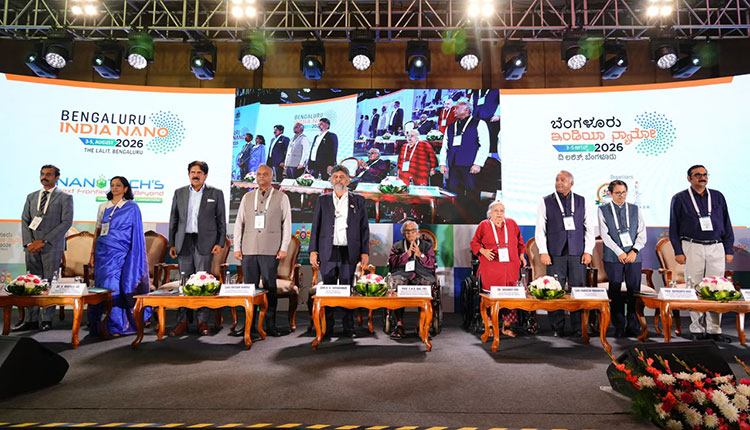

The 14th edition of Bengaluru INDIA NANO, India’s flagship international nanotechnology conference and exhibition, was inaugurated in Bengaluru, bringing together scientists, researchers, industry leaders, startups, policymakers and students to accelerate innovation and commercialisation in nanotechnology.
Organised by the Department of Science & Technology, Government of Karnataka; the Karnataka Science and Technology Promotion Society (KSTePS); and the Jawaharlal Nehru Centre for Advanced Scientific Research (JNC), this year’s conference is centred on the theme “Nanotech’s Next Frontier: AI & Beyond – Conceive, Converge, Commercialise”.
The event was inaugurated by Shri D.K. Shivakumar, the Hon’ble Chief Minister of Karnataka, in the presence of Bharat Ratna Prof. C.N.R. Rao; Shri Priyank Kharge, the Hon’ble Minister for Home, IT, BT and e-Governance; senior government officials; academia; and industry leaders.
During the inaugural session, Bharat Ratna Prof. C.N.R. Rao was felicitated for his pioneering contributions to science and nanotechnology. The Prof. C.N.R. Rao Bengaluru INDIA NANO Science Award was presented to Prof. B. L. V. Prasad, Director of the Centre for Nano and Soft Matter Sciences (CeNS), Bengaluru.
AI and nanotechnology convergence take centre stage
The conference explores how nanotechnology is converging with artificial intelligence and other frontier technologies to accelerate innovation across industries.
Technical sessions cover areas including semiconductors, healthcare, agriculture, energy and environmental sustainability, alongside a dedicated Global Innovation Alliance (GIA) track featuring collaborative programmes with Germany, France and the Netherlands.
The conference programme includes plenary lectures, multi-track technical sessions, startup interactions and industry networking focused on translating research into commercially deployable technologies.
Leading researchers and industry experts participating in the event include representatives from the Department of Science & Technology, the Indian Institute of Science (IISc), the Australian National University, the Technical University of Denmark, the University of Cambridge, the University of Manchester, KLA, TCS Research, TERI and other academic and industrial organisations.
Karnataka positions itself as a deep-tech innovation hub
Speaking at the inauguration, Shri D.K. Shivakumar, the honourable Chief Minister of Karnataka, said, “Karnataka has established itself as India’s technology capital, and today we are laying the foundation for the next era of scientific leadership. The future belongs to those who can translate research into real-world impact, and Bengaluru INDIA NANO demonstrates our commitment to building an ecosystem where science, industry and innovation come together to solve global challenges. We want Karnataka to lead not only in digital technologies but also in nanotechnology, advanced materials, semiconductors and deep-tech innovation.”
Shri Priyank Kharge, the honourable minister for home, IT, BT and e-governance, said, “The next wave of innovation will be driven by the convergence of AI, nanotechnology, biotechnology and semiconductors. Karnataka is uniquely positioned to lead this transformation because of its strong research institutions, thriving startup ecosystem and progressive policy environment. Through platforms like Bengaluru INDIA NANO, we are accelerating the journey from scientific discovery to commercial innovation, creating technologies that are globally competitive while delivering meaningful impact for society.”
Dr N. Manjula, IAS, Secretary, Department of Electronics, IT, BT and Science & Technology, added, “Bengaluru INDIA NANO continues to strengthen its position as India’s premier nanotechnology platform by bringing together researchers, industry, startups and policymakers under one roof. This year’s theme reflects our focus on fostering interdisciplinary collaboration and accelerating the commercialisation of breakthrough research. Our objective is to build partnerships that translate scientific excellence into scalable technologies and sustainable economic growth.”
Global participation and startup engagement
Complementing the technical programme are initiatives such as Nano for the Young, the Nanotech Quiz, poster presentations and networking sessions aimed at fostering collaboration between academia, startups and industry.
The event also features an international exhibition showcasing innovations from research institutions, startups, technology providers and industry across the nanotechnology ecosystem.
According to the organisers, Bengaluru INDIA NANO 2026 includes 26 conference sessions, more than 80 speakers, over 800 delegates, 150 scientific posters, participation from 10 countries and 50 exhibitors and is expected to attract over 4,000 attendees, making it one of India’s largest nanotechnology platforms.
This year’s edition is supported by organisations including Applied Materials, Indian Oil, Visvesvaraya Technological University, Detroit Engineered Products (DEP), Ramaiah University of Applied Sciences and ACT Enterprise, alongside international partners from Denmark, France, Germany and the Netherlands.